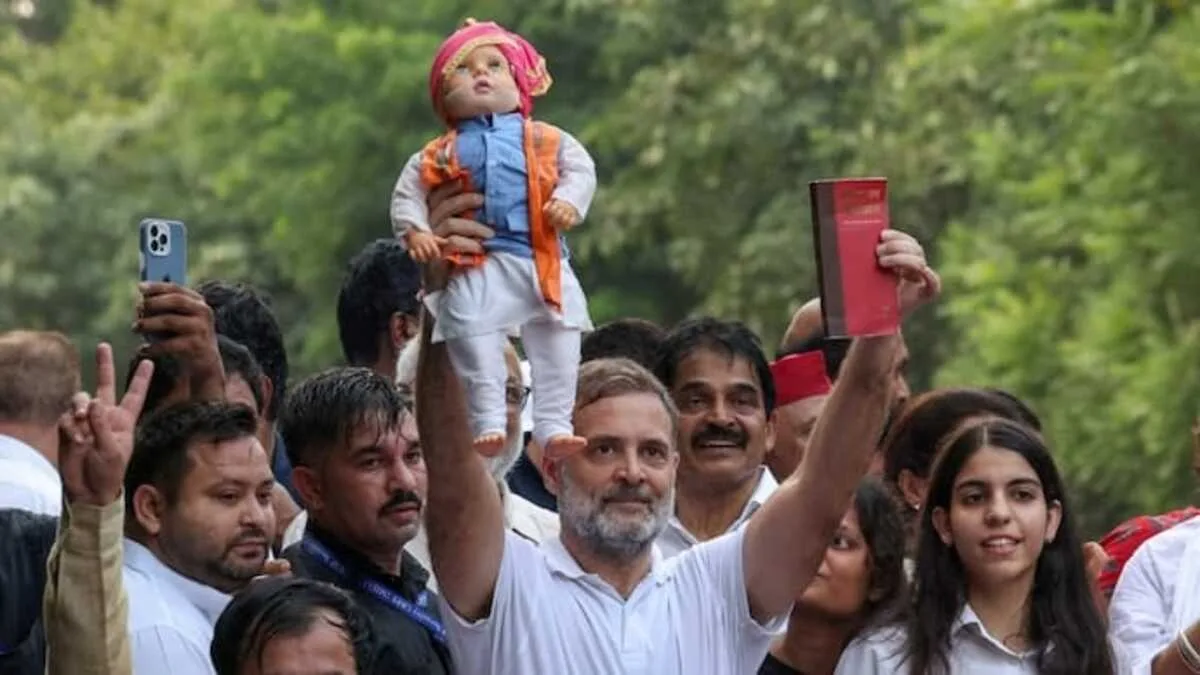
The events of October 12, 2026 raise a fundamental question about constitutional morality, judicial independence and the responsibility of political leaders towards the institutions of our Republic. When Rahul Gandhi, accompanied by Congress and its INDIA bloc allies, led a march towards the Supreme Court of India over allegations concerning electoral rolls and the functioning of the Election Commission, the issue extended beyond political confrontation. It brought into focus the relationship between democratic protest and the constitutional discipline that must govern every institution and every political actor.
The concern is not with the right to protest, nor with the right of the Opposition to question the Election Commission. Both are legitimate features of a constitutional democracy. My concern is with the propriety of the method adopted when related matters are already before the highest court of the country, and with the message that such conduct conveys about our respect for the judicial process.
The images of advocates standing outside the Supreme Court with copies of the Constitution in support of the political mobilisation invite an equally important reflection. The Constitution is not merely a document to be displayed at a demonstration. It is the supreme legal framework that defines rights, imposes limitations upon power and safeguards the independence of constitutional institutions.
A copy of the Constitution in one’s hand carries a responsibility to uphold its spirit, not merely an opportunity to make a political statement.
The most significant constitutional aspect of this episode was the request made by Rahul Gandhi and Mallikarjun Kharge for a meeting with the Chief Justice of India to submit a memorandum concerning the Election Commission, student arrests and restrictions affecting public transport, among other matters.
Chief Justice of India Surya Kant declined the request, explaining that the issues were already sub judice and that discussing pending cases in an administrative meeting would be incompatible with the separation of powers and established judicial propriety. He also indicated that the grievances could be pursued through the Court’s judicial process. In my considered view, this distinction goes to the heart of constitutional governance.
The Supreme Court is not a political negotiating table, and the office of the Chief Justice cannot become an alternative forum for discussing disputes that properly belong before a judicial bench. The Court has established procedures for filing petitions, mentioning matters in accordance with applicable rules, hearing the parties and delivering reasoned judgments.
If Congress or its allies believe that their constitutional rights have been violated, they are entitled to seek appropriate judicial relief. But the remedy lies in pleadings, evidence and legal submissions—not in seeking a separate administrative audience to discuss the merits of pending disputes.
The same principle would apply if a delegation from the ruling party sought a private or administrative discussion with the Chief Justice concerning litigation involving the government. Judicial independence cannot be selective, and access to justice cannot depend upon political prominence.
The distinguish between a strong constitutional objection and a categorical legal conclusion is significant. Articles 19(1)(a) and 19(1)(b) protect freedom of speech and expression and the right to assemble peacefully and without arms, subject to the restrictions permitted by the Constitution. The mere fact that a political march takes place while related litigation is pending does not, by itself, render the demonstration unconstitutional.
Nevertheless, constitutional freedoms must be exercised consistently with the law and with due regard for the functioning of judicial institutions. Conduct intended to intimidate the judiciary, obstruct court proceedings or improperly influence the adjudication of a pending case may raise serious legal questions, depending on the facts and applicable law.
The march towards the Supreme Court was reportedly stopped approximately 600 metres from the Court, while a delegation was permitted to enter the premises to complete petition-filing formalities. These facts must be distinguished from the separate question of whether the political approach adopted was constitutionally appropriate.
My objection is to the institutional propriety of combining political mobilisation with an attempt to secure an administrative meeting concerning pending disputes. Such an approach risks creating the impression that public pressure may provide a parallel route to judicial attention.
I regard that approach as ethically questionable and institutionally inappropriate. Whether any particular act amounts to an actual constitutional violation or an offence must, however, be determined on the evidence and the applicable law. That is not a dilution of my position. It is the discipline that the Constitution demands of every advocate.
The participation of advocates in political demonstrations is not inherently improper. Members of the Bar retain their constitutional freedoms and may express their views on public affairs within the applicable legal and professional framework.
But the legal profession has a distinctive responsibility. An advocate must distinguish an allegation from a judicial finding, a political demand from an enforceable legal right, and public mobilisation from judicial adjudication. The Constitution must be read as a whole. Article 19 protects civil liberties. Article 32 provides a remedy for the enforcement of fundamental rights. The doctrine of separation of powers safeguards the independence of constitutional institutions and forms part of the basic structure of the Constitution.
One cannot invoke constitutional freedoms while disregarding the institutional principles that sustain the constitutional order. The question I would put to every advocate participating in such a demonstration is this: are we strengthening public confidence in the judicial process, or are we risking the impression that political pressure should influence the manner in which pending disputes receive judicial attention?
For me, the answer must begin with professional responsibility. The dignity of the Bar rests upon reasoned legal argument, independent judgment and respect for judicial procedure—not merely upon the political visibility of a demonstration. The Constitution deserves informed advocacy, not selective invocation.
I do not suggest that the Election Commission of India is beyond scrutiny. No constitutional institution is above the Constitution. Article 324 entrusts the Election Commission with the superintendence, direction and control of elections, subject to the constitutional and statutory framework. Its decisions and actions may be questioned through lawful means and examined by the competent courts.
If Congress or any other political party possesses evidence that eligible voters have been unlawfully excluded, statutory safeguards have been violated, or fundamental rights have been infringed, it is entitled to place that evidence before the Court and seek appropriate relief. The judiciary must examine such claims independently, without fear or favour.
But an allegation does not become a constitutional violation merely because it is repeated at a public demonstration. Equally, a political party’s disagreement with the Election Commission does not establish that the Commission has acted lawfully or unlawfully. Those questions must be determined on the evidence and the applicable law.
The credibility of our democracy depends upon applying the same standard to every institution and every political party. Constitutional accountability is essential. Political pressure is no substitute for establishing a legal case.
The Opposition has an indispensable role in parliamentary democracy. It must question the government, scrutinise public authorities and raise legitimate grievances. A democracy in which dissent is silenced cannot fulfil the promise of the Constitution. However, the constitutional importance of the Opposition does not place it above the institutional discipline applicable to every other political actor.
If a political party believes that a court has erred, it must pursue the remedies available under law. If it believes that a constitutional authority has acted unlawfully, it must establish its case through appropriate proceedings. If it wishes to protest, it must do so peacefully and within the applicable legal framework.
What it must not do is create the impression that the intensity of a political demonstration should determine the urgency, direction or outcome of judicial consideration. My concern is also about the precedent such conduct may establish. If political disputes pending before the Supreme Court routinely become occasions for seeking separate administrative audiences with the Chief Justice, the distinction between judicial adjudication and political negotiation risks becoming blurred.
The Court must remain free to decide against the government, against the Opposition or against any other litigant on the merits of the case. That independence is not a privilege enjoyed by judges alone. It is a constitutional safeguard available to every citizen who may one day require justice against a powerful institution.
Constitutional principles should change according to who occupies the Treasury Benches and who sits in the Opposition. If the ruling party were to mobilise supporters to exert pressure upon the Supreme Court in a pending matter, I would apply the same standard. If an opposition party challenges a constitutional authority, I would defend its right to pursue lawful remedies. This is the meaning of constitutional consistency.
Respect for institutions cannot be demanded only when their decisions favour one’s political position. Nor can their authority be questioned merely because their decisions are inconvenient. The Chief Justice’s response is an important reminder that pending disputes must be addressed through established judicial procedures. It does not establish that the Opposition’s substantive grievances are false or without merit. Those questions must be decided independently on the record.
The issue is not whether Rahul Gandhi has the right to raise concerns. He does. The issue is whether every method adopted in pursuit of those concerns is consistent with constitutional morality and institutional propriety. In my view, that is the question that deserves serious public debate.
The Constitution is not merely a source of rights, but a framework of duties, institutional boundaries and restraints upon power. The march led by Rahul Gandhi and Congress and its allies on 12 October 2026, considered alongside the request for a meeting with the Chief Justice concerning pending matters, raises serious questions about judicial propriety and the relationship between political mobilisation and constitutional adjudication.
The approach is ethically questionable and undemocratic in its institutional implications. It is unconstitutional in spirit insofar as it risks undermining the constitutional discipline expected in dealing with an independent judiciary. The message to the political class is straightforward: challenge institutions where the law permits, question decisions where evidence justifies it, and protest where constitutional freedoms allow. But do not allow political mobilisation to create the impression that judicial attention can be secured through a route outside the established legal process.
The message to the legal fraternity is equally clear: the Constitution demands more than symbolic allegiance. It demands intellectual honesty, professional independence and fidelity to the rule of law. The Constitution is not a political prop. The Supreme Court is not a political battleground. And justice must never appear to be a product of political pressure. India’s constitutional strength lies in the confidence that every grievance can be tested under the law and every institution can be held to its constitutional responsibilities. That is the standard expected from every political party, whether in power or in opposition. And that is the constitutional culture we must preserve for generations to come.
