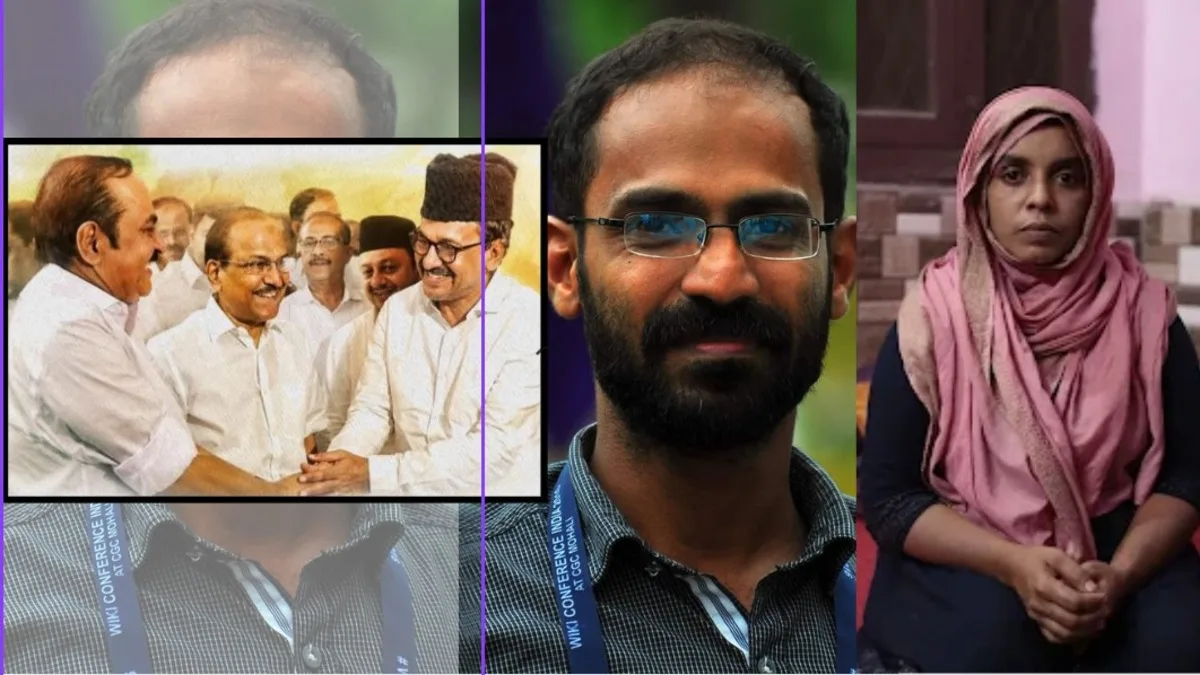
In a stark display of selective justice, Kerala Police have refused to act against the wife of UAPA-charged terror accused Siddique Kappan after she posted vulgar abuse targeting Prime Minister Narendra Modi. Kochi Cyber Cell ACP B.A. Suresh went on record claiming the post referred not to the Prime Minister but to the ‘Modi’ caste in Gujarat — an explanation widely seen as a convenient cover to bury the offence. No FIR was registered. No investigation followed.
In what critics describe as a stark case of selective enforcement, the Kerala Police have come under scrutiny over their handling of a social media post attributed to the wife of UAPA-accused Siddique Kappan, which contained an obscene jibe at Prime Minister Narendra Modi. Kochi Cyber Cell ACP BA Suresh claimed that the reference was to the ‘Modi’ caste in Gujarat and not the Prime Minister. No FIR was registered, and no investigation followed. The case is closed!
The new development came after Cyber cell ACP’s written reply objecting the filing of case.
So, is invoking a caste name now a convenient shield against scrutiny—even when the post is a vulgar jibe that targets the country’s Prime Minister, and that too made by the wife of a UAPA-charged terror accused?
If the police accept that the post targeted a caste rather than the Prime Minister, they must also confront an obvious question: does the explanation justify leaving the matter entirely unexamined, particularly when the wording itself is being challenged as obscene?
The explanation has raised questions about the standards applied by the police when dealing with potentially offensive online content. The post read: “New Sex position called ‘Modi’ where you get on top and do nothing.”
So does it raise another question about whether an entire community is being subjected to an obscene stereotype?
The Kerala Police’s handling of the matter has therefore become the focus of allegations of double standards. The key question is whether the authorities applied a consistent legal test to the post, rather than allowing the interpretation of its target to determine whether action was warranted.
Contrast this with the treatment meted out to BJP State Vice President Sastamangalam Councillor and retired DGP R. Sreelekha. For remarks made at a BJP public meeting in Punalur — where she compared Rahul Gandhi’s aggressive behaviour in Delhi to that of a heavily intoxicated man, noting how he shoved Congress ministers and how videos of him throwing plastic bottles had surfaced — Punalur police promptly registered a case. The charge: deliberately creating a stir to cause riots. The complaint was filed by Congress Punalur Block President C. Vijayakumar.
Sreelekha did not remain silent. Sharing Organiser’s article, “Shocking! Kerala Police Refuse Action Against UAPA-Charged Siddique Kappan’s Wife for Vulgarly Depicting PM Modi | PFI.” The retired DGP described it as a clear-cut case of selective justice.
Insult the Prime Minister, and it becomes a mere defamation matter that the police cannot easily take up. Criticise Rahul Gandhi and it instantly turns into a criminal case of inciting riots.
This is the latest example of selective enforcement under the Congress-led UDF government, the presence of the Muslim League (IUML) as a key coalition partner influences the soft handling of cases linked to figures with extremist associations.
Raihana Siddique’s post amplified a sexually charged personal insult directed at the Prime Minister while expressing support for the CJP protest and related figures.
Social activist Martin Menachery filed a complaint at the Kochi City Cyber Crime Police Station alleging the post was obscene, targeted the Prime Minister, and risked creating social discord. The Assistant Commissioner of Police Suresh replied in writing that they couldn’t register an FIR. Later, when Martin enquires on phone ASP stated that Siddique’s wife post refers to ‘Modi’ community of Gujarat and no FIR could be filed.
CM VD Satheesan and Home Minister Ramesh Chennithala are competing to demonstrate loyalty to their powerful coalition partner, Muslim League.
Ramesh Chennithala holds the Home, Vigilance, Prisons, Fire and Rescue Services, and Coir portfolios. The Kochi City Cyber Crime Police Station’s written reply to complainant Martin Menachery — that no case could be registered because the post mentioned only “Modi” and “Narendra Modi is not the only Modi” — falls squarely under the Home Department’s administrative control. The post by Raihana Siddique, wife of UAPA-accused Siddique Kappan (who faced charges linked by investigators to the now-banned PFI), featured a sexually abusive placard: Police treated it as a technical defamation matter rather than registering an FIR for obscenity or related offences.
This soft response is not isolated bureaucratic caution. Muslim League, which secured 22 seats in the 2026 Assembly elections and holds several ministerial berths (including key portfolios under P.K. Kunhalikutty), was instrumental in Satheesan’s elevation as Chief Minister over rivals that included Chennithala himself. Multiple reports noted the League’s firm backing for Satheesan during the post-election leadership contest, citing his earlier outreach to Muslim organisations and his positioning as a leader who would not isolate the ally.
Satheesan has publicly described the Muslim League as a “brother party” vital to Kerala’s secular fabric and has warned that weakening it would open space for extremist outfits.
In this context, the Home Minister’s department declining action against the wife of a figure with documented PFI linkages is portrayed by opponents as Chennithala signalling reliability to the same ally that helped sideline him for the top job. Simultaneously, the Chief Minister’s overall political line — prioritising alliance stability with the League — is seen as setting the tone that discourages aggressive policing in sensitive cases involving Muslim political or social networks.
The result, according to this reading, is a quiet competition in which both Congress heavyweights calibrate their actions (or inaction) to keep the Muslim League satisfied, ensuring the coalition’s arithmetic and the Muslim vote bank remain intact.
What Delhi Police did?
Delhi Police Special Cell registered FIRs against multiple social-media handles for objectionable and defamatory posts targeting the Prime Minister during the same protest period, invoking provisions on criminal intimidation, public mischief, and defamation under the Bharatiya Nyaya Sanhita, and sought account details from platforms.
In Kerala itself, Kozhikode City Cyber Police arrested transgender makeup artist Jaanmoni Das and two others in August 2026 for derogatory video remarks against the Prime Minister and his family linked to the same protest; they were later released on station bail after an apology as the offences were bailable. Arrests for abusive posts against the PM have occurred in other states under relevant IPC/BNS sections.
Siddique Kappan was arrested on 5 October 2020 by Uttar Pradesh Police under UAPA and other sections while travelling toward Hathras. Investigators linked him and associates to the Popular Front of India (PFI, later banned), noted possession of material from a publication alleged to inflame tensions, referenced his stay at the PFI national office in Shaheen Bagh, and cited statements from co-accused. Parallel Enforcement Directorate money-laundering proceedings continue; lower courts have repeatedly rejected bail in that matter. The Supreme Court granted him bail in the UAPA case in September 2022; he was released in February 2023 and has remained on bail. Bail conditions were further relaxed in November 2024 (ending weekly police reporting). On 12 October 2026 he approached the Supreme Court seeking temporary release of his passport for Umrah, unfreezing of salary and PF accounts, and return of seized items.

