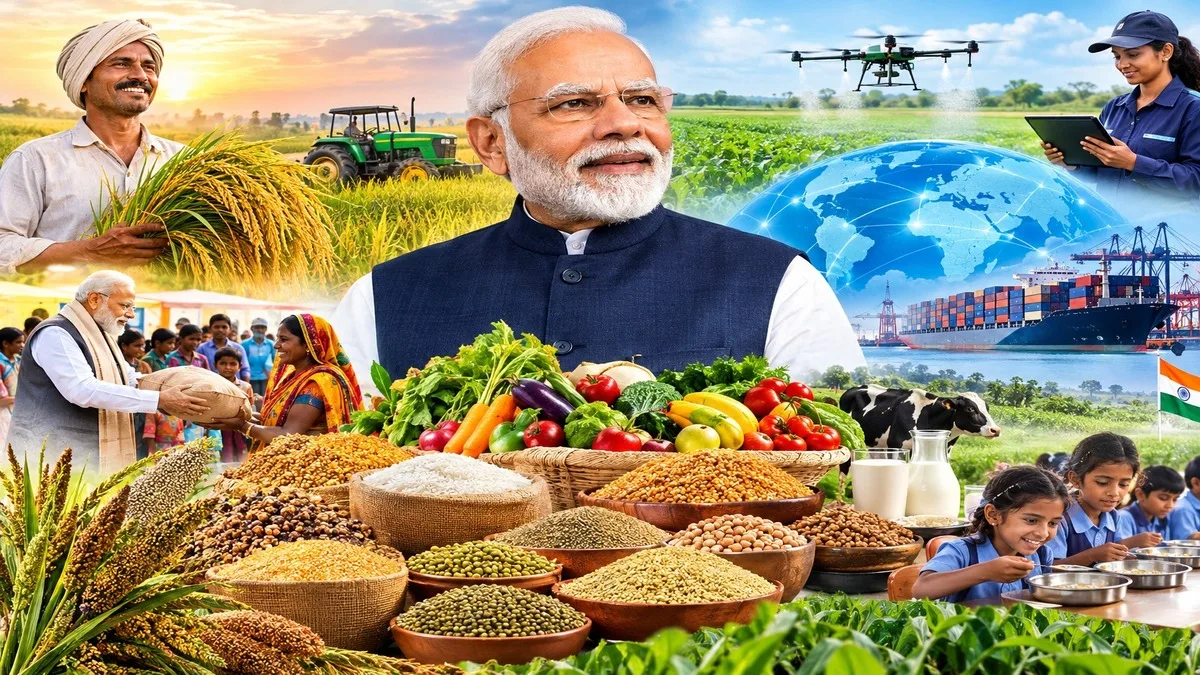
Innovate Today, Nourish Tomorrow: How Modi Govt Built World's Largest Food & Nutrition Security Ecosystem
Today, October 16, 2026, the world observes World Food Day. The official theme of this global day for 2026 is “Innovate today. Nourish tomorrow.” The theme fits India’s present agri-food landscape closely. In the 1960s, India struggled with a grave “ship-to-mouth” existence and depended on foreign aid. Today it not only feeds a population of more than 140 crore (1.4 billion) but, under Prime Minister Narendra Modi’s leadership, has emerged as a credible “food basket” for the world.
Over the past decade, the Central Government’s far-sighted policies have lifted agriculture and food security from a mere “means of survival” into a central pillar of “empowerment and national security”. The Modi government’s policy reforms, timely distribution of improved seeds and expansion of irrigation schemes have helped India take its place among the world’s leading agricultural producers. According to the latest figures from the Ministry of Agriculture, India’s total foodgrain production in the 2025-26 financial year crossed a historic record of 376.56 million tonnes.
Within this total, India has overtaken China to become the world’s largest rice producer (154.02 million tonnes). India also ranks first globally in milk and millet (Shree Anna) production, and second in fish, fruit and vegetables. Over the past decade, fruit and vegetable production has risen by more than 64 million metric tonnes, giving the rural economy a fresh economic footing.
Treating food security as a basic right of every citizen, the Modi government runs the world’s largest food security programme. Under the National Food Security Act (NFSA), around 81.35 crore (813.5 million) beneficiaries receive its direct benefit.
The Pradhan Mantri Garib Kalyan Anna Yojana (PMGKAY), launched during the Covid crisis, was extended by the Central Government, in a landmark decision, for a further five years from 1 January 2024 (that is, until 2029). Under this scheme, eligible citizens receive foodgrains entirely free of charge. The Centre is itself bearing the vast financial outlay of Rs 11.80 lakh crore (about Rs 11.8 trillion) for this mega-campaign. The scheme is not only removing the spectre of hunger from the country but also giving poor families dignity and social security.
Filling stomachs alone cannot be the measure of food security; the body must also receive proper nutrition. To tackle “hidden hunger” (micronutrient deficiency) and, in particular, anaemia among rural women and children in a planned manner, the Modi government has placed its focus squarely on “nutritional security”.
Taking a landmark step in this direction, the Central Government has approved a policy to implement Universal Rice Fortification across the country by December 2028. Under this scheme, iron, folic acid and vitamin B12 are being added to rice distributed through the Public Distribution System (PDS) and the PM-POSHAN midday meal scheme. The government is spending ₹17,082 crore on the project as a whole. In addition, the Indian Council of Agricultural Research (ICAR) has developed new varieties of more than 100 biofortified crops, which are improving nutrition levels naturally.
It was thanks to Prime Minister Narendra Modi’s diplomatic and far-sighted efforts that the United Nations declared 2023 the International Year of Millets. By giving India’s traditional coarse grains the proud name Shree Anna, India has established them as a global superfood.
In the context of World Food Day 2026, Shree Anna is a major strategic and environmental asset for India. These crops grow easily with little water and in adverse climatic conditions, making them the safest option for farmers in this difficult era of climate change. The government is steadily promoting millet processing, agri start-ups and global exports, so that India’s traditional food culture is becoming an integral part of plates around the world.
Although India is fully self-reliant and in surplus in cereals, it has until now had to depend on other countries for edible oils and some pulses. To remove this weakness permanently, the Modi government has taken major steps in mission mode, chiefly the Pulses Mission, the Oilseeds Mission and measures on edible oil imports.
The government has approved the National Mission for Self-Reliance in Pulses, with a substantial budgetary allocation of Rs 11,440 crore for 2025-26 to 2030-31. Its main goal is to make India 100% self-sufficient in pulses by 2031. To reduce edible oil imports (currently 55-60% of total consumption), palm cultivation is being expanded on a war footing in the north-eastern states and the Andaman and Nicobar Islands under the National Mission on Edible Oils – Oil Palm, so that the country’s valuable foreign exchange reserves are conserved and domestic farmers prosper.
The Modi government has also sanctioned Rs 2,817 crore for the Digital Agriculture Mission (AgriStack). Under it, technologies such as digital records of farmers’ land, safe spraying of pesticides through “Kisan Drones” and accurate weather forecasting are now at work on the ground. Through the PM-KISAN Samman Nidhi scheme, more than Rs 3 lakh crore (about Rs 3 trillion) has so far been deposited by Direct Benefit Transfer (DBT) into the bank accounts of more than 11 crore (110 million) farmers. This steady financial support has freed small farmers from the clutches of local moneylenders when buying seed and fertiliser, helping sustain the country’s agricultural productivity.
On the basis of all these facts, it can be said that World Food Day is not merely a day for domestic introspection; it also reflects India’s responsibility towards the world. In the 2025-26 financial year, India’s total agricultural exports reached an all-time high of $53.1 billion (roughly Rs 4.4 lakh crore). Since the minimum export price (MEP) and other restrictions on non-basmati rice exports were removed entirely, India has been supplying foodgrains steadily to more than 140 countries. During geopolitical crises and famines in African countries, India has sent consignments of grain as humanitarian aid as a responsible global power, bringing to life Prime Minister Modi’s vision of Vasudhaiva Kutumbakam (“the world is one family”).
On the occasion of World Food Day 2026, India’s distinctive position makes clear that, under the Modi government, the country has successfully crossed the first milestone of “food security” and entered a new golden age of “nutritional security” and “agricultural diplomacy”. These policy efforts will not only free India’s future generations from malnutrition but also keep India at the top as one of the world’s strongest, most self-reliant and sustainable food systems.
