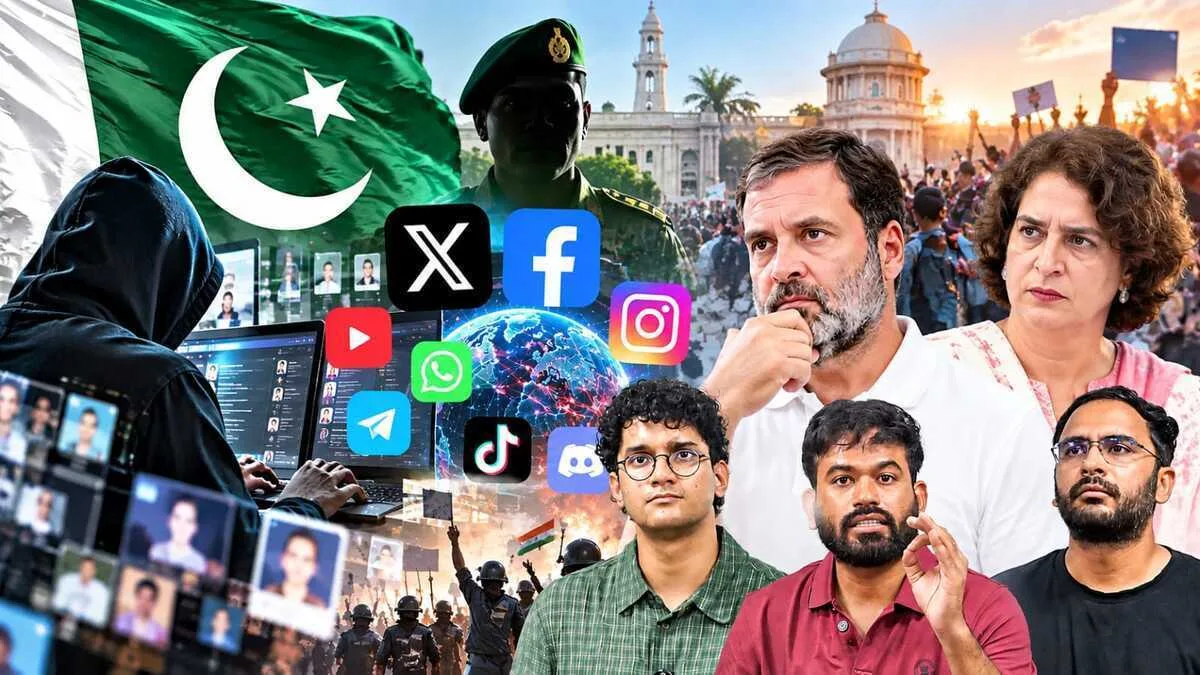
Pakistan’s ISI-linked disinformation network is targeting the CJP protests and SIR controversy, seeking to exploit young protesters, inflame public anger and trigger unrest across India
A report published by the Indian Defence Research Wing on October 15 has highlighted Pakistan’s expanding digital jihad campaign against India, with more than 5,000 social media accounts created over a fortnight to spread disinformation, provoke unrest and exploit the ongoing protests against the Special Intensive Revision (SIR) of electoral rolls.
The reported operation, linked by intelligence officials to Pakistan’s Inter-Services Intelligence (ISI), targets Indian security forces and the Union government through fabricated claims intended to inflame tensions and encourage violence.
The campaign focuses on circulating misleading reports about police firing, lathi charges and tear gas shells during demonstrations. Intelligence officials cited in the report said the objective is to provoke young protesters, trigger confrontations with law enforcement agencies and create opportunities for further misinformation.
Pakistan support to SIR protests forms part of a broader information campaign designed to manipulate public perceptions and spread unrest across India.
The reported operation highlights how Pakistan’s digital jihad increasingly exploits domestic political controversies. The ISI uses coordinated social media networks to circulate inflammatory claims, undermine confidence in Indian institutions and amplify hostility towards security personnel.
Pakistan’s SIR protest campaign seeks to exploit demonstrations by spreading fabricated reports when emotions are high, and users are less likely to verify information before sharing it.
An Intelligence Bureau official cited in the report said the sudden proliferation of these accounts was directly linked to the ongoing anti-SIR protests. The intention is to provoke young people and push them towards violence.
If confrontations erupt, police intervention could trigger further clashes, providing additional opportunities to circulate misleading accounts of law enforcement actions.
The ISI plot relies on the speed of online communication. False claims about police firing or injuries can reach thousands of users before fact-checkers establish the facts. Repeated circulation may make fabricated information appear credible, encouraging people to share it without checking its authenticity.
The Pakistan support to SIR protests therefore extends beyond online commentary, seeking to exploit political tensions and influence public reactions.
Investigating agencies have identified accounts operated by both Indian and Pakistani users. Although fake accounts have been used previously, officials cited in the report describe the present pattern as different because of its geographical spread and organisation.
The involvement of Indian accounts provides additional channels for distributing content that appears locally generated, complicating efforts to identify coordinated disinformation.
According to intelligence officials, the ISI previously relied largely on hubs in Rawalpindi and Islamabad to create fake accounts and generate misleading content. Concentrating operations in these locations made tracing their origins comparatively easier. The latest campaign distributes account creation and content circulation across multiple locations in Pakistan.
The locations identified in the report include Bhimber, Rawalakot, Tarakhal, Sialkot, Kolti, Mendhar and Peshawar, among others. Individuals in these places are reportedly recruited to create social media accounts and circulate information supplied to them. The ISI directs participants to publish specific claims, enabling the network to amplify selected narratives surrounding the SIR protests.
This decentralised arrangement allows the Pakistan disinformation campaign to operate through numerous accounts instead of relying on a few identifiable centres. Distributing activities across several locations complicates investigations and makes it harder to establish connections between accounts.
The reported ISI plot also enables similar claims to circulate simultaneously through different networks.
Participants are reportedly instructed to tag users in foreign countries to expand the reach of their posts. This tactic takes misleading narratives beyond India and Pakistan, exposing international audiences to claims about events they may not understand.
By the time Indian fact-checking agencies identify fabricated content, it may already have gained traction and influenced public discussions.
Intelligence officials said the ISI understands that fact-checking takes time. The number of people following fact-checkers remains comparatively small, while viral misinformation can reach much larger audiences. This imbalance gives the reported digital jihad campaign an advantage during politically sensitive developments.
Young people participating in the SIR protests are a significant target of the Pakistan-linked campaign. Many rely on smartphones and social media platforms for immediate updates. During demonstrations, emotionally charged messages can influence perceptions before users establish whether the information is accurate.
The information gap is particularly significant in smaller towns and villages. People in metropolitan areas and larger cities may have greater access to multiple news sources, while others may take days to receive reliable corrections. Meanwhile, rumours spread through personal conversations, creating lasting impressions even after the original claims are exposed as false.
The ISI plot also exploits geographical confusion. When a demonstration takes place in New Delhi, fabricated reports may emerge claiming that police violence has occurred elsewhere. People in other cities, unfamiliar with developments at the original protest site, may accept the claims and mobilise in solidarity. Such reactions could trigger further confrontations and extend unrest beyond the initial demonstration.
One example concerns a false report about Congress leader and Leader of the Opposition Rahul Gandhi. Some social media handles reportedly claimed that Delhi Police had opened fire and injured Gandhi. The objective, according to officials cited in the report, was to provoke Congress supporters elsewhere into protesting or engaging in violence.
The incident illustrates how politically sensitive claims involving prominent leaders can increase the reach of disinformation. By circulating fabricated reports about injuries and police action, the Pakistan digital jihad campaign seeks to provoke emotional reactions and intensify tensions surrounding the SIR protests.
The ISI operation is not restricted to Pakistani participants. Under an operation identified as Operation Ground Wire, Indian individuals have been targeted and paid to create content against the Indian state. Officials cited in the report said the objective is to shift public narratives and damage the reputation of Indian institutions.
Indian accounts provide additional channels for circulating content among domestic audiences. Posts shared by local users may appear credible to people who assume that the information originates from individuals familiar with events on the ground. The ISI support to the CJP protest narrative and the wider SIR-related campaign consequently combines foreign networks with domestic content distribution.
The Intelligence Bureau and state police are monitoring suspicious accounts and reporting them as they are identified. However, tracing thousands of handles and establishing links between them requires time. Meanwhile, other accounts can continue circulating similar claims, allowing misleading narratives to spread before corrective information reaches the same audiences.
The scale of the reported operation presents a major challenge. Intelligence officials said the activity involves thousands of accounts rather than a handful of profiles. Pakistan’s digital jihad campaign exploits this numerical reach, geographical dispersion and the speed of online communication to amplify disinformation during politically sensitive protests.
