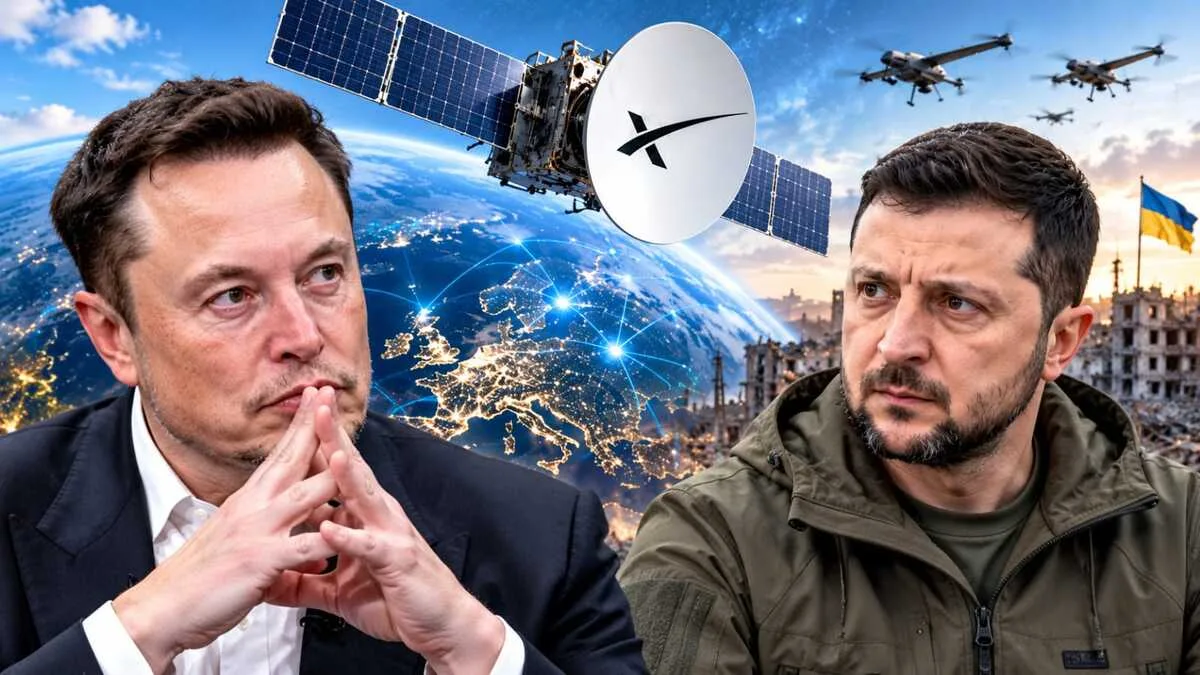
Elon Musk’s Starlink restrictions disrupt Ukraine’s drone operations against Russia, exposing risks of private satellite dependence
SpaceX’s decision to impose an overnight speed limit on Starlink terminals has disrupted Ukrainian drone operations, exposing the risks of relying on Elon Musk’s privately controlled satellite network for communications.
Ukraine’s officials say the restrictions were introduced without prior notification, raising questions about the reliability of a system that has become integral to battlefield operations against Russian forces.
Serhiy Beskrestnov, an adviser to Ukrainian President Volodymyr Zelensky, said Ukraine had not been informed that SpaceX would restrict Starlink connectivity at speeds exceeding 160 km/h. In a Telegram post on October 14, he reported that the overnight change had already disrupted several military missions.
A Ukrainian defence ministry source subsequently confirmed that Starlink terminals lost connectivity when vehicles or other assets crossed the speed threshold, adding that the underlying cause was being investigated.
The development has highlighted a critical vulnerability in Ukraine’s dependence on commercial satellite infrastructure. While Starlink provides essential connectivity for military coordination, reconnaissance and drone operations, the latest disruption demonstrates how changes made by a private operator can affect battlefield capabilities without advance warning to its users.
According to Ukrainian defence ministry sources, the speed restrictions have complicated the deployment of interceptor drones and medium-range strike drones. The disruption has also affected frontline logistics, reconnaissance and signal-relaying capabilities.
Starlink has become an important communications tool for Ukraine, enabling its forces to coordinate operations and guide drones towards Russian targets. Beskrestnov described the satellite network as the most effective tool for supporting interceptor drones against Russia’s newly developed jet-propelled drones.
However, the reported restrictions have raised concerns about the operational consequences of relying on a network whose technical conditions are determined by a commercial company. If connectivity can be interrupted when military assets exceed a specified speed, the restrictions could affect operations requiring rapid movement and uninterrupted communications.
Beskrestnov said SpaceX’s decision could not be considered coincidental and suggested that it was connected to the prevailing political situation.
The episode also follows SpaceX’s February decision to deny Russian forces access to Starlink. That move reportedly disrupted Russian communications and complicated battlefield coordination.
The successive restrictions affecting access to the same satellite network illustrate how decisions by a private operator can influence the communications capabilities available to countries.
For Ukraine, the immediate concern is the disruption of military operations. The broader question is whether a commercial satellite network can provide predictable and dependable connectivity when access conditions may change without advance consultation. The absence of a public explanation from SpaceX has left these concerns unresolved.
The Starlink disruption coincided with overnight Russian missile and drone strikes that Ukrainian officials said had left at least 600,000 people without electricity. President Zelensky reported damage to critical energy infrastructure in Kyiv, the surrounding region and Kharkiv.
Local officials reported three deaths in Kyiv. Later on October 14, at least six people were killed in a Russian drone strike on a warehouse in Lutsk, in north-western Ukraine. Russia said its strikes had targeted communications and energy facilities used by the Ukrainian military.
Ukraine’s air force said Russia had launched 39 ballistic and cruise missiles and 128 drones overnight, claiming that four missiles and 115 drones had been shot down. Separately, Russia’s defence ministry said 902 Ukrainian drones had been intercepted over Russian regions, including Moscow and Crimea.
The strikes came after US President Donald Trump announced an energy ceasefire between Russia and Ukraine on October 11. Zelensky has said Ukraine is prepared to halt attacks on Russian oil refineries and other energy facilities if Moscow does the same.
Russian Foreign Minister Sergei Lavrov argued that a ceasefire would give European countries an opportunity to supply Ukraine with additional weapons.
Ukraine also relies on US satellite systems to track incoming Russian missiles, issue alerts and support interception efforts.
Zelensky alleged that Washington threatened to restrict intelligence-sharing unless Kyiv accepted Trump’s proposed energy ceasefire, a claim Trump denied on October 13.
Against this backdrop, the Starlink episode has brought the risks of dependence on privately controlled satellite infrastructure into sharper focus. The disruption raises questions about whether Ukraine can depend on uninterrupted Starlink connectivity when Elon Musk’s SpaceX retains control over the network’s operating conditions. Until the company explains the restrictions and clarifies its service policies, the reliability of Starlink as a critical communications system will remain under scrutiny.
