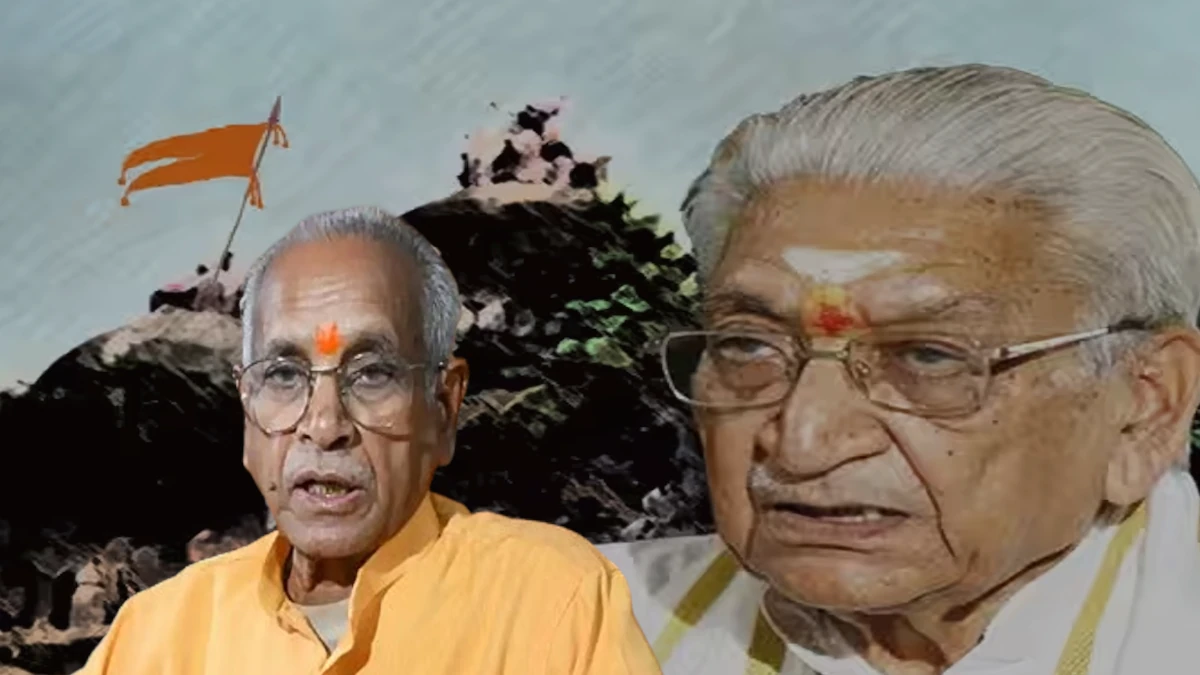
DEHRADUN: Ashok ji Singhal, was the most prominent face of the Ram Janmabhoomi movement and he had got the temple’s blueprint prepared in 1986. The Ram Mandir constructed in Ayodhya today is an expanded version of that original plan, said Champat Rai, Vice-president of the Vishva Hindu Parishad (VHP) while addressing an event organised on the occasion of centenary year celebrations of Ashok Ji Singhal.
Rai also recalled that Ashok ji had predicted the number of seats the BJP would win in different states in 2013.
According to him, the party eventually secured the numbers Ashok jihad indicated. Rai further said that Ashok ji had advocated making Narendra Modi the face of the BJP’s election campaign.
He also narrated several episodes highlighting Ashok ji’s efforts to unite saints for the Ram Janmabhoomi movement, promote harmony in Punjab and advance social harmony.
Champat Rai said Ashok ji came into contact with the Rashtriya Swayamsevak Sangh (RSS) at a young age. His growing involvement in organisational work gradually kept him away from his family. When his father fell ill, his mother asked him to take care of him. However, Ashok ji suggested that his younger brother be entrusted with the responsibility. According to Rai, his mother called him close and applied a tilak on his forehead with her own blood.
Ashok ji studied Metallurgical Engineering at Banaras Hindu University (BHU). Rai observed that pursuing engineering between 1945 and 1950 was considered a significant achievement.
Champat Rai said, no single individual formally assigned Ashok Singhal the responsibility of leading the Ram Janmabhoomi movement. While working under the guidance of senior RSS officials, Ashok ji took the initiative to carry the movement forward. He subsequently focused on bringing saints and different religious traditions together to build a broad platform for the movement.
He recalled that, on April 7 and 8, 1984, more than 600 acharyas gathered at Delhi’s Vigyan Bhawan. Champat Rai said the event was called the Dharma Sansad. The objective was to bring saints and religious leaders from across the country onto a common platform.
He further recalled the tense situation in Punjab during the 1980s. He said Ashok ji participated barefoot in the Sadbhavana Yatra organised from Har Ki Pauri in Haridwar to Harmandir Sahib in Amritsar to spread a message of harmony.
Rai narrated an episode associated with Manikarnika Ghat in Varanasi. He said that in 1994, Ashok ji arranged for saints to be invited to the residence of the Dom Raja. The following day, the Dom Raja was seated on the stage among the saints. Rai described the episode as an initiative towards promoting social harmony and breaking social barriers.
Champat Rai said that, the stones carved for the construction of the Ram Mandir were examined by the National Building Research Institute. The tests reportedly indicated that the stones could last for more than 1,000 years. Rai said Ashok ji had ensured that the carving of stones for the proposed temple began well in advance as part of the construction plan.
Champat Rai said Kameshwar Chaupal, who hailed from Supaul in Bihar, was selected for the Ram Mandir Shilanyas (foundation-laying ceremony) in 1989. Chaupal was the VHP’s prant secretary and belonged to a Scheduled Caste community. He was entrusted with the responsibility of performing the foundation-laying ceremony in Ayodhya.
Champat Rai said Ashok ji Singhal believed that Hindu and Buddhist traditions shared several common philosophical ideas, even though their doctrines differed in certain respects. With this understanding, he organised six Buddhist conferences in Bharat to bring the two communities closer and encourage greater dialogue and unity.
Ashok ji Singhal dedicated his entire life to organisational activities and prioritised his responsibilities towards the organisation over family commitments. Several episodes from his life reflected his commitment to the organisation and the causes he worked for, Champat Rai said.
Uttarakhand Chief Minister Pushkar Singh Dhami also recalled Ashok Ji’s contribution to the country and Hindu society. Dhami said Ashok Ji devoted his life to protecting the country and Hindu Dharma. He added that the Ram Mandir was a result of Ashok ji’s contribution and that he would have been delighted to witness its completion had he been alive today.
He said his government is following the path shown by Ashok ji Singhal. He cited the implementation of the Uniform Civil Code (UCC) in Uttarakhand and claimed that the number of religious conversions had declined following its implementation. He also said government efforts were facilitating the return of people who had previously converted from Hinduism.
Dhami said the state government had removed encroachments from around 13,000 acres of land in Uttarakhand. The government had enacted a stringent law to prevent cow slaughter and was ensuring its strict implementation, he said.
Dhami also said that the government is working to restore and develop ancient religious sites. He cited the construction of a ghat on the Yamuna at Haripur in Kalsi, where regular Maa Yamuna Aarti is now performed.
He assured the gathering that the government would continue to follow the path shown by Ashok ji Singhal.
The event was organised by the Vishva Hindu Parishad (VHP) on October 11 at the Doon Medical College Auditorium in Dehradun to mark the beginning of Ashok ji Singhal’s birth centenary celebrations.
