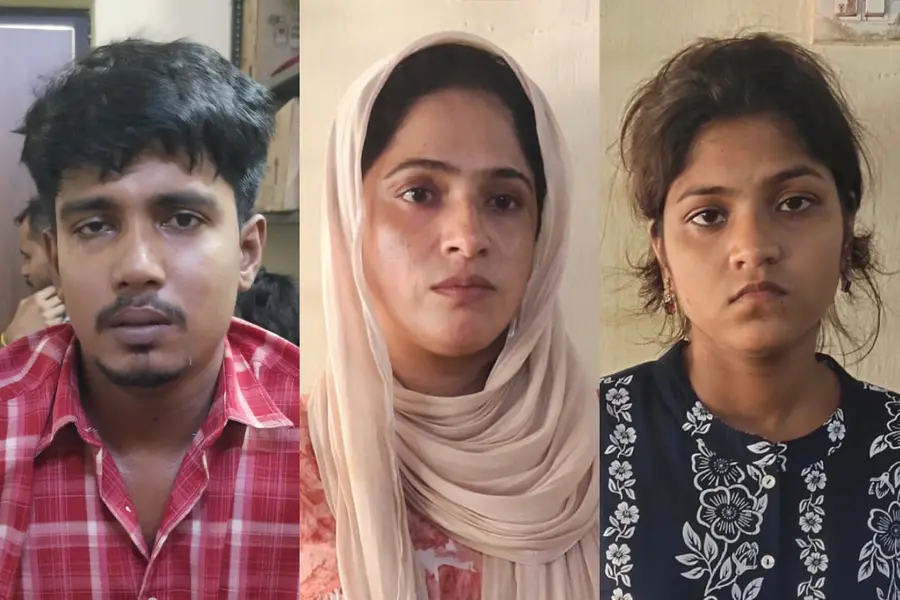
The Keralam police have arrested three Bangladeshi nationals staying in Kozhikode illegally after a dispute among them led to an investigation that revealed their nationality and the use of fake Indian identity documents. The incident occurred on October 8 in the Vellayil area of Kozhikode, where police reached the spot after receiving information about a scuffle.
Rabbi Sheikh (27), from Kishoregunj, his wife Roshnara Begum (38), from Khulna, and Papizaa (22), from Manikgunj, were arrested by the Medical College Police. They were living in a rented room in the city. According to reports, the dispute involved other migrant workers, following which local residents informed the police.
The police initially arrested Rabbi Sheikh. During interrogation, they found that he was a Bangladeshi citizen. Further questioning revealed that the other two women were also Bangladeshi nationals. They were subsequently taken into custody and brought to the Medical College Police Station.
During interrogation, the three reportedly admitted that they had entered Bharat eight months earlier. They had worked in Bengaluru for four months before moving to Kozhikode. Rabbi Sheikh was employed at a welding workshop after arriving in Kozhikode, while his wife, Roshnara Begum, had been working in spas for the last eight months.
According to the police investigation, the couple obtained fake Aadhaar cards, PAN cards and Election ID cards from Kolkata while they were in Bengaluru. The documents reportedly carried addresses in Kolkata, and the police said they had obtained evidence of the alleged forgery.
Papizaa, aged 22, had arrived in Kozhikode ten days before her arrest and had been working at a spa for the previous seven days. The police are searching the room where the three had been staying and examining whether any additional documents are present.
Arrests of illegal Bangladeshis have been reported in Keralam for a long time. According to reports, the number of illegal Bangladeshi nationals living in the state while posing as people from West Bengal remains unknown. Observers attribute the situation to what they describe as a soft approach by the authorities. They maintain that the situation remains unchanged regardless of whether the CPM-led Left Democratic Front (LDF) or the Congress-led United Democratic Front (UDF) is in power.
The issue also brings into focus the Keralam government’s position on the Citizenship (Amendment) Act, 2019 (CAA). On December 31, 2019, the Kerala Assembly unanimously passed a resolution against the legislation.
The Pattern: Illegal stay of Bangladeshis using forged Indian identity documents
The arrest of three Bangladeshi nationals in Kozhikode is the latest in a series of cases involving Bangladeshi nationals staying illegally in Keralam and using forged Indian identity documents.
The arrests have been reported across Kollam, Kochi, Kozhikode and Kannur, with the latest high-profile case involving a Bangladeshi national who had worked as a contract employee inside the Indian Naval Academy at Ezhimala in Kannur.
The accused, identified as Biplob Soren (32), was arrested on September 18, 2026, after naval authorities reportedly grew suspicious of his identity. He had been working in the academy’s laundry section and allegedly used a fake Aadhaar card and a forged Police Clearance Certificate to secure employment.
In Kannur five Bangladeshi women were arrested on September 14 and 15. The women, identified as Salina Akter, Nazma Akthar, K. Taslima, K. Moina and Nasrin Bibi, were staying and working in the district without valid travel documents. Police recovered forged Indian identity documents, including Aadhaar cards.
In all these cases, investigators have found links involving West Bengal, Guwahati, Mumbai, Karnataka and Keralam.
According to reports, some of those arrested allegedly paid up to Rs 1 lakh to intermediaries for forged identity documents.
The sequence of arrests dates back to June 2026. On June 8, the Kerala Anti-Terrorism Squad (ATS) arrested Bangladeshi national Mumtaz Begum from Kulasekharapuram in Kollam district. She was suspected of being involved in a network that allegedly provided Indian identity documents to Bangladeshi nationals using local addresses.
Her ration card reportedly carried a Kerala address, while certain Akshaya Centres came under scrutiny during the investigation.
A report at the time stated that the ATS had arrested 36 Bangladeshi nationals in recent operations and was investigating how they entered the state, obtained accommodation and secured Indian documents.
On June 24, the Kerala ATS arrested 19-year-old Moshiur Khan, alias Aman Khan, from an Islamic madrasa in Kollam. He was allegedly staying and studying at the Shariathul Islam Madrasa under the Karunagappally Puthentheruvu Muslim Jamaath mosque without valid travel documents. Police recovered a forged Aadhaar card, ration card and voter ID card from him.
The following day, June 25, Kerala Police, the Special Branch, the ATS and the Bharatiya Navy jointly arrested six more Bangladeshi nationals from two rented houses in Eroor, Tripunithura, near Kochi. The accused — Meydi Hassan, Mohammed Assim, Tarekh, Sokhir, Mohammed Sohail and Mohammed Mijan — were reportedly engaged in scrap and junk collection without the required documents or legal permission to stay in Bharat.
On July 1, three more Bangladeshi nationals — Mohammed Woola, Mohammed Mafdi Hassan and Mohammed Hassan Ali — were arrested in Kozhikode.
On July 29, the Kerala ATS arrested another Bangladeshi national, Mohammed Hassan, from a rented house at Kayalam Market in Mavoor, Kozhikode, following specific intelligence inputs. Bangladeshi identity documents and currency were reportedly seized, while an alleged accomplice escaped. The report described the arrest as part of a statewide operation and stated that more than 60 Bangladeshi nationals had been arrested in recent operations by Kerala Police and the ATS.
The recurring features across these cases include alleged forged Aadhaar cards and other Indian identity documents, rented accommodation, employment through intermediaries and suspected document-procurement networks.
On June 12, an inscription reading “I Love Pakistan” was reportedly found inside a vessel undergoing maintenance at Cochin Shipyard.
The arrests across Kollam, Kochi, Kozhikode and Kannur involve people reportedly engaged in scrap collection, spa and massage-centre work, rented-house accommodation and madrasa education, besides the contract worker at the Indian Naval Academy.
Illegal Bangladeshis staying in Bharat pose potential national security concerns, particularly when they allegedly obtain forged Indian identity documents, evade verification and establish networks across different states.
Such cases raise questions about possible cross-border networks, document forgery, trafficking, smuggling, misuse of identity and electoral records, and vulnerabilities in security screening at sensitive establishments.
The presence of illegal Bangladeshi nationals in Keralam also raises concerns about demographic changes and the effectiveness of state law and order.
