Punjab Paddy Procurement Row: Opposition slams AAP Govt after rain floods Fazilka Mandi
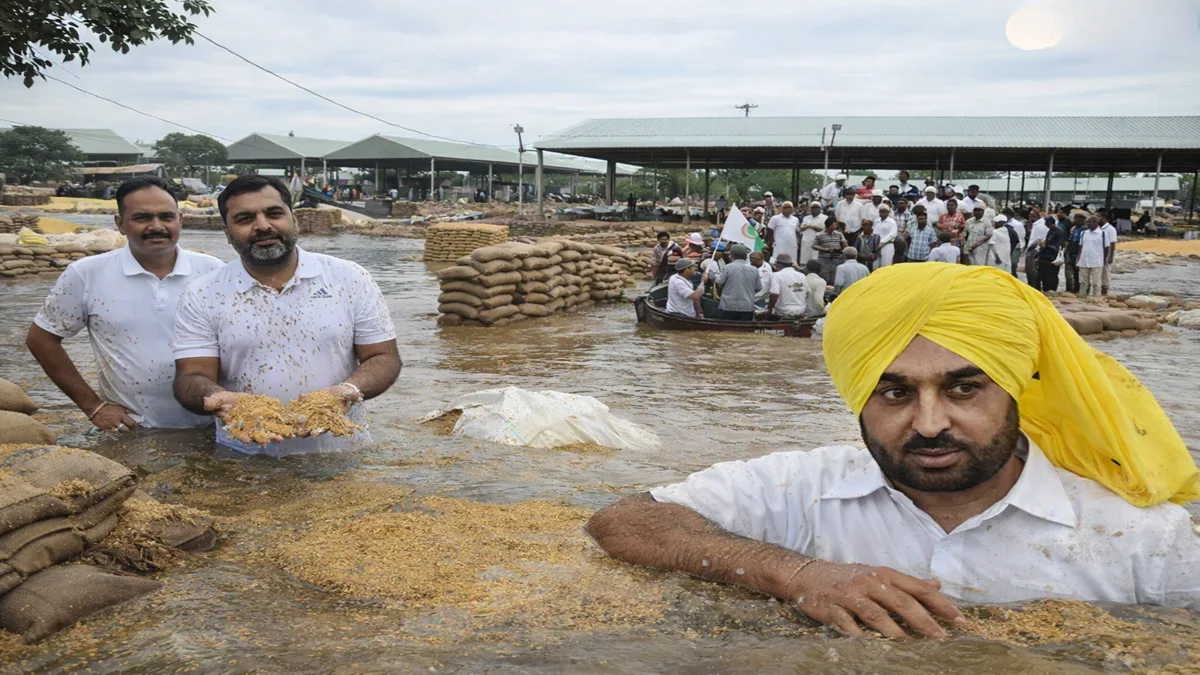
FAZILKA: In a devastating spectacle that has shocked Punjab’s farming community, the main grain market in Fazilka was turned into a shallow lake overnight by unseasonal heavy rain. Lakhs of quintals of freshly harvested paddy lay submerged under three to four feet of water.
Loose grains floated freely, sacks soaked through, and portions of the produce were washed away. Farmers and commission agents (arthiyas) estimate losses of ₹15–20 crore in Fazilka alone.
Sunil Kumar Jakhar, the President of the Bharatiya Janata Party (BJP) Punjab unit has come down heavily on the failure of the Punjab CM Bhagwant Mann in preparing mandis for paddy procurement despite full central government funding, and thereby ruining farmers’ crops and aspirations in the recent rains.
Central funds for paddy arrived, but Mann’s govt neglected mandi arrangements—rains soaked crops and drowned farmers’ dreams, Jakhar posted on his X account.
For the first time in living memory, protesters had to bring a boat into the mandi simply to move around the flooded yard.
The images of Punjab’s hard-working farmers standing knee-deep in water, holding fists full of ruined grain, have triggered widespread anger. Traders and cultivators blocked the Fazilka–Ferozepur highway, demanding immediate compensation and accountability.
“Farmers’ hard-earned harvest is floating around,” said Sanjeev “Goldy” Sachdeva, president of the Fazilka Arhtiya Association. “Neither the Punjab government made any arrangements to store the harvested paddy, nor is there any mechanism to drain rainwater standing in the mandi.” He noted that the infrastructure has seen no meaningful upgrade since the market was built in 1971.
Local farmer leaders and union activists echoed the charge. Harish Nadha of the Bharatiya Kisan Union (Dakaunda) reached the site by boat and declared that the drainage system had remained dysfunctional for years.
Commission agents complained that repeated requests for advance drainage arrangements before the procurement season had been ignored. Stocks had been left stacked in low-lying open areas without adequate tarpaulins or covered storage.
Shiromani Akali Dal (SAD) General Secretary Bikram Singh Majithia posted his angst on X (formerly Twitter), asking Punjab’s Aam Aadmi Party’s Bhagwant Singh Mann – the Chief Minister of the state – why the farmers’ plight has not stirred his conscience, especially since he keeps reiterating that he is a kisan ka beta.
SAD president Sukhbir Singh Badal demanded immediate compensation at ₹50,000 per acre and a special girdawari across the state. He reminded Chief Minister Bhagwant Mann of his own earlier promise to compensate farmers without waiting for formal reports, and blamed inadequate drainage facilities for the scale of the damage.
Punjab BJP president Kewal Singh Dhillon called the visuals from Fazilka’s Dana Mandi “deeply concerning.” He listed three critical failures: lack of functional drainage, shortage of tarpaulins, and absence of basic procurement infrastructure. Former BJP state president Sunil Jakhar pointed out that while the Centre had released procurement funds, the state government had failed to make the necessary arrangements on the ground.
Congress leader Vijay Inder Singla described the episode as “administrative criminal negligence,” noting that the local arhtiya association had warned the AAP administration repeatedly.
Singla called out the Aam Aadmi Party govt’s bluff that in Fazilka, paddy worth crores floated away in flooded grain markets; in Sangrur and Mansa, crops lay soaked in mandis even though the AAP government had declared clean and ready just nine days ago.
Singla pointed out, “This tragedy is not an act of nature,” he said. Other opposition voices questioned whether the government’s much-publicised promise to procure “every single grain” still held when produce was rotting in knee-deep water.
The immediate trigger was intense, unseasonal rainfall. But the scale of destruction exposed deeper systemic failures under the Aam Aadmi Party government.
The Punjab Mandi Board and the local Market Committee are directly responsible for maintenance, drainage, platforms, and storage facilities in regulated markets.
The state government holds ultimate accountability for ensuring these systems function during the critical procurement season.
Experts, traders, and farmer organisations have listed clear, actionable steps that were neglected:
Fazilka Deputy Commissioner Amarpreet Kaur Sandhu acknowledged that water accumulated in low-lying corners of the roughly 100-acre market and recommended action against Mandi Board authorities.
Market Committee officials described the event as a natural calamity while deploying pumps after the damage had already occurred.
Broader Context
Fazilka district has recorded paddy arrivals in the range of 1.7–2.1 lakh metric tonnes in recent seasons. At the time of the flooding, seven to eight lakh bags of sold and unsold paddy were present in the main market.
Similar complaints of delayed lifting and open-stock rain damage have surfaced in previous years, but the visual severity of the current incident, floating grain and boats inside a major mandi, has crystallised public frustration with the present administration’s preparedness.
Punjab’s farmers, already under pressure from rising input costs and climate variability, now face quality deterioration, possible rejection of high-moisture grain, and delayed payments. While national buffer stocks will prevent any immediate food-security crisis, the local economic and emotional toll is severe.
The episode is a stark reminder that governance is measured not by slogans or photo-ops, but by whether the hard-earned produce of the annadata is protected when it reaches the mandi.
Activists batting for farmer and trader justice have begun demanding that compensation must be assessed and disbursed promptly. More importantly, the structural neglect of drainage, storage, and market infrastructure must be addressed before the next heavy shower repeats the same tragedy. Punjab’s farmers deserve functional systems, not floating grain and empty assurances.
