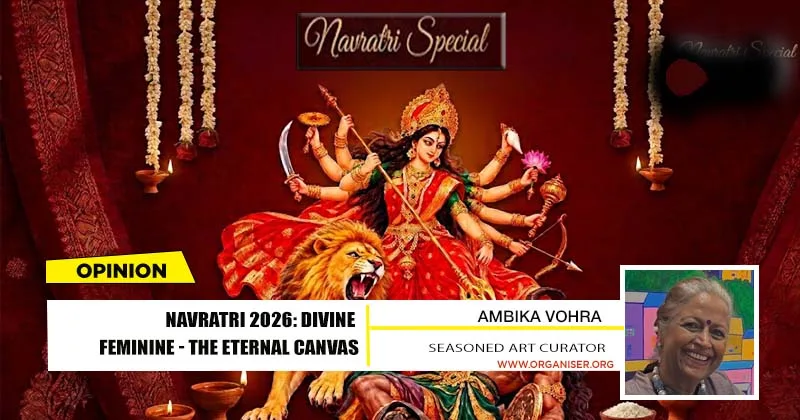
For me, the divine feminine has never been an abstract idea. She has always had a voice, a face, a presence. I grew up as a Malayali child in Punjab, and some of my earliest memories of the Goddess are sounds. Through the years, our home was filled with the extraordinary voice of MS Subbulakshmi rendering the Lalita Sahasranama. During Navratri, that intimate world of devotion expanded beyond our home, into Mata ki Chowkis, community celebrations and the collective energy of people coming together to invoke the Mother.
I may not have understood the philosophy behind every name then, but I felt its power. Lalita, Kameshvari, Rajarajeshvari, Shivakari, Shankari — each name seemed to open another door into the same infinite presence. The Goddess could be gentle and fierce, protective, and formidable, nurturing and uncompromising. She was Maa but never simply one thing.
Perhaps that is why, for me, art has always been more than an image on a wall. It is another way of encountering memory, belief and emotion. And when I look at the way Bharatiya artists have interpreted the divine feminine, I see not simply representations of goddesses, but an evolving conversation with Shakti, with feminine energy, power, creativity and consciousness.
The idea of feminine divinity is deeply embedded in the Bharatiya imagination. The Vedas give us Ushas, the dawn; Prithvi, the earth; Saraswati, associated with speech, knowledge, and wisdom; and Aditi, the boundless mother.
But within the Shakta traditions, the Goddess takes on an even more profound meaning. She is not simply the companion or consort of a male deity. She is the divine itself — the source, sustainer, and force behind creation. Shakti is energy in motion. She creates, nourishes, transforms, and destroys. She is both the force that gives life and the force that makes change possible.
I think that understanding has profoundly influenced the way I look at art. I am drawn to artists who do not merely illustrate Pauranik history but also find ways of making these eternal stories speak to their own time and, in doing so, to us.
Giving The Goddess A Face
Perhaps no artist did more to bring the Hindu Goddess into the visual vocabulary of the modern Bharatiya home than Raja Ravi Varma. His paintings and oleographs of Lakshmi, Saraswati and other deities travelled far beyond the world of fine art. They entered homes, calendars, prayer rooms, and everyday life. He brought together European academic realism and Bharatiya Pauranik history, giving the goddesses an extraordinary physical presence.
His Lakshmi, standing upon a lotus with coins flowing from her hands and elephants beside her, became almost synonymous with prosperity. His Saraswati, dressed in white and holding the Veena, became an enduring image of knowledge, music, and the arts.
For me, these images carry a particularly personal resonance. Ravi Varma’s Goddesses never felt remote. They were part of the visual landscape of home and family, almost as familiar as the sound of the Lalita Sahasranama playing in the background. That, to me, is one of the great powers of art — It can take something eternal and
make it intimate.
When The Nation Became Mother
Abanindranath Tagore’s Bharat Mata offers a very different interpretation of the divine feminine. Painted in 1905, at a time of intense national empathy, he transformed the idea of the mother into an embodiment of the nation. She is shown with four arms, carrying a book, sheaves of paddy, cloth, and a rosary — offering knowledge, food, clothing, and spiritual nourishment.
What moves me about the painting is the way Tagore draws upon an existing sanskritik memory of the Devi. The land becomes mother; the mother becomes divine; and the divine becomes something that belongs to all her children. I find myself thinking again of the names in the Lalita Sahasranama: the Goddess as giver of knowledge, nourishment, protection, and grace. The vocabulary may change, but the emotional idea of the Mother remains remarkably constant.
Bringing Devi Home
Jamini Roy’s Durga speaks to me in another way. Turning away from Western academic conventions, Roy looked towards Bengal’s folk traditions and Kalighat painting. His Goddesses are bold, graphic and immediate. Durga appears not only as the warrior who defeats Mahishasura but as a mother surrounded by Lakshmi, Saraswati, Ganesha and Kartik.
There is something wonderfully democratic about his Devi. She does not seem to belong exclusively to the mandir, the museum, or the collector. She belongs to the street, the festival, the home. She feels close enough to touch.
Having spent so much of my own life working to make art more accessible and to create spaces where people can encounter it without intimidation, I find that quality particularly beautiful. Roy reminds us that the sacred does not always have to be distant. Sometimes the divine is right there, in the world around us.
The Goddess Unbound
KG Subramanyan takes the Goddess into a much more contemporary and questioning space. His engagement with Pauranik history is playful, intelligent, and often subversive. Drawing from folk traditions, terracotta, narrative scrolls, and popular visual culture, he reimagined the Goddess through questions of gender, power and sanskritik memory.
This is where I find the idea of the sahasranama particularly fascinating. The Goddess can be Kameshvari, the embodiment of desire, and Shivakari, the one who brings auspiciousness. She can be fierce and peaceful, compassionate, and terrifying.
Why should we expect femininity to fit into one neat category? Subramanyan’s work allows the Goddess to be complex. She can be powerful without being severe, playful without being frivolous, and deeply rooted in tradition while questioning it. As a curator, that tension interests me enormously. I am always asking not simply, “What is the artist showing us?” but also, “Why have they chosen to show it this way? What does it tell us about the time in which they are living?”
When History Remembers
Nalini Malani brings another deeply moving dimension to this conversation. Through video, reverse painting on glass and installation, she has returned repeatedly to women from Pauranik history and literature — Sita, Radha, Yashodara, Putana and others — reconsidering their stories through a contemporary female lens.
What I find powerful in her work is the refusal to flatten these women into simple archetypes. Sita Mata is not merely the abandoned wife. Radha is not merely Krishna’s beloved. These women have inner lives, contradictions, desires, and moral agency.
In Malani’s hands, Pauranik history becomes memory — and memory becomes a way of asking what we have inherited, what we have forgotten and whose voices have been left unheard.
Jayasri Burman’s work takes me somewhere almost dreamlike. Her Durga, Kali and female figures inhabit fantastical worlds where humans become mermaids, animals transform into birds and the natural and celestial worlds seem to merge.
Her relationship with Mata Chandi is deeply personal, and that devotional impulse comes through in the extraordinary energy of her paintings. Looking at her work, I often think of it as a visual sahasranama, not of a thousand names, but of a thousand possibilities. The Goddess is constantly transforming. And perhaps that is what makes her timeless.
Becoming Devi
Pushpamala N takes the conversation further still by using photography and performance to inhabit and interrogate representations of the Bharatiya woman and the goddess. By placing herself within these constructed images, she asks a deceptively simple question: Who gets to be the Goddess?
My Shakti
Perhaps what I love most about the divine feminine is that she refuses to be reduced to a single idea of womanhood. She can be Lakshmi and Kali, Saraswati and Durga, consort and mother, creator and destroyer, gentle and fierce, and that multiplicity feels deeply relevant to women today.
From chant to canvas, from mother to muse, from ancient deity to contemporary woman, the divine feminine continues to evolve because she has never truly belonged to the past. She belongs to us, and to every generation that finds its own way of seeing her
As a woman, a mother, a curator and someone who has spent much of my life around artists, I have come to believe that strength does not always announce itself loudly. Sometimes it is in nurturing. Sometimes it is in creating. Sometimes it is in beginning again. Sometimes it is in having the courage to destroy what no longer serves us.
Perhaps that is what Shakti has always meant to me. Not power over, but the power to create, to transform, to endure. Every Navratri, when the chants begin again, I find myself returning to that childhood sound of MS Subbulakshmi’s voice. The words are familiar, but somehow, they never feel the same. As life changes, we hear them differently.
Perhaps that is the beauty of the Goddess. She does not remain fixed in an image. She lives in sound, in memory, in ritual, in art and in the lives of the women who continue to reinterpret what it means to be powerful, compassionate, creative and free.
From chant to canvas, from mother to muse, from ancient deity to contemporary woman, the divine feminine continues to evolve because she has never truly belonged to the past. She belongs to us, and to every generation that finds its own way of seeing her.


