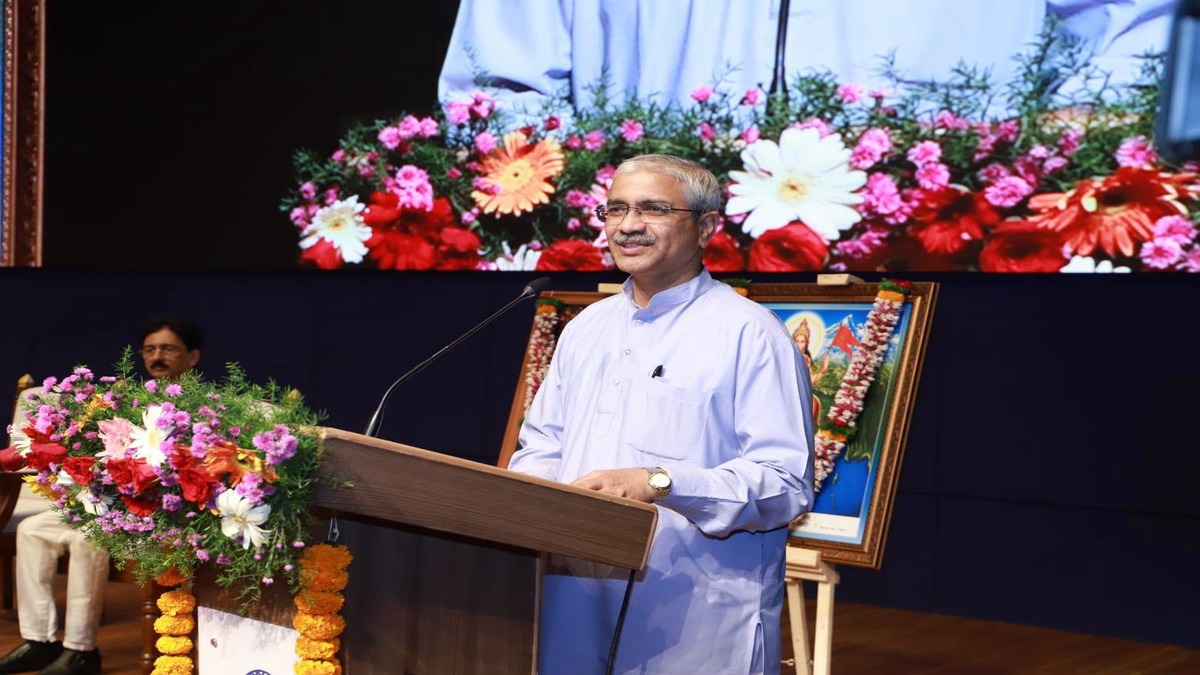
RSS Sah-Sarkaryavah Atul Limaye Ji addressing the gathering
PUNE: Rashtriya Swayamsevak Sangh (RSS) Sah-Sarkaryavah Atul Limaye Ji emphasised the importance of incorporating the Bharatiya perspective into higher education at ‘Navonmesh – Study Board Members’ Dialogue’, organised by the Bharatiya Shikshan Mandal (Western Maharashtra Province and Pune Metropolitan Unit).
The programme was held at Bhausaheb Chitale Auditorium on the campus of S.P. College in Pune, with over 500 convenors and members of Boards of Studies from various universities and autonomous colleges in Pune and neighbouring areas participating. The programme commenced with floral tributes, worship and the ceremonial lighting of the lamp before the portraits of Bharat Mata and Maa Saraswati.
Addressing the gathering, Limaye Ji said education plays a crucial role in realising the vision of a ‘Viksit Bharat’. He emphasised that education must sow the seeds of patriotism, character-building and sensitivity among students. For this, incorporating the Bharatiya knowledge tradition and Indian perspective into the curriculum is essential.
He said that those seeking to bring about change in the education sector must take the initiative themselves rather than wait for others to act.
Limaye Ji observed that academic campuses had, in the past, given undue priority to leftist ideology instead of teaching students about great national icons and exemplary personalities such as Swami Vivekananda and Chhatrapati Shivaji Maharaj.
Emphasising the need for impartiality and neutrality in education, he said that while revising curricula, academic institutions must first introspect on what needs to be removed before deciding what should be included. He stressed that the Indian perspective and knowledge systems must be incorporated not only into history but also into subjects such as environmental studies, science, political science and jurisprudence.
Limaye Ji called for the following measures to strengthen the Bharatiya perspective in education:
1. Subject-specific study groups: Independent study groups should be established for every subject, bringing together Board of Studies members and subject experts from the respective fields.
2. Technical education in Indian languages: Special emphasis should be placed on imparting technical education through Indian languages.
3. Practical projects for students: Students should be assigned practical projects addressing real-world social problems to develop social sensitivity and a deeper understanding of societal challenges.
4. Information bank of educational innovations: A comprehensive data and information bank should be created by documenting outstanding experiments and innovations taking place in the education sector.
Setting the context for the programme, Ravikumar Chitnis said Pune has historically been a major centre of education. He added that the dialogue seeks to provide comprehensive guidance to young people and inspire them to contribute to building a ‘Samarth Bharat’.
Bharatiya Shikshan Mandal’s B R Shankaranand Ji said the fundamental objective of education is to foster an interest in learning, refine students’ personalities and build character.
He clarified that the Bharatiya perspective is not a narrow or one-sided ideology but a comprehensive and holistic worldview.
