Pakistan Terror Deaths Surge 83 per cent in Q3 2026
JAMMU: Despite the repressive and draconian measures Pakistani forces have been taking in Balochistan and Khyber Pakhtunkhwa provinces, levels of violence have escalated sharply during the past few months. Enforced disappearances, extrajudicial killings and long terms of imprisonment to political activists have failed to deter them in pursuit of a dignified life in both provinces.
Interestingly, while Balochistan tops the province with the most violent record, the Federal government headed by Prime Minister Shehbaz Sharif has chosen to dismiss the Khyber Pakhtunkhwa government. The difference in the governments of two provinces is that the KP government was headed by Pakistan Tehreek Insaf (PTI) of jailed former Prime Minister Imran Khan and that of Balochistan by the Pakistan Peoples Party (PPP).
Incidentally, PPP is supporting Sharif’s government from outside and is an ally of the ruling Pakistan Muslim League-N. That is why the Balochistan CM Sarfaraz Bugti cannot be touched by Mr Sharif’s government lest it lose support of the PPP.
A steep surge of 83 per cent has been recorded in casualties linked to terrorism and counter-terrorism operations in Pakistan, according to a report released by the Center for Research and Security Studies (CRSS). The report reveals that the declining trend in violence and fatalities observed in the first and second quarters of the year completely ended in the third quarter. In fact, the country’s security situation has experienced its most alarming intensity since 2021, a report of the voicepak.net says.
The primary driver behind this nationwide increase is the province of Balochistan, where the number of fatalities more than tripled in in this quarter. Balochistan, which is Pakistan’s largest province by way of geographical area with a small population, contributed nearly 88 per cent to the overall national increase. Presently, several armed groups of nationalist Baloch fighters are waging a war of independence against Pakistan. These groups have also inflicted heavy costs on the country by enforcing an economic blockade in several cities and towns.
The violence in the province has surpassed Khyber Pakhtunkhwa province to become the country’s most affected region in terms of both total recorded violent incidents and fatalities.
Incidentally, despite the province recording extraordinary levels of violence, the Federal government headed by Prime Minister Shehbaz Sharif has never, till date, talked of imposing emergency or Governor’s rule in Balochistan. This is because the government there is headed by Chief Minister Sarfaraz Bugti of Pakistan Peoples Party (PPP). In contrast, the Federal government as also Governor of Khyber Pakhtunkhwa have repeatedly threatened to take drastic measures in the province, including dismissal of Chief Minister Sohail Afridi.
The report’s statistics show that nearly three-fourths of the nationwide increase in fatalities during the third quarter comprised anti-state elements and terrorists, whose casualties more than doubled in security operations. On the other hand, however, overall fatalities among civilians and security personnel also saw a significant increase. This comes to around 54 per cent, indicating that the impact of security challenges was felt equally and devastatingly across all sides.
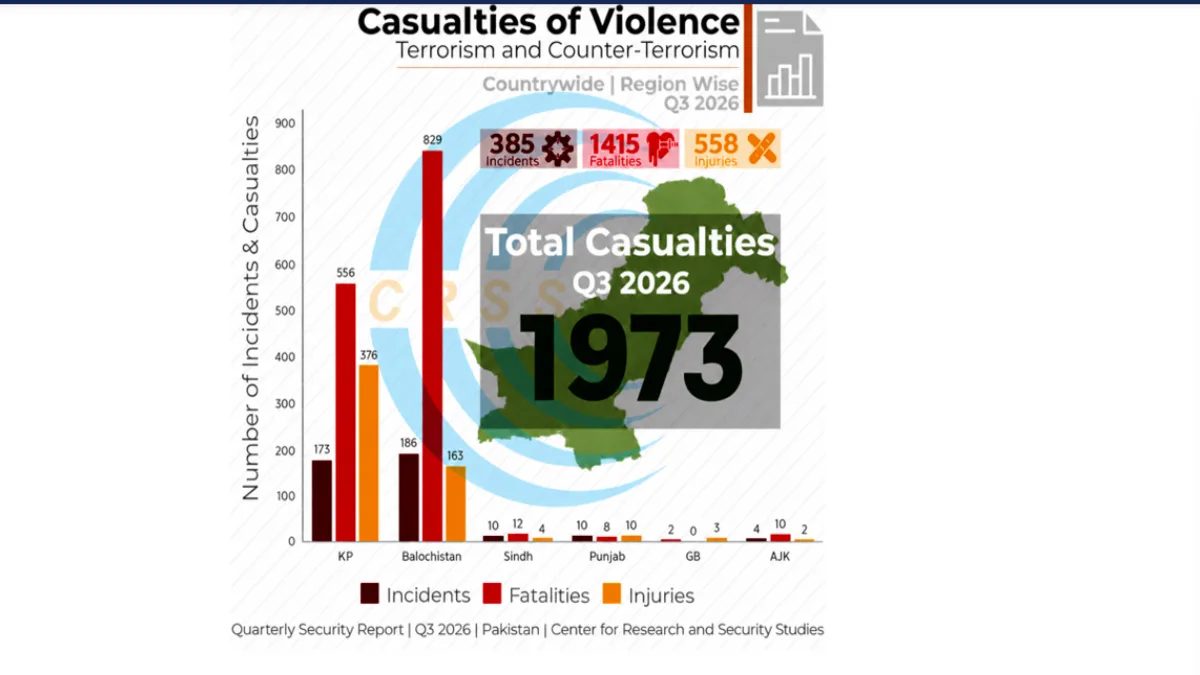
Taking a comprehensive look at the overall figures, during the third quarter of 2026, CRSS recorded a total of at least 385 violent incidents involving terrorist attacks and counter-terrorism operations, resulting in 1,415 fatalities and 558 injuries. In terms of regional impact and geographical distribution, south western Balochistan and north western Khyber Pakhtunkhwa remained the primary epicenters of violence.
Together, these two provinces accounted for 98 per cent of all violence-related fatalities, with Balochistan recording nearly 59 per cent of total deaths (829 individuals), while Khyber Pakhtunkhwa recorded over 39 per cent (556 fatalities).
Balochistan also recorded the highest number of violent incidents during the third quarter at 186 incidents (over 48 per cent of the total), followed by Khyber Pakhtunkhwa with 173 incidents (nearly 45 per cent). However, in terms of injuries, KP topped the list with 376 injured individuals (over 67 per cent of total injuries), whereas 163 individuals (over 29 per cent) were injured in Balochistan.
Compared to the previous quarter, there was a dramatic 83 per cent increase in terrorism and response operations nationwide, with fatalities rising from 774 in Q2 to 1,415 in Q3. The core reason for this was an extraordinary jump of 213 per cent in Balochistan, where deaths increased from 265 to 829.
In Balochistan, fatalities had previously decreased by 40 per cent in the second quarter compared to the first quarter (from 443 down to 265). Similarly, Khyber Pakhtunkhwa also witnessed an increase of over 17 per cent during Q3, with fatalities rising from 475 to 556.
In other regions, fatalities in Pakistan Occupied Jammu Kashmir (POJK) rose from 5 to 10, reflecting a 100 per cent increase, while fatalities in Punjab decreased from 12 to 8 (a 33 per cent decline), in Sindh from 14 to 12 (a 14 per cent decline), and in Gilgit-Baltistan from three down to zero, representing a 100 per cent reduction.
An analysis of victim categorization reveals that the largest portion of reported fatalities — over 65 per cent (921 deaths)— consisted of militants and outlawed elements. They were killed as a result of around 154 operations by security forces, while their share in injuries was only 5 per cent (27 injured).
Civilians ranked second with 254 fatalities (18 per cent) and security personnel third with 240 fatalities (17 per cent), falling victim to 145 (38 per cent) and 86 (22 per cent) terrorist attacks, respectively. During this period, 284 civilians (51 per cent) and 247 security personnel (44 per cent) were injured.
Six key security trends emerge from these statistics. The first and most significant aspect is the 103 per cent increase in militant fatalities, rising from 453 in Quarter 2 to 921 in Quarter 3; out of the total additional 641 casualties nationwide, 468 were terrorists, accounting for three-fourths of the entire increase.
The second trend shows that civilian and security force fatalities also increased by 36 per cent (187 to 254) and 79 per cent (134 to 240), respectively, pushing their combined loss of life up by 54 per cent from 321 to 494. The third trend indicates that 95 per cent of the injury burden (531 individuals) was borne by civilians and security forces, with civilians making up more than half.
Fourth, compared to only five per cent of terrorists being injured, their heavy death toll highlights the extraordinarily decisive and intense nature of the security operations. Fifth, there was a massive 111 per cent increase (117 to 247) in injuries among security forces, whereas civilian injuries rose by 39 per cent (205 to 284), meaning the rate of injuries among security forces grew much faster.
Sixth and finally, security personnel fatalities (240) drew extremely close to civilian fatalities (254), leaving a gap of only 14 deaths between them, whereas in Q2 this difference stood at 53 fatalities.
Among the banned and terrorist organisations claiming responsibility for attacks, Tehreek-e-Taliban Pakistan (TTP) emerged as the most lethal and formidable group in Quarter 3 of 2026. These attacks resulted in 117 deaths and 65 injuries. The Baloch Liberation Army (BLA) claimed responsibility for five attacks that killed 34 people and injured 42.
Meanwhile, the Hafiz Gul Bahadur group claimed three attacks resulting in 27 deaths and 129 severe injuries, marking the highest number of injuries caused by any single group’s attacks.
Historically, attacks claimed by TTP since 2021 have caused higher fatalities compared to BLA (706 versus 650). However, in the overall record for 2026 so far, BLA has held the upper hand over TTP, with its attacks resulting in 173 deaths compared to 165 fatalities linked to TTP.
A more nuanced examination of these activities by tactic reveals a stark contrast between methods that caused higher fatalities and those that resulted in higher injuries. Nine Vehicle-Borne Improvised Explosive Device (VBIED) suicide attacks affected 285 people in total, with 81 deaths and 204 injuries, representing the largest total casualties of any tactic, far exceeding the 35 casualties caused by three other suicide bombings.
In contrast, armed attacks caused the highest number of fatalities, with 61 distinct incidents resulting in 147 deaths and 116 injuries. Direct firing and shooting incidents proved exceptionally lethal, with 58 events reporting 72 deaths and only 18 injuries, meaning four people were killed for every one injured. Additionally, 30 cases involving mutilated or recovered bodies resulted in 77 deaths, while a single incident of target killing following abduction claimed 31 lives with no injuries reported.
A new and dimension has emerged in the form of drone attacks, where the proportion of injuries far outweighed fatalities; 16 drone attacks resulted in 13 deaths and 48 injuries, meaning nearly four people were injured for every single fatality. Vehicle suicide blasts and drone attacks technically demonstrated how modern violent tactics are disproportionately causing more injuries and disabilities.
