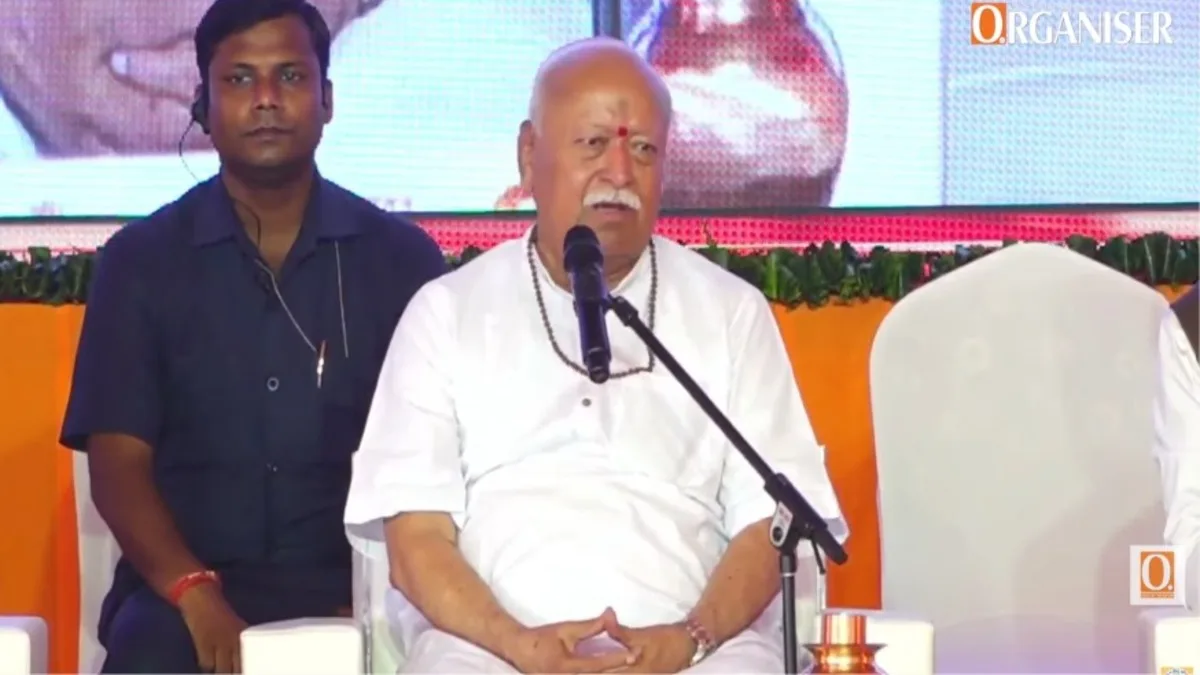
RSS Sarsnghchalak Dr Mohan Bhagwat
NAGPUR: “The true remembrance of great personalities lies in making their life, conduct and contributions a living reality through one’s own actions,” said RSS Sarsanghchalak Dr Mohan Bhagwat, while addressing the gathering at the birth centenary celebration of Ashok Ji Singhal in Nagpur on October 7, 2026.
Dr Bhagwat emphasised the need for society to act together. Referring to the words of the Sangathan Sukta — “Sangachchhadhwam, Samvadadhwam, Sam Vo Manamsi Janatam” — he said that people should move together, speak together and understand one another’s minds. He said the Devas followed this path and attained their share.
“We all have to do this,” Dr Bhagwat said, adding that collective effort is necessary for the protection of one’s own life and family, the protection of Dharma and culture, and also for the welfare of the world.
Dr Bhagwat said that merely remembering personalities is not enough. Their memory remains alive when people strive to embody their life, conduct and contributions.
He said that the path becoming increasingly essential was for the people of Bharat to shape their lives according to the traditions of Bharat and make efforts accordingly. “Everyone should make an effort,” he said.
Dr Bhagwat said that what people had heard at the programme was not merely meant to be applauded. Everyone should do something in their own capacity.
He said there were two ways of looking at remembrance. One could say that Moropant Ji and Ashok Ji should be remembered, but the question was how. “Remember them through your efforts,” he said.
He cautioned against the attitude that others should do what needs to be done. He said society is fond of celebrations and participated in such events with enthusiasm, but often thought that someone else should undertake the actual work.
Dr Bhagwat said that people may wish for the establishment of Dharma and the destruction of Adharma, but then expect God to incarnate and accomplish it while asking what they themselves could do. He said people often considered their jobs and families as reasons for not taking responsibility.
However, whenever the things desired by society had been achieved, he said, they had been the result of the efforts of the entire society.
He said individuals demonstrate penance and sacrifice in their lives so that everyone understands that the difficult path has to be taken, but that it can indeed be followed.
Dr Bhagwat recalled that when Ashok Ji and Moropant Ji embarked on the path of dedicating everything they had for the nation, they were not as well known as they later became. They had not yet accomplished the major works for which they became known.
Dr Bhagwat while referring to the speech of Alok ji, VHP International Working President, said that much had already been said during the programme, particularly in the speech of Alok Ji, and there was little left to add. He said the thoughts shared should be reflected upon, especially the point that the work being undertaken today carries the inspiration of Moropant Ji and Ashok Ji.
“They started from there,” he said, adding that when they began, their position in terms of qualities and accomplishments was similar to that of ordinary people. What they possessed additionally was a firm resolve that their lives would not be lived merely for themselves.
Their resolve was that their lives were for the nation and that whatever strength they possessed would be devoted to the upliftment of the nation.
Dr Bhagwat said they continued throughout their lives with that resolve. When Ashok Ji felt that he would not be able to work effectively while maintaining a household, he gave up household life. He said such a decision was not easy, but when one firmly resolves to pursue something, everything else becomes secondary.
Recalling a statement by Ashok Ji, Dr Bhagwat said that if he were to attain Moksha, he would be willing to give up even that for the construction of the Ram Mandir.
He also recalled the words attributed to Raja Rantidev: “Na tvaham kamaye rajyam, na svargam, na punarbhavam” – expressing the desire neither for a kingdom, nor heaven, nor liberation, but only to alleviate the suffering of people afflicted by various difficulties and deprivation.
Dr Bhagwat said that when a person holds on to such a goal and gives everything for it, everything eventually comes to him. Through such dedication, he said, Ashok Ji and Moropant Ji acquired immense accomplishment, extraordinary policy, unparalleled courage and deep sensitivity towards the suffering of others.
“Where did all these qualities come from?” he asked, and said that they had immersed their sense of “I”. They did not worry about what would happen to them or desire that something should happen for themselves.
He said that Ashok Ji and Moropant Ji did not know that one day thousands of people would gather to remember them. When they had stepped into the unknown, they did not know that the work would eventually attain such stature that everyone associated with it would themselves gain recognition.
“They had stepped into the darkness,” Dr Bhagwat said, adding that they did not worry about what would happen or what they would receive. Instead, they applied all the strength they possessed in their lives towards the welfare of the nation and society.
He urged people to make a resolve, devote their time and make efforts so that something good could be accomplished through their own hands. If one had earned something, one should try to share something through one’s own hands.
He said that if people spent time on many things, they should also devote some of that time to their people, their land, forests, animals and agriculture.
“If we begin our journey with such a resolve,” Dr Bhagwat said, people will be able to say that the people of Bharat preserved the memory of such accomplished great personalities through their own actions.
Dr Bhagwat said the project itself was an example of this. Seeing the work being undertaken there naturally reminded people of Moropant Ji, Ashok Ji and Shyam Balla. He said this was because the work being undertaken there reflected what they used to do and what they wanted to see being done.
Concluding his address, Dr Bhagwat said that the programme had been organised to mark Ashok Ji’s birth centenary and to remember him, while also reviewing the work being undertaken on the occasion.
He urged those present to bring what they had seen and heard into their own lives and resolve from that very day to remain continuously engaged in such efforts and take them forward. He said that this would be the true remembrance and real tribute to the late Ashok Ji and late Moropant Ji.
Addressing the gathering, Vishwa Hindu Parishad (VHP) International Working President Alok Kumar said that remembering great personalities is not merely a matter of words but must be expressed through action, effort and resolve.
He described the occasion as both a festival and a day of gratitude. Recalling Moropant Pingle Ji, he said his name must be remembered in connection with the conception, establishment, development and future of the entire project. Describing him as a silent ascetic, Alok Kumar said Moropant Ji did not expect that people would remember him, organise fairs in his memory or celebrate his birth anniversary.
He said Moropant Ji, as an RSS Pracharak, had sown himself into the soil like manure, water and a seed and helped create what exists today.
Recalling Ashok Ji Singhal, Alok Kumar said that had he been alive, he would have turned 100 on September 27, and that the entire country is observing his birth centenary.
Recalling an incident from 1990, Alok Kumar said a journalist once asked him which aspect of Ashok Ji, whom he had seen in many forms, remained most deeply etched in his heart. He recalled the events of October-November 1990, when the Vishva Hindu Parishad had called for Kar Seva. He said the then Chief Minister had declared that not even a bird would be allowed to enter Ayodhya. Trains were stopped in Lucknow, roads were dug up and filled with water, while dharamshalas and hotels were closed in an attempt to prevent people from reaching Ayodhya.
Alok Kumar recalled that the roads were deserted and there was silence. Around 10:30 pm, Ashok Ji arrived at a crossing on a motorcycle with his head covered. Around 150 people gathered and raised the call of “Jai Shri Ram” before moving towards the disputed structure.
He recalled that a brick came from somewhere and struck Ashok Ji on the head. Blood began flowing from his head, onto his kurta and then onto his dhoti. Yet, Ashok Ji appeared as though he was in a state of samadhi. He neither appeared conscious of the injury nor of the pain.
Alok Kumar said that thereafter, Kar Sevaks came out onto the streets and women of Ayodhya also came out. “Jai Shri Ram” began to reverberate everywhere. When people were stopped at a bridge and firing took place, five people were killed, including the Kothari brothers.
Despite the killings, he said, nobody returned. “When the blood of a great personality flows, such a result follows,” Alok Kumar said. He said Ashok Ji gave Hindu society courage and a sense of valour. He said Ashok Ji had a great deal of sattva guna and gave Hindu society rajoguna, the strength to fight and the resolve to fulfil its commitment.
Recalling the decision taken in Ayodhya in 1989 to conduct the Shilanyas of the Ram Mandir, Alok Kumar said a question arose as to who would perform the ceremony.
He said Ashok Ji pointed out that a large section of society had been kept suppressed and backward for generations. Such people were made to live outside villages, were not allowed to wear new clothes or footwear, and were not allowed to ride horses during weddings. He said they were treated as impure if they came near others, and people would purify themselves with cow dung if touched by them.
Alok Kumar said Ashok Ji believed that the community which had been unnecessarily subjected to suffering and oppression should be given the opportunity to perform the Shilanyas. Thus, Kameshwar Chaupal, a full-time worker of the Vishva Hindu Parishad from the Scheduled community, was chosen to lay the first foundation stone of the Ram Mandir in the presence of saints, political leaders and a large gathering. “This social harmony was given to us by him,” Alok Kumar said.
He also recalled the first International Hindu Conference organised at the call of the Vishva Hindu Parishad. He said there was a view at the time that women did not have the right to study the Vedas. Some even cited a verse claiming that molten lead should be poured into the ears of women if the sound of the Vedas reached them.
Alok Kumar said,” VHP workers, with confidence and courage, and the then Sarsanghchalak Pujaniya Shri Guru Ji, decided that a woman saint who had studied the Vedas and had a pure voice and good pronunciation should inaugurate the international conference through Vedic mantras. The proposal was accepted and the programme began with Vedic chanting by the woman saint.”
He said this was another example of bringing all sections of society together and giving them equal and greater participation.
Alok Kumar further recalled the decision regarding who would take the resolve for the construction of the Ram Mandir. He said Ashok Ji and others collectively decided that Hindu society followed the guidance of saints and that people followed the path shown by saints with shraddha. A large Dharma Sansad of saints was therefore organised at Vigyan Bhawan. The saints announced that the three places would be reclaimed. Following the announcement, people participated in the movement and went to jail.
Recalling another incident involving a saint from Maharashtra, Alok Kumar said that when the saint decided to participate in Kar Seva and offer arrest, his advisory group told him that going to jail would violate the dignity of his position and that he could not do so while holding that post. The saint responded with affection and humility that if remaining in his position while participating in Satyagraha and Kar Seva amounted to a violation, he would respectfully give up the position. He went ahead, and society continued to place him where he had been.
He also recalled a large Kanwar Yatra that travels from Haridwar through Delhi and onwards. He said that in those days, the 12-lane road was filled entirely by Kanwariyas and no vehicles could move on it.
He said secularism did not mean that people should think by separating themselves from their Dharma. There is a relationship between the nation and Dharma, he said, adding that Dharma should have a place in the works undertaken for the nation.
Alok Kumar said remembering Ashok Ji was part of the tradition of a grateful nation, but the remembrance was not being done merely through words. “We are doing it through our efforts,” he said.
Alok Kumar expressed his admiration for the people involved in the work and said that whatever was happening at the place would eventually transform it into Vrindavan. “And if it becomes Vrindavan, Kanhaiya too will move around somewhere here,” he said.
He called for keeping Bhagwan Krishna in their hearts, serving Gau Mata, making the nation happy and prosperous, and ensuring that everyone follows Dharma.
