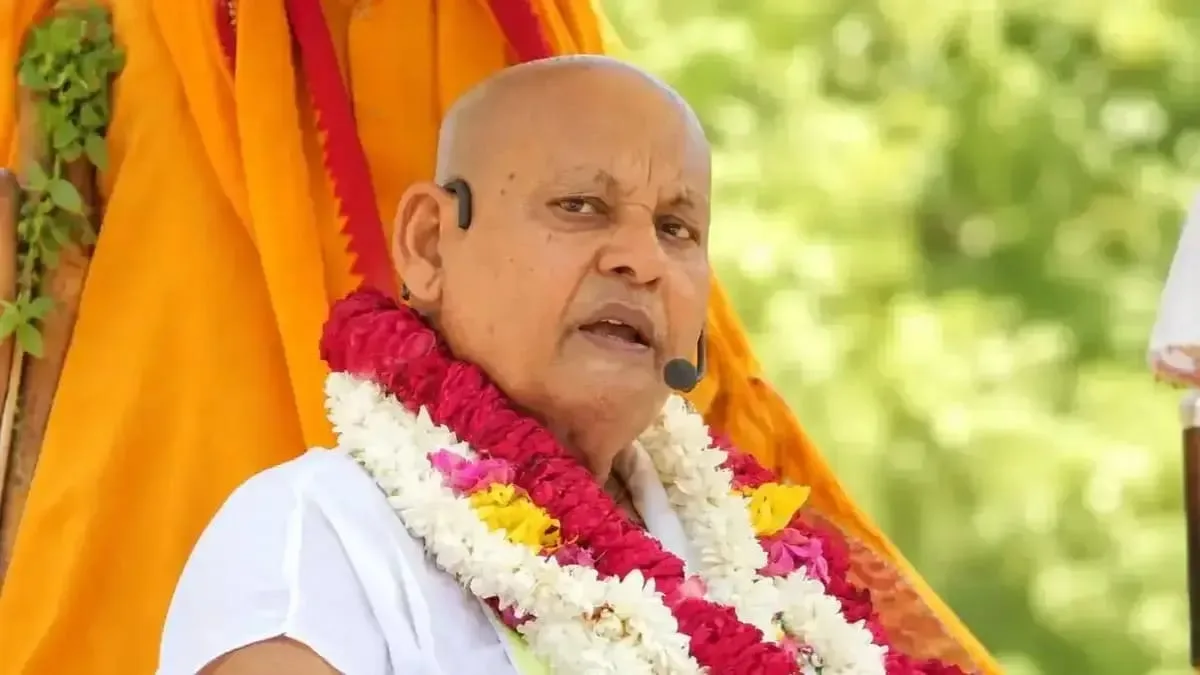
Padma Shri awardee and Braj Sant Ramesh Baba passed away in Barsana, leaving behind a legacy of Gau Seva and Braj conservation
MATHURA: Padma Shri awardee and revered Braj Sant Ramesh Baba passed away at his ashram in Barsana on October 6, leaving behind a legacy of devotion to Radharani, Gau Seva, environmental conservation and the preservation of Braj’s ancient religious heritage. He was known for spending more than seven decades in Braj and making the service of the holy land the central purpose of his life.
Ramesh Baba breathed his last at the Maan Mandir in Barsana. His demise has left devotees, pandits and residents of Braj deeply saddened. Mathura District Magistrate Chandra Prakash Singh and SSP Shlok Kumar visited Barsana and paid their respects to the revered pandit.
Born in Prayagraj in 1938, Ramesh Baba developed a deep spiritual inclination from an early age. He came to Braj as a teenager and eventually made Barsana his permanent home. His life thereafter remained closely connected with Radharani’s devotion and the service of Braj. He made the Brahmachal hill in Barsana his spiritual centre and developed Maan Mandir as an important place of devotion. Over the decades, the ashram became associated with religious service, Harinam Sankirtan, Gau Seva and the preservation of Braj’s cultural and natural heritage.
One of the defining aspects of Ramesh Baba’s life was his unwavering commitment to Braj. He had taken a vow not to leave the Braj region and remained committed to it until his final days. His devotion to Braj was so strong that when he was selected for the Padma Shri in 2019, he did not travel to Delhi to receive the honour. Instead, the award and related ceremonial items were brought to Barsana for him. His decision reflected his lifelong resolve to remain in the land he regarded as his spiritual home.
Ramesh Baba’s contribution to Gau Seva became one of the most recognised aspects of his work. In 2007, Mataji Gaushala was started with just two cows. Over the years, it grew into a major centre dedicated to the protection and care of cows.
Reports state that the gaushala today shelters tens of thousands of cows, with estimates of around 65,000 animals. His work through the gaushala became an important part of his wider mission of serving Braj and protecting its traditional cultural values.
Ramesh Baba was not known only for spiritual activities. He also played a prominent role in efforts to protect the natural heritage of Braj. He raised his voice against mining in the hills associated with Braj and areas extending towards Rajasthan. His campaigns sought to protect the hills, forests and religious landscapes that form an integral part of Braj’s traditional identity.
He was also associated with efforts to protect Gahvar Van and other environmentally significant areas. His activism for the preservation of Braj’s natural heritage eventually earned him recognition well beyond the region.
Another significant part of Ramesh Baba’s legacy was the restoration and preservation of ancient kunds and religious sites associated with Braj. Several traditional water bodies, including Ratna Kund, Vihwal Kund, Krishna Kund, Bichhua Kund, Gaya Kund, Lal Kund, Gopal Kund and Rudra Kund, were restored through efforts associated with Maan Mandir and his wider campaign for preserving Braj’s heritage. These efforts were aimed not only at conserving water bodies but also at protecting places deeply connected with the religious and cultural traditions of Braj.
Ramesh Baba also played an important role in promoting the Radharani Braj Yatra, associated with the traditional 84-Kos Braj Parikrama. The initiative enabled devotees to undertake the pilgrimage while also connecting them with the villages, religious sites and cultural traditions of Braj.
Harinam Sankirtan remained another important aspect of his mission. Through religious programmes and pilgrimages, he helped carry the spiritual traditions of Braj to thousands of devotees.
The pandit was also associated with efforts to protect and restore the Yamuna. Campaigns were undertaken to highlight pollution and seek restoration of the river’s traditional flow and importance in Braj. His environmental work therefore extended beyond individual forests, hills and kunds, forming part of a broader effort to protect the ecological and religious character of the Braj region.
Recognising his decades-long contribution to spiritual and social service, Gau Seva and environmental conservation, the Government of India conferred the Padma Shri on Ramesh Baba in 2019.
The honour recognised a life that had remained closely tied to the preservation of Braj’s spiritual, cultural and ecological heritage. Rather than moving away from his chosen path after receiving national recognition, he continued his work from Barsana.
Sant Ramesh Baba’s life represented an unusual combination of spiritual devotion and social and environmental service. From Gau Seva and the restoration of ancient kunds to the protection of Braj’s hills, forests and Yamuna, his work extended across several dimensions of the region’s heritage.
For decades, devotees travelled to Barsana to seek his darshan and blessings. His passing marks the end of a long chapter in the modern history of Braj’s spiritual and conservation movements. Ramesh Baba’s legacy, however, is likely to continue through Maan Mandir, Mataji Gaushala, the Braj Yatra and the various initiatives associated with the preservation of Braj’s religious and natural heritage.
