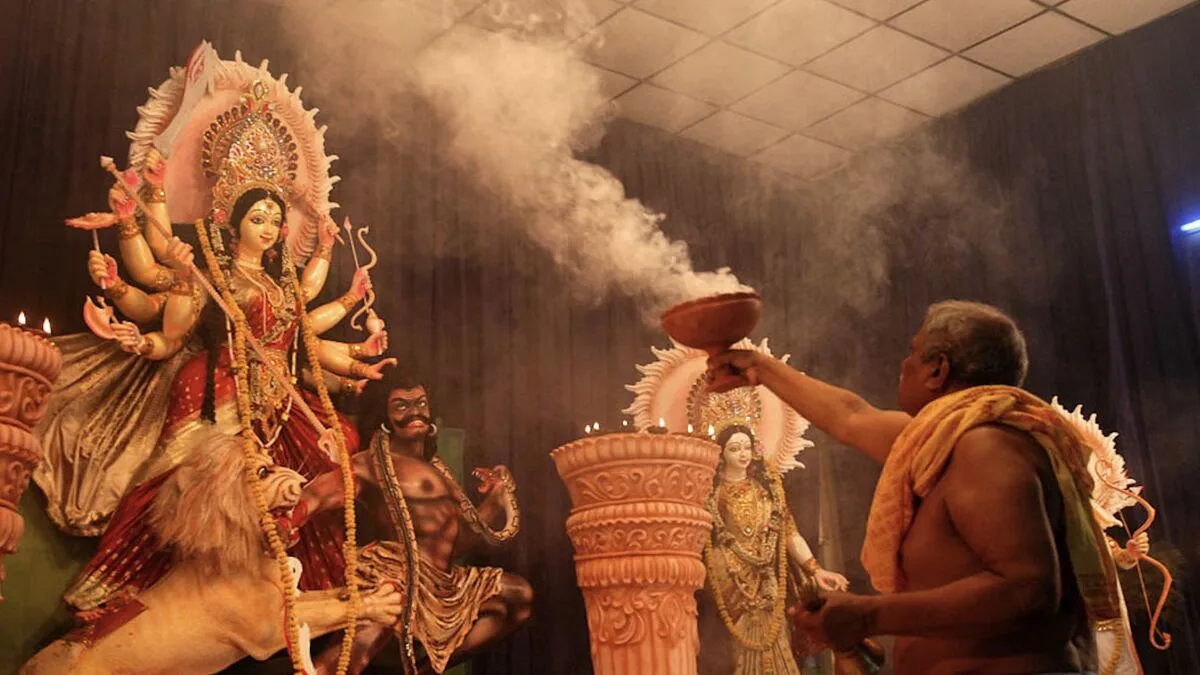
Representative Image
Durga Puja or Durgotsav from October 16 to 21, 2026 at Ugratara temple in Ujanbazar locality of Guwahati readies for welcoming thousands of devotees. But unlike other annual Durgotsav events, Ugratara Devalay does not adore clay-idols of Devi Durga along with Lakshmi, Saraswati, Ganesha and Kartik.
Sharadiya festival at the temple is dedicated to Goddess Ugratara, which attracts hundreds of thousands of pilgrims and other enthusiasts, where they offer red cloth & flowers, sindoor, sweets etc. to Maa Ugratara. The practice of animal sacrifice is also observed during Durga Puja at the centuries-old Ugratara Devalay.
The tiny sacred campus, on the western part of Jor-pukhuri, comprises a Shiva temple as well. No idol of Maa Ugratara is worshipped in the Devalay, but a pit filled with water inside the sanctum resonates the presence of Devi. Erected in Saka 1647 (1044 CE) during the reign of the Ahom king Siva Singha, the temple has the history of observing Sharadiya Durga Puja continuously for nearly 982 years, probably the oldest continuing worship of Maa Tara across the region.
The current temple witnessed a series of renovation & modifications after the earthquake damaged its upper section. Ancient Kamrup (present day Assam along with a huge part of adjacent areas including northern Bangladesh) is known for the practice of Devi Puja. Ugratara Devalay, a Shakti Peeth after Kamakhya temple atop Nilachal Hill in the city, observes Durga Puja annually with rituals including the sacrifice of buffaloes, goats, ducks, pigeons, etc.
The Shakti shrine, where the legend claims a navel-like entity of Sati fell at the place, traditionally observes Durgotsav during Sharadiya Navaratri festival in the month of Aahin/Ashvina, where Devi’s nine incarnations are worshipped. As the legend goes, Sati was one of the incarnations of Goddess Shakti, who sacrificed her life protesting the behaviour of her father. Dakshya Raja organized a massive Yagna, where his daughter Sati and son-in-law Mahadev were not invited.
But Sati could not control her temptation and finally arrived at Yagna Bhumi that angered Dakshya Nripati. He made abusive remarks about Mahadev which pained Sati and she sacrificed her life at the site of Yagna. Hearing the death of Sati, Mahadev got angry and appeared at Yagna, where he pronounced punishment to Dakshya.
Soon a furious Shiva started Tandav Nritya (the dance of demolition) with the body of his beloved wife Sati on his shoulder. It continued for several days and the universe was on the brink of collapse. Apprehending the destruction, all the gods and goddesses appealed to Vishnu to cool down Maheswar.
The caretaker of the universe chopped-off Sati’s body with his Sudarshan Chakra to finally bring back Shiva to sanity. Pieces of her lifeless body fell in different parts of Bharatbarsha and each location later emerged as a holy Shakti Peeth.
According to the Hindu mythology, 51 Shakti Peeths in the Indian subcontinent are considered as primary sacred sites of Sati, while the list of 108 shrines include the additional sites. Worshipping Ugra Tara, considered to be another form of Parvati, the devotees celebrate the victory over the demon king Mahisasur.
The buffalo demon (Mahisasur) began a massive battle against all Devata and finally dominated them with a boon that ensured his victory against any male opponent. Worried Devata- Gan approached Hindu trinity Brahma, Vishnu and Maheswar to overpower Mahisasur.
They created a warrior goddess named Durga with combined energies and finally the divine feminine power, riding roaring a lion and wielding multiple weapons offered by the gods, vanquished the demon king. The first day of Durga Puja is known as Mahalaya, the day Devi arrives on maternal home (Earth).
The celebrations begin on Sasthi and the next three days are set for worshipping. Vijayadashami is observed on the tenth day with immersion of idols symbolizing Devi’s departure to Kailash Parbat. The worship of Durga’s clay image in community celebrations is associated with the Akalbodhan, where Devi was invoked by Ayodhya prince Rama to defeat Ravan in the battle of Lanka.
Traditionally, Durga Maa is worshipped with Lakshmi (goddess of wealth), Saraswati (goddess of learning), Ganesh (elephant-headed god) and Kartik (god of war).
