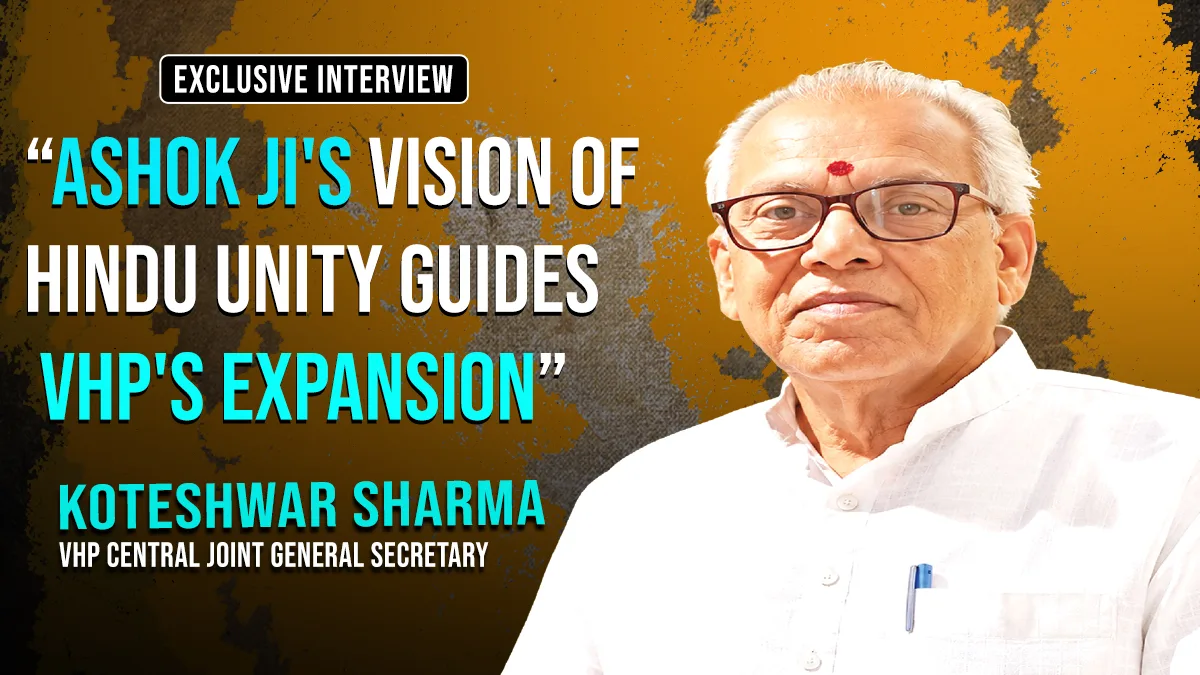
As the Vishwa Hindu Parishad (VHP) observes the birth centenary year of its former International President Ashok Ji Singhal, the organisation is renewing its focus on Hindu unity, cultural awakening and social harmony. In an interaction with Organiser representative Dr Mayank Chaturvedi, VHP Central Joint General Secretary Koteshwar Sharma discusses Singhal Ji’s legacy, the organisation’s expansion plans, the role of Satsang Mandals, mandir autonomy, social harmony & the initiatives to strengthen Hindu society and pass on its cultural values to the next generation. Excerpts:
The VHP is observing the year 2026 as the birth centenary year of Ashok Ji Singhal. Does the VHP view this occasion merely as a year of remembrance, or have new goals been set for the organisation?
For us, this is not just an occasion for remembrance. Ashok Ji Singhal’s life was dedicated to the organisation of Hindu society, cultural awakening and Hindu self-respect. Therefore, we have moved forward with the aim of organisational expansion. Our endeavour is to convey his ideas and work with the new generation while ensuring that organisational and cultural activities reach every administrative block and sensitive locality.
According to the VHP, thousands of ‘Satsang Mandals’ are active across the country. You have designated 2026 as the year for organisational expansion. What will be the criteria for this expansion, merely increasing numbers, or achieving specific social outcomes?
Numbers are important, but our goal is not just to increase them. Our resolve for 2026 is to establish Satsang Mandals in every ‘block’ and sensitive locality. Currently, over 35,000 Satsang Mandals are operating nationwide and we are working towards doubling this figure. The objective of Satsang is to integrate values (sanskar) and service with the organisation. Therefore, the success of a Mandal should be measured not merely by the number of meetings held, but by the changes brought about in society.
“Our fundamental point is that Hindu mandirs are centres of Hindu faith, not sources of revenue generation for the Government. The Government’s role is to govern, not to manage religious affairs of mandirs. We want Hindu society to have the constitutional right to independently manage its own religious sites”
Social harmony and the eradication of untouchability occupy a prominent place in the VHP’s stated agenda. How are slogans like ‘one well, one mandir, one cremation ground’ being translated into practice at the grassroots level?
Social harmony cannot be achieved merely by raising slogans. We are fostering greater interactions among different sections of society through saints and activists. Samarasata Bhoj and religious discourses are organised within Satsang groups. Our endeavour is to eliminate discrimination in key areas of social life, such as mandir, water sources and funeral rites. Within Sanatan society, there should be no notion of hierarchy or inequality based on birth.
Regarding ‘Ghar Wapsi’, the VHP speaks of ‘returning to the original Sanatan Dharma.’ What is the actual nature of this campaign in tribal areas and to what extent has it expanded?
For us, Ghar Wapsi does not mean pressuring anyone. We maintain that those who were compelled to move away from their original traditions in the past, due to circumstances, fear, or inducement, should be given the opportunity to reconnect with their roots. The VHP is also working in tribal areas through initiatives focused on education, healthcare and social service. According to us, thousands of families have voluntarily returned to their original Sanatan tradition. This campaign is being driven by a spirit of service, awareness-building and a sense of self-pride.
The VHP is also linking the training of ‘Archaks’ to social harmony. Does this imply that the
organisation is working towards bringing about significant changes in the traditional priesthood (pujaree) system?
We believe that the basis for becoming a priest (pujaree) should not be birth alone, but also competence and initiation. Therefore, through our training centres, we are training youths from Scheduled Castes, Scheduled Tribes and Backward Classes in Vedic worship methods, rituals and sacraments. This serves two objectives. On one hand, qualified ‘archaks’ (mandir pujarees) are being trained and on the other, caste-based divides within society are diminishing
Engaging children in the era of mobile phones and social media is a major challenge. The VHP has spoken about expanding ‘Bal Sanskar Kendras’ (children’s values-education centres). How extensive is this initiative?
We aim to establish these centres in every district headquarters and major neighbourhood. The objective is not merely to impart religious teachings; we will also introduce children to yoga, the life stories of patriots, moral values, family responsibilities and the scientific aspects of Sanatan traditions. We believe that the inculcation of values (sanskar) should begin in childhood. In this age of mobile phones and social media, the roles of the family and society have become even more crucial.
Due to urbanisation, the new generation is losing touch with traditional information regarding ‘gotra’, ‘kuldevta’ and genealogy. Does the VHP have a concrete plan to preserve this?
Through the Kutumb Prabodhan initiative, we are encouraging families to document their family trees, ‘gotras’ and ancestral traditions. Records maintained for centuries by traditional communities like the ‘Jaga’, ‘Rao’ and ‘Bhat’ are also significant. Preserving these is essential because a family’s roots are defined by more than just names and surnames; the coming generation ought to be aware of its familial and cultural heritage.
The VHP has consistently raised questions about the Government’s management of mandirs. According to Tamil Nadu Government data, there are 46,338 Hindu and Jain religious (Dharmik) institutions across the State. Given such a vast religious institutional framework, what kind of system does the VHP actually envision?
Our fundamental point is that Hindu mandirs are centres of Hindu faith, not sources of revenue generation for the Government. The Government’s role is to govern, not to manage religious affairs of mandirs. We want Hindu society to have the constitutional right to independently manage its own religious sites. The VHP is mobilising public awareness nationwide on this issue, bringing together saints, legal experts and the intellectual community, and is demanding a central law. While the sheer number of mandirs is vast, the question regarding the faith and religious rights of the millions of devotees associated with them is far more significant.
If we consider mandir autonomy, social harmony, ‘satsang’, ‘bal sanskar’, training for mandir pujarees (archaks) and organisational expansion together, what appears to be the core focus of the VHP’s upcoming campaign?
The core focus is the organisation and awakening of Hindu society. Mandirs are centres of faith, satsang is a medium to unite society, sanskar (values) provide direction to the new generation and social harmony strengthens society from within. We strive to integrate service, values, organisation and cultural consciousness. The organisation’s objective will be truly fulfilled only when every section of society considers itself a part of this broad social and cultural stream.
Disputes often arise regarding the utilisation of mandir revenues. The VHP maintains that mandir income should be directed towards religious and social causes. Do you propose a specific model for this?
It is our firm view that every single penny of mandir revenue should be utilised for the upliftment of Sanatan Dharma and society. Activities such as running Gurukuls, Vedic schools, Gaushalas and hospitals, as well as serving the underprivileged, can be undertaken through mandirs. If mandirs are sustained by the faith of the community, then their income should also be utilised in alignment with the needs of society and the religion. We are fighting a legal battle on this issue while simultaneously working to raise public awareness.
VHP is marking the birth centenary of Ashok Singhal with a year-long campaign to advance the causes and initiatives to which he devoted his life. Outlining the programme, VHP International President Alok Kumar said the organisation, along with the Ashok Singhal Foundation, Sant Samaj and other social organisations, would use the centenary year to renew its focus on Singhal’s key areas of work.

