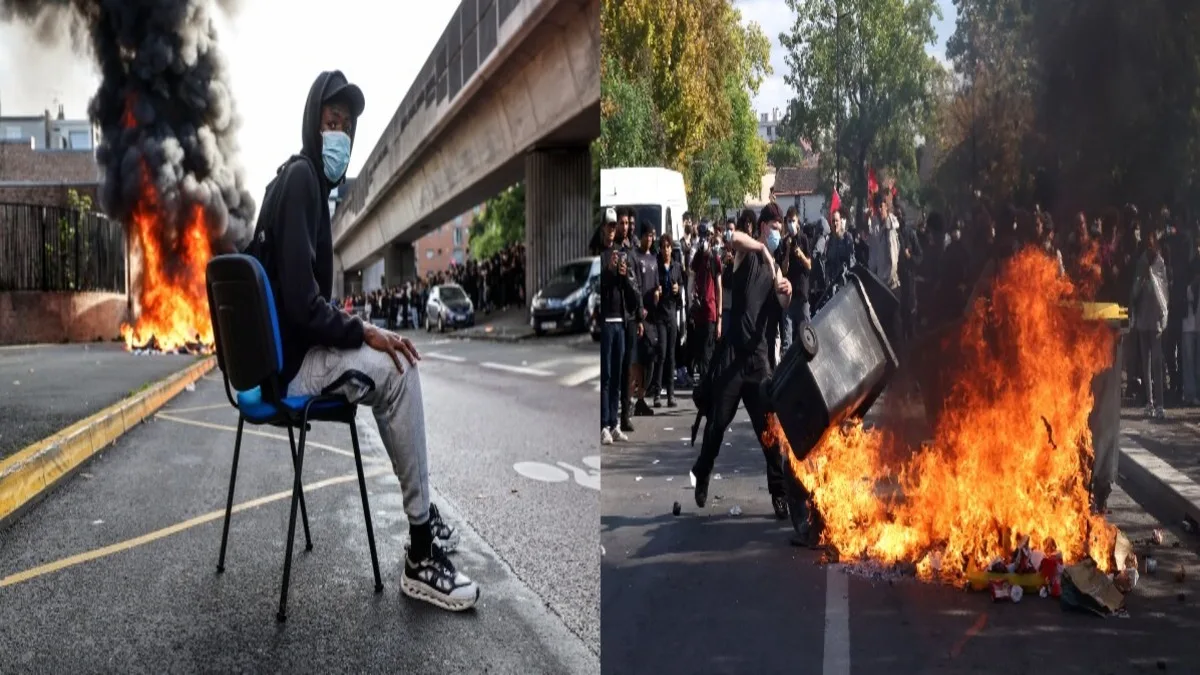
Violent Students Protest in France
PARIS: France is witnessing escalating violent student protests. What began as a demonstration against teacher shortages, overcrowded classrooms and dilapidated schools, turned violent in several cities. The unrest has converged with public-sector strikes against the government’s proposed €54 billion austerity package, intensifying pressure on President Emmanuel Macron and Prime Minister Sébastien Lecornu as France battles mounting debt ahead of the 2027 presidential election.
What began as localised demonstrations in Créteil, near Paris, has spread to Lille, Lyon, Marseille, Nantes, Bordeaux, Rennes and other cities. Students have blockaded school entrances, erected barricades and disrupted classes. Hundreds of educational establishments have reportedly been affected, with some forced to close following vandalism and attacks on school staff.
Students said that the unequal access to quality education is undermining their future prospects. They have also criticised long school days, often stretching from 8AM to 6AM.
The demonstrations have been characterised by arson, vandalism and violent confrontations with police. In Marseille, individuals attacked firefighters responding to burning barricades near Lycée Saint-Exupéry before setting their vehicle ablaze. At Lycée Victor Hugo, an arson attempt exposed the school principal and vice-principal to splashing petrol, forcing them to seek shelter.
Violence and property damage have also been reported in Nantes, Lille and Lyon. Police have deployed tear gas and batons to disperse crowds, while authorities have reported attacks involving stones, fireworks and in several incidents, hydrochloric acid.
Thousands of arrests have been reported, with officials stating that most detainees were minors. Teachers, police personnel and other school staff have also sustained injuries. The government has condemned the violence while maintaining that legitimate grievances cannot justify attacks on people or property.
Students and teachers cite overcrowded classrooms, vacant teaching positions and deteriorating facilities as the movement’s principal grievances. Some pupils report classes exceeding 34 students and prolonged gaps in instruction when substitute teachers are unavailable.
Reports of leaking roofs, collapsed ceilings, broken furniture, rodents and inadequate sanitation have intensified anger. Poorly insulated classrooms reportedly become unbearably hot during summer heatwaves and excessively cold in winter.
Students have also complained about expensive school meals, inadequate toilet facilities and limited time for extracurricular activities. Teachers argue that years of resource constraints have weakened public education, particularly. Protesters say these conditions contradict France’s national motto of “Liberty, Equality, Fraternity”.
The student movement has converged with public-sector strikes involving teachers, healthcare workers, firefighters, transport employees and other civil servants protesting over pay, staffing and budget cuts. The CGT labour union has threatened broader industrial action unless the government reconsiders its spending measures, raising the prospect of further disruption to transport and essential services.
The protests have also become a political flashpoint ahead of France’s 2027 Presidential election. The far-left France Unbowed (LFI), led by Jean-Luc Mélenchon, has supported the students and criticised police tactics. On the other hand, the government has accused sections of the hard left of exploiting the unrest and misleading the public for political reasons.
