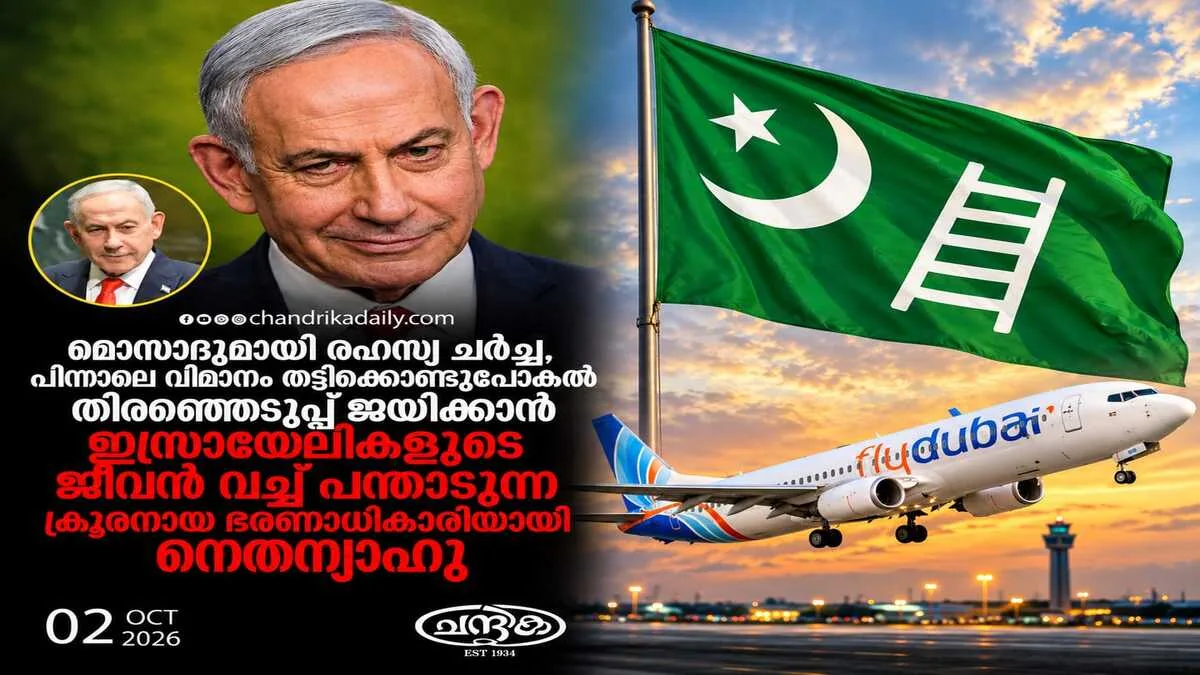
Muslim League peddles misleading narratives linking the Flydubai terror attack to Netanyahu and Mossad despite the UAE’s official terror confirmation.
With the United Arab Emirates (UAE) officially describing the Flydubai cockpit attack as a terrorist attack, the Indian Union Muslim League (IUML) mouthpiece Chandrika has published a misleading report alleging that Israeli Prime Minister Benjamin Netanyahu could be using the incident to advance his electoral interests ahead of the October 27 general election.
The Malayalam daily Chandrika report links the September 30 attack aboard Flydubai flight FZ1073, travelling from Dubai to Tel Aviv, with a series of developments involving Netanyahu in the days preceding the incident. It alleges that Netanyahu held a secret meeting with Mossad chiefs on September 27, three days before the attack.
According to the report, Netanyahu subsequently addressed the Israeli public on September 29 through a live television broadcast and warned of an “imminent serious threat” facing Israel. The report then connects that warning with the cockpit attack on the Flydubai flight the following day.
The report argues that the sequence of events, occurring shortly before the October 27 election, has triggered political debate and questions in Israel. It claims that Netanyahu could be using heightened security concerns and fears of conflict to influence the political atmosphere ahead of the vote.
The episode has also raised questions over the narrative being advanced by the Muslim League mouthpiece, with the publication’s framing seeking to divert attention from the Islamic terrorism dimension of the incident, promote an unsubstantiated alternative narrative and obscure the terror aspect of the attack.
The Chandrika report alleges that Netanyahu is unwilling to “play with the lives of ordinary Israeli citizens” and create a climate of war for his “political gains and to retain power”. It further claims that the alleged move was intended to divert public attention ahead of the October 27 election and secure votes by raising security concerns.
The publication specifically describes the episode as part of a sequence of developments that, in its account, raises questions about the timing of the attack. Rather than focusing primarily on the actions of the Islamic terrorist aboard the aircraft, the report places considerable emphasis on Netanyahu’s political position, his September 29 warning and the proximity of the incident to the Israeli election.
The allegations were published despite the UAE and Israel subsequently identifying the incident as a terrorist attack and launching an investigation into the circumstances surrounding it.
On September 30, the Flydubai aircraft came under attack inside the cockpit after co-pilot Hammam al-Hammami, an Omani national, attacked Indian captain Smith Machhar with a crash axe. The aircraft reportedly descended rapidly before the crew and passengers managed to restrain the attacker. The flight was subsequently diverted and landed safely in Tabuk, Saudi Arabia.
On October 3, UAE Attorney General Hamad Saif Al Shamsi said the incident was being treated as a terrorist attack. UAE authorities said the attacker had attempted to seize control of the aircraft and crash it, while an investigation was launched into his motives, objectives and possible connections.
The UAE’s official characterisation of the incident therefore places the attack within a terrorism investigation, while Chandrika’s report focuses on an political connection involving Netanyahu and the forthcoming Israeli election.
The publication’s report does not establish evidence demonstrating that Netanyahu or the Israeli government organised, directed or facilitated the Flydubai cockpit attack. Its central argument instead rests on the timing of Netanyahu’s September 29 warning, the September 30 aircraft incident and the October 27 election.
The UAE investigation into the attack remains the principal ongoing inquiry into the circumstances surrounding the incident, including the attacker’s motives and any possible connections.
