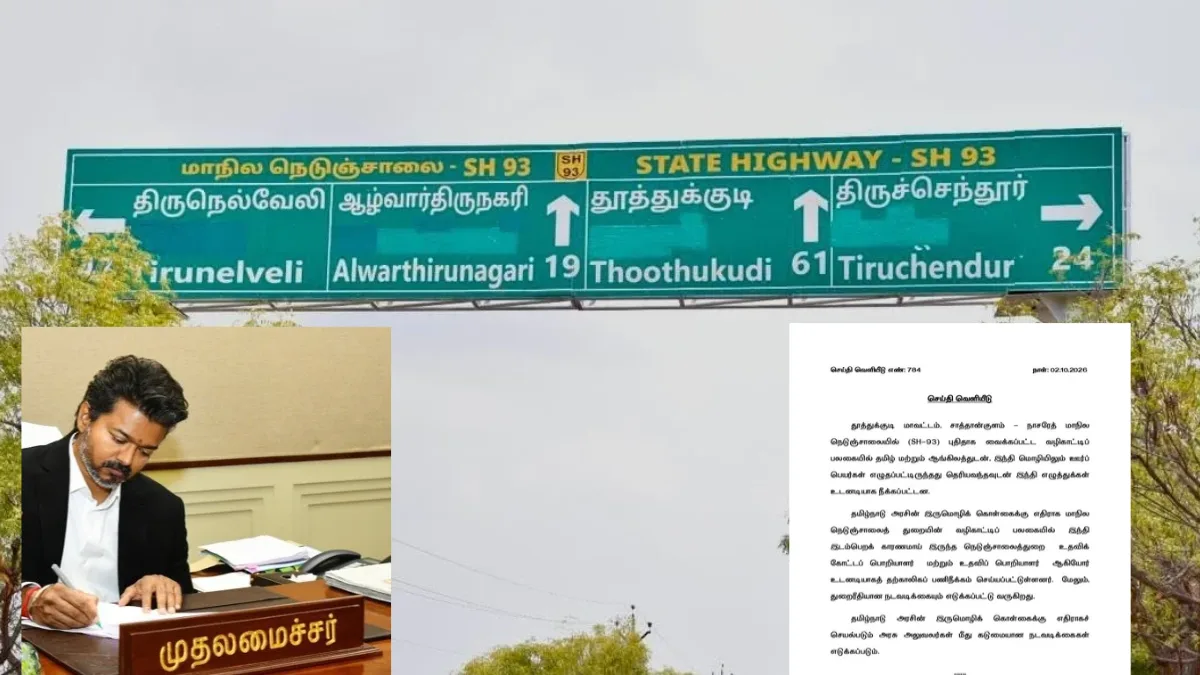
The C Joseph Vijay-led TVK government suspended two Highways Department engineers on October 2 following objections to Hindi lettering on a road signage board on the Sathankulam-Nazareth stretch of State Highway 93 (SH-93) in Thoothukudi district.
The government also initiated departmental action against Assistant Divisional Engineer N Boominathan and Assistant Engineer T Muthulakshmi. In a swift action, it replaced the trilingual road signboard after removing Hindi and retaining Tamil and English.
The signboard on the Sathankulam-Nazareth section of State Highway-93 displayed the names of Tirunelveli, Alwarthirunagar, Thoothukudi and Tiruchendur in Tamil, Hindi and English. The stretch was laid by the Tamil Nadu government’s Highways Department.
The inclusion of Hindi triggered a political controversy in Tamil Nadu, with the DMK opposing the trilingual signage and accusing the TVK government of moving towards the three-language formula that the party has historically opposed.
DMK president MK Stalin questioned the move and said Tamil Nadu’s two-language policy was a core principle.
The DMK has opposed the National Education Policy as a tool to impose Hindi and has also opposed the establishment of Jawahar Navodaya Vidyalayas in Tamil Nadu. Against this backdrop, the appearance of a three-language road signboard under the TVK government triggered criticism from the DMK.
On October 2, social media was flooded with posts condemning, questioning and supporting the signage.
DMK cadres shared images of the trilingual board, while highway officials reportedly justified the inclusion of Hindi on the grounds that it would help the growing number of tourists and truck drivers from northern and Hindi-speaking states.
Stalin said, “is this yet another attempt by TVK government, which tests the waters in every issue and makes u turn once opposition flares up”.
He said the two-language policy is Tamil Nadu’s core principle and warned against playing with it.
TVK Minister for Highways and Minor Ports Aadhav Arjuna said the trilingual board resulted from the “carelessness” of officials. He said the board was unauthorised and action had been taken against the officials concerned.
He also said the two-language policy introduced by Perarignar Anna, former Chief Minister C N Annadurai, is one of TVK’s fundamental principles.
A netizen criticised the action against officials for including Hindi on the signboard, calling it narrow-mindedness. He said Hindi was written additionally to help tourists and truck drivers from northern parts of the country and questioned how writing Hindi would affect the rights of people in Tamil Nadu. He also said Aadhav Arjuna, being a sportsperson, should know that Hindi is spoken across India.
The DMK IT wing said, “from Dhanushkodi Ram yatra to highways road sign boards where adding Hindi are clear indication TVK is the branch of the BJP in Tamil Nadu. CM is dummy as BJP pulling the strings. The BJP’s destroying diversity of the country’s nature is now being staged in Tamil Nadu jointly by TVK, Congress, VCK and others.”
Exposing what he described as DMK’s love for Tamil, one netizen said SUN Network has announced its upcoming brand-new Hindi entertainment channel, “Sun Neo. Coming soon”.
In Tamil Nadu, there are also signboards with Hindi. On the newly built Madurai-Dindigul National Highway, a roughly 30-km link road has signboards in Hindi, Tamil and English. Critics questioned why there had been no similar objection to those boards. Highway engineers cited the usefulness of Hindi for tourists and interstate drivers.
Critics said, “during poll campaign, DMK would print Hindi posters and banners to attract north Indian voters residing in Tamil Nadu. They would speak to them in their mother tongue of Hindi for votes. But when it comes to education in government schools, they would oppose turning a blind eye to their own CBSE board schools where Hindi is being taught and exclusive government Urdu and Arabic schools. But no to Sanskrit and Hindi schools. It is a sheer hypocrisy”.
Another netizen, Sundara Rajan, said, “Smart people of TN learn Hindi and travel/ work nationwide with ease.”
Another said, “Most fanatical/parochial/fascist decision //For travellers–tourist it will be useful–award the engineers and praise them.!”
PMK president Dr Anbumani Ramadoss also condemned the Hindi text on the signage board and demanded strict action against the officials.
Responding to Anbumani Ramadoss, netizen Sasikumar said, “We are not mad brainless idiots, writing name board in Hindi will not destroy Tamil, we got lots of north Indian tourists & migrant labours, they need Hindi”.
A 2004 Union Road Ministry circular on the use of languages on kilometre stones and signboards said advance information signs on National Highways should carry the local language, Hindi and English. It also asked State governments to adopt the same policy for general information signs on State Highways to avoid inconvenience to road users and domestic tourists.
However, under the Indian Road Congress Code, Tamil Nadu is not required to use Hindi on direction boards on State Highways and can continue with Tamil and English; Hindi can be added where considered necessary.
Critics argue that the TVK IT wing and political machinery have been spending heavily to promote Joseph Vijay as a potential future Prime Minister candidate. They point to promotional campaigns on social media in northern states in Hindi to build a national stature for Vijay.
However, in Tamil Nadu, the TVK government has followed the position of the Dravidian parties in opposing the use of Hindi in the present road-signage controversy.
In September, a Supreme Court bench of Justices B V Nagarathna and Augustine George Masih asked the Tamil Nadu government to reconsider its position on Hindi while hearing the case relating to the establishment of Jawahar Navodaya Vidyalayas in the state. The bench also directed the state to identify land for establishing a Navodaya school in every district within three months.
The bench said Tamil Nadu needed to “change its approach and mindset towards Hindi” and urged the state and the Centre to resolve their differences through dialogue.
The Tamil Nadu government had argued that the establishment of Navodaya schools was against the state’s language policy and that Hindi would supersede Tamil. The Supreme Court, however, declined to recall its earlier order and asked the state to engage with the Centre constructively.
The latest road-signage controversy has therefore brought the language question back into the political spotlight in Tamil Nadu, with the TVK government simultaneously reiterating its commitment to the two-language policy while facing questions over the appearance of Hindi on a State Highways Department signboard.
