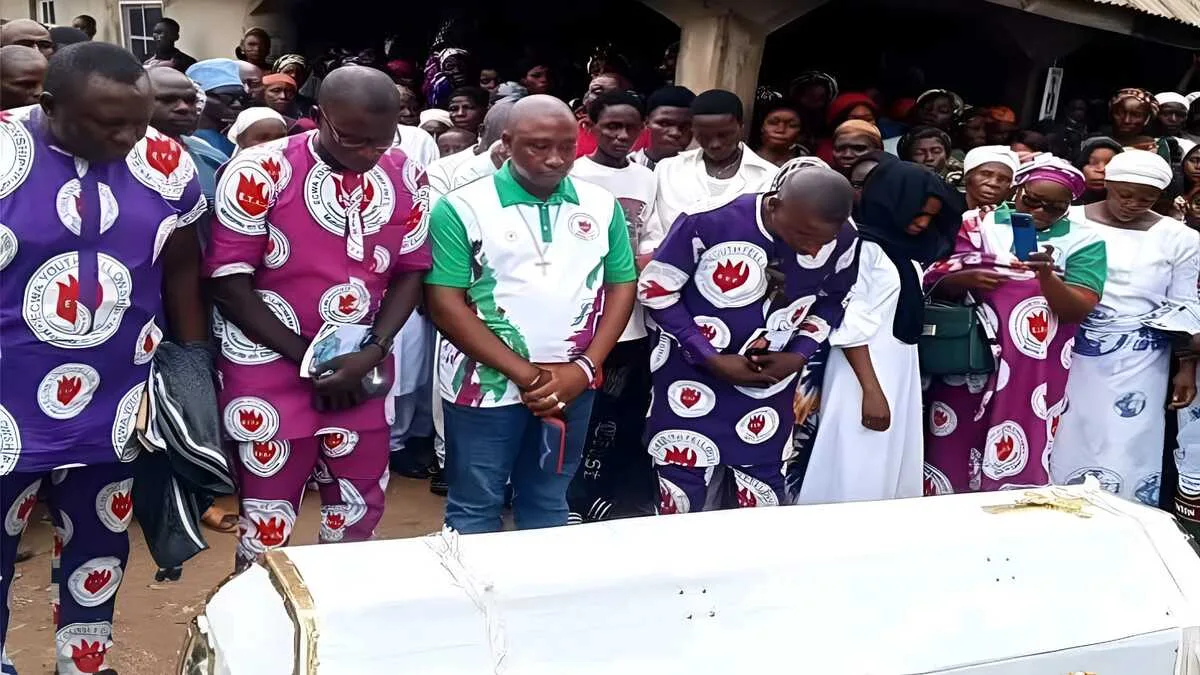
Burial service for Christian youth leader Filibus Usman Kuje on Aug. 10, 2026 in Amaha village, Kokona County, Nasarawa state, Nigeria
A report by the U.S.-based aid organisation Equipping The Persecuted (ETP) has documented 4,216 Christian deaths in Nigeria between January 1 and September 8, 2026, equivalent to an average of 16.8 deaths a day, or approximately one Christian killed every 86 minutes.
The report, Crisis in the Middle Belt: Religious Persecution and Security Failure in Nigeria, identifies the Middle Belt as the main area affected by the violence and says the recorded figure represents a documented minimum.
According to the report, the violence against Christian farming communities has frequently involved organised militant networks and attacks on villages, churches and civilian populations. ETP says the pattern includes killings, abductions, village raids, destruction of property and the displacement of Christian communities.
The report estimates that more than five million Christians have been displaced and more than 600 Christian communities have been destroyed or emptied amid the violence. It says the continuing displacement has consequences beyond the immediate humanitarian crisis, particularly where displaced families are unable to return to their farms, villages and ancestral lands.
ETP’s Nigeria Terror Tracker (NTT) records substantially higher fatalities attributed to Fulani Islamic terrorists than to Boko Haram and the Islamic State West Africa Province (ISWAP) combined during the comparable periods examined.
The NTT recorded 4,932 fatalities attributed to Fulani Islamic terrorists between January 1 and September 7, 2025, compared with 1,958 attributed collectively to Boko Haram and ISWAP. During the corresponding period in 2026, Fulani Islamic terrorists accounted for 786 recorded fatalities, while Boko Haram and ISWAP together accounted for 189.
On those figures, the report calculates that Fulani Islamic terrorist networks accounted for 2.5 times as many recorded deaths as Boko Haram and ISWAP combined in 2025 and 4.2 times as many in 2026. ETP separately cites Observatory for Religious Freedom in Africa data attributing 53 per cent of documented killings of civilian Christians to Fulani Islamic militant groups, compared with 8 per cent attributed to Boko Haram and ISWAP combined.
The report identifies Benue, Plateau, southern Kaduna, Nasarawa and Taraba among areas where Fulani Islamic terrorist networks have been identified as a major armed threat in incident reporting. It also identifies Boko Haram, ISWAP and other Islamic terrorist organisations as part of Nigeria’s wider security crisis.
ETP says the violence cannot be understood solely through the framework of farmer-herder disputes, land conflicts or other communal disagreements. Its documented incidents include attacks on Christian villages, burning of churches, killings, kidnappings and prolonged displacement.
The report says the destruction of communities can result in Christian farming populations abandoning ancestral lands, while insecurity prevents many displaced families from returning. More than five million displaced Christians are cited in the report, alongside more than 600 Christian communities described as destroyed or emptied.
Kidnapping forms another major element of the Nigeria crisis. ETP reports that victims may face torture, starvation, forced labour and ransom demands. Women and girls face additional risks of sexual violence, while boys and young men can be subjected to beatings, forced labour and prolonged captivity.
The report also says kidnapping incidents connected to Islamic terrorist organisations are not comprehensively recorded. It argues that kidnappings involving Boko Haram and ISWAP are more likely to enter official records, while kidnappings attributed to Fulani Islamic terrorist networks in parts of the Middle Belt may be underreported because families fear retaliation or lack confidence in authorities.
ETP says its 4,216 figure is a documented minimum compiled from field reporting, eyewitness and survivor testimony, local contacts and subsequent verification. The organisation says deaths are added to its master registry only after names, incidents and supporting evidence have been reconciled.
As a result, the report says the actual number of Christians killed in Nigeria during the period could be higher. Eight Christians reported killed in Ayilamo, Benue State, on September 10 were not included in the audited total because the incident occurred after the September 8 cut-off.
ETP also says media reporting can affect how the violence is recorded when the religious identities of victims or attackers are omitted. According to the report, describing attacks exclusively as rural insecurity or farmer-herder conflict can obscure patterns involving Christian communities, churches, targeted killings and displacement.
The report therefore presents Nigeria’s Christian killings, displacement and destruction of communities as a sustained security and humanitarian crisis, with Fulani Islamic terrorist networks and established Islamic terrorist organisations such as Boko Haram and ISWAP identified among the armed actors responsible for recorded violence.
The figures cover January 1 through September 8, 2026, and are presented by ETP as documented minimums rather than a comprehensive count of every Christian death in Nigeria.
