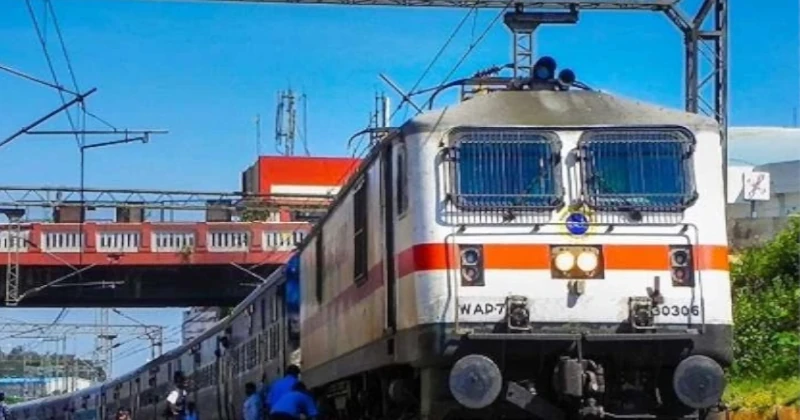
Representative Image- Indian Railways
Indian Railways has witnessed a major expansion of technology-driven safety systems over the past decade, with automated train protection, artificial intelligence, machine vision, satellite-based tracking, ultrasonic inspection, drones, digital surveillance and predictive maintenance becoming increasingly important components of railway safety. From the trials of broken rail detection technology in 2016 to the commissioning of KAVACH Version 4.0 in 2026, the initiatives reflect a broader shift towards automated, real-time and technology-based safety monitoring across the railway network.
The decade-long transformation has involved technologies designed to detect defects before they become critical, monitor trains and infrastructure in real time, improve visibility during adverse weather, strengthen surveillance and coordinate railway operations. Systems such as Ultrasonic Flaw Detection, Ground Penetrating Radar, Online Monitoring of Rolling Stock, Real-Time Train Information System, GPS-based Fog Safety Devices, UAV-based surveillance, AI-enabled Machine Vision Inspection Systems and Distributed Acoustic Sensing have expanded the technological capabilities available for railway safety and maintenance.
The development of KAVACH has also been part of this wider transformation. KAVACH was first field-tested in February 2016 and adopted as India’s National Automatic Train Protection system in July 2020. Its Version 4.0, approved by the Research Designs and Standards Organisation in July 2024, introduced improved train-location accuracy, enhanced signal information, Optical Fibre Cable-based communication and integration with electronic interlocking. In September 2026, KAVACH 4.0 was commissioned across 108 route kilometres between Malkajgiri and Kamareddi in the Hyderabad Division of South Central Railway.
The reported railway safety indicators also show a substantial decline over the period covered by the report. Consequential accidents averaged 171 per year during 2004-14, compared with 68 per year during 2014-24. Annual accidents declined from 135 in 2014-15 to 31 in 2024-25, while accidents per million train kilometres fell from 0.11 to 0.03, representing a 73 per cent reduction. Rail fractures declined from 2,548 to 289, while weld failures fell from 3,699 in 2013-14 to 370 in 2024-25.
The expansion of technology-driven safety measures can also be seen in the deployment of Fog Safety Devices, which increased from 90 in 2014 to 25,939 in 2025. Alongside train protection, railway authorities expanded automated rolling-stock inspection, AI-based surveillance, digital communication, aerial monitoring, level-crossing interlocking and systems designed to detect track and infrastructure defects.
The detailed Indian Railways’ Decade of Safety Technology: 15 Major Initiatives from KAVACH 4.0 to AI, Drones and Predictive Track Monitoring(2016-2026), are given below.
Indian Railways commissioned indigenous KAVACH Version 4.0 across 108 route kilometres between Malkajgiri and Kamareddi in the Hyderabad Division of South Central Railway, marking an upgrade of the Automatic Train Protection system from Version 3.2.
KAVACH is an indigenous Automatic Train Protection system developed for railway safety. It was first field-tested in February 2016 and was adopted as India’s National Automatic Train Protection system in July 2020.
KAVACH Version 4.0 received approval from the Research Designs and Standards Organisation (RDSO) on July 16, 2024. The upgraded version introduced improved train-location accuracy, enhanced signal information, Optical Fibre Cable-based communication and integration with electronic interlocking.
Before its deployment on the Malkajgiri-Kamareddi section, KAVACH 4.0 had also been commissioned on sections of Western, Northern and East Central Railways.
The system automatically monitors train movement and applies brakes during critical situations, providing collision and overspeed protection. The upgrade strengthened indigenous train-protection technology, reduced dependence on manual intervention, improved collision and overspeed protection, and prepared KAVACH for wider deployment across India’s railway network.
Indian Railways expanded the use of Artificial Intelligence (AI), Machine Learning (ML), machine vision, drones and data-driven technologies for automated safety monitoring and predictive railway maintenance across its network.
Indian Railways had deployed 24 Wheel Impact Load Detector (WILD) systems, 25 Online Monitoring of Rolling Stock (OMRS) systems and three Integrated Track Monitoring Systems (ITMS) to strengthen railway safety.
Machine Vision Inspection Systems (MVIS) were being piloted at six locations to detect loose or missing components. Drone-based thermal monitoring was also being tested in Raipur Division, while IIT Madras was developing an AI-enabled drone inspection system for predictive maintenance and automated monitoring of railway infrastructure.
These technologies supported automated defect detection, real-time monitoring and predictive maintenance, enabling faster identification of faults in trains, tracks and overhead infrastructure and helping improve railway safety.
Indian Railways expanded the interlocking of Level Crossing gates with railway signalling systems across its network as part of measures to strengthen safety at railway crossings.
Interlocking links the operation of Level Crossing gates with railway signals so that train movement and gate operation remain coordinated. As of June 30, 2026, a total of 10,395 Level Crossing gates had been provided with interlocking.
The technology prevents signals from permitting incompatible train movements when a crossing is not secured, ensuring that the operation of the gates remains coordinated with railway signalling.
Level Crossing Interlocking reduced risks arising from improper coordination between road traffic and train movements and strengthened safety at railway crossings.
Indian Railways expanded CCTV surveillance across railway stations and passenger coaches, integrating Artificial Intelligence (AI)-based video analytics for enhanced security monitoring.
Indian Railways had equipped 3,215 stations and 13,409 passenger coaches with CCTV systems. All operational Vande Bharat and Amrit Bharat train rakes had also been covered under the surveillance system.
Station cameras included AI-based intrusion, loitering and fallen-person detection capabilities. Between 2023 and June 2026, a total of 9,840 security-related incidents were detected through the surveillance systems, according to the Railway Ministry.
The technology strengthened real-time security surveillance, enabled automated detection of suspicious or unsafe situations and expanded technology-based passenger safety across railway stations, coaches and trains.
Indian Railways signed a Memorandum of Understanding (MoU) with Dedicated Freight Corridor Corporation of India Limited (DFCCIL) for the procurement and deployment of four Machine Vision-Based Inspection System (MVIS) units for automated rolling-stock safety monitoring.
Under the MoU, four MVIS units will be procured, installed, tested and commissioned. The wayside system uses Artificial Intelligence (AI) and Machine Learning (ML) to capture high-resolution images of the under-gear of moving trains and automatically identify hanging, loose or missing components.
The system will generate real-time alerts to help railway personnel take preventive action and reduce the requirement for manual inspections.
The technology introduced automated, real-time monitoring of rolling-stock components, supporting early fault detection, preventive maintenance and improved train safety while reducing dependence on manual inspections.
Indian Railways expanded the use of Artificial Intelligence (AI)-enabled Intrusion Detection Systems (IDS) using Distributed Acoustic Sensing to detect elephant movement near railway tracks.
The AI-enabled IDS was operational across 141 route kilometres of Northeast Frontier Railway, while tenders had been awarded for an additional 981 route kilometres across the country.
Using Distributed Acoustic Sensing, the system generated real-time alerts for loco pilots, station masters and control rooms when elephant movement was detected near railway tracks. The alerts enabled timely preventive action in vulnerable sections.
The technology strengthened wildlife protection and railway safety by providing early warnings of elephant movement, while supporting faster intervention and reducing the risk of train-animal collisions.
Indian Railways signed a Memorandum of Understanding (MoU) with Delhi Metro Rail Corporation for the induction of the Automatic Wheel Profile Measurement System (AWPMS).
The AWPMS was introduced to provide automatic, non-contact measurement of train-wheel profiles. The technology enables real-time measurement of wheel geometry and wear, helping maintenance personnel identify deviations in wheel condition without relying entirely on conventional manual measurements.
The system supported preventive maintenance by enabling earlier identification of wheel wear and geometry abnormalities and improving the consistency of rolling-stock inspection.
Indian Railways expanded Artificial Intelligence (AI)-enabled surveillance, automated passenger information, IP-MPLS networking and tunnel communication systems across its network to modernise railway safety and operations.
During 2025-26, Indian Railways deployed AI-enabled video surveillance at 1,874 stations, with analytics for intrusion, loitering and facial recognition. Automatic train announcements were operational at 1,405 stations, while IP-MPLS technology covered 1,396 stations to support mission-critical railway applications.
Tunnel communication systems were also being installed on projects including the Udhampur-Srinagar-Baramulla Rail Link.
These technologies strengthened station surveillance, passenger information, communication reliability and operational coordination, supporting safer and more digitally connected railway operations.
Central Railway deployed 497 GPS-based Fog Safety Devices (FSDs) to assist loco pilots with advance signal information during fog and poor-visibility conditions.
The 497 FSDs were deployed across five divisions, including 248 in Bhusawal, 220 in Nagpur, 10 in Mumbai, 10 in Pune and nine in Solapur. The GPS-based devices provided audio and visual alerts for the next three signals and announced signal information 500 metres in advance.
Central Railway also placed orders for 500 additional devices, including 120 for Mumbai.
The technology improved loco-pilot awareness during poor visibility and allowed trains to operate at speeds of up to 75 kmph, compared with typical fog-related speeds of 30-60 kmph, helping reduce detention and improve punctuality.
Indian Railways deployed the Real-Time Train Information System (RTIS), developed in collaboration with the Indian Space Research Organisation (ISRO), to automatically track train movement and provide real-time operational updates. The system uses satellite-based technology for real-time train tracking.
Indian Railways installed RTIS devices on 2,700 locomotives across 21 electric locomotive sheds. Phase-II was planned to cover an additional 6,000 locomotives across 50 sheds using ISRO’s Satcom hub.
The RTIS provided train-location updates every 30 seconds. At the time, GPS feeds from around 6,500 locomotives were also being integrated with the Control Office Application (COA).
The system enabled automatic monitoring of train position and speed without manual intervention, supported automatic train charting, and improved real-time passenger information through its integration with COA and the National Train Enquiry System (NTES).
Central Railway’s Mumbai Division procured two Ninja Unmanned Aerial Vehicles (UAVs) to strengthen surveillance of railway stations, tracks, yards, workshops and other railway assets.
The Railway Protection Force (RPF) had also procured nine drones at a cost of RS.31.87 lakh across South Eastern Railway, Central Railway, Modern Coaching Factory, Raebareli and South Western Railway. Four RPF personnel in Mumbai were trained in drone operation, surveillance and maintenance.
The UAVs supported real-time tracking, video streaming and fail-safe operation. Their deployment expanded railway security capabilities through aerial surveillance, asset inspection, data collection and monitoring of vulnerable areas.
The technology also supported disaster response, rescue and restoration operations.
Indian Railways moved towards the induction of Ground Penetrating Radar (GPR) technology for the scientific assessment of railway-track ballast and formation conditions.
Ground Penetrating Radar was intended to examine conditions below the visible track surface, including the condition of the ballast bed, ballast cushion and other subsurface characteristics. The technology provided a non-destructive method of assessing track-bed health and could help maintenance teams identify sections requiring attention that might not be apparent through surface-level visual inspection.
The introduction of GPR brought subsurface sensing into railway-track maintenance, supporting better identification of deteriorated track-bed conditions and more targeted preventive maintenance.
Indian Railways adopted digital Ultrasonic Flaw Detection equipment and pursued Self-Propelled Ultrasonic Rail Testing systems to improve the inspection of rails and welds.
Digital Ultrasonic Flaw Detection uses ultrasonic waves to identify internal defects in rails and welds that may not be visible during conventional visual inspection. Digital systems can record inspection information for analysis, while self-propelled testing technology was intended to make large-scale ultrasonic rail inspection faster and more systematic.
Ultrasonic inspection enabled early detection of internal rail and weld defects, helping maintenance teams address potentially dangerous flaws before rail failure occurred.
Indian Railways introduced the Online Monitoring of Rolling Stock (OMRS) system to automatically detect wheel and bearing defects in trains. The first OMRS system was installed at Panipat in November 2017.
A National Command Centre was subsequently established at Delhi in March 2018. The first phase of the initiative targeted the deployment of 25 OMRS systems across 20 locations.
By June 2019, the technology had detected bearing faults in 33 wagons, six coaches and one locomotive. It had also detected wheel defects in seven coaches.
The deployment of OMRS shifted inspections from predominantly manual methods towards automated, condition-based and predictive maintenance. The system enabled earlier detection of critical wheel and bearing faults and supported improved rolling-stock reliability and operational safety.
Indian Railways undertook trials of an Ultrasonic Broken Rail Detection system for identifying rail breaks on railway tracks.
The technology was evaluated for the automatic detection of broken rails. Unlike routine visual inspection, the system was intended to provide technology-based identification of rail discontinuities, enabling railway personnel to respond before a train encountered a dangerous track condition.
Early detection of broken rails could help prevent derailments and improve the reliability of railway-track safety monitoring.
The 15 initiatives documented from 2016 to 2026 show the expansion of technology-based railway safety systems across multiple areas of Indian Railways. The technologies covered automatic train protection, track inspection, rolling-stock monitoring, real-time train tracking, fog operations, level-crossing safety, CCTV surveillance, artificial intelligence, machine vision, drones, digital communication and acoustic intrusion detection.
The progression also shows a shift from systems focused primarily on inspection towards technologies capable of automated monitoring, real-time alerts and predictive maintenance. Ultrasonic systems and Ground Penetrating Radar expanded the ability to examine railway infrastructure, while OMRS and Automatic Wheel Profile Measurement addressed wheel and bearing conditions. RTIS introduced satellite-linked real-time train tracking, and GPS-based Fog Safety Devices provided advance signal information during poor visibility.
More recent initiatives expanded the role of Artificial Intelligence, Machine Learning and machine vision in railway safety. AI-enabled surveillance, automated rolling-stock inspection, drone-based monitoring and Distributed Acoustic Sensing introduced additional capabilities for identifying faults, monitoring infrastructure and providing early warnings.
KAVACH 4.0 represents another significant development within this broader technological expansion. Its commissioning across 108 route kilometres between Malkajgiri and Kamareddi in September 2026 marked the deployment of an upgraded indigenous Automatic Train Protection system with improved train-location accuracy, enhanced signal information, Optical Fibre Cable-based communication and electronic interlocking integration.
The reported safety indicators provide another dimension to the decade covered by the report. Consequential accidents, annual accidents, accidents per million train kilometres, rail fractures and weld failures all recorded declines across the periods specified. At the same time, the deployment of Fog Safety Devices expanded substantially, reflecting the wider adoption of technology-assisted railway operations.
Taken together, these 15 initiatives document a decade of increasing reliance on automated detection, real-time information, predictive maintenance and technology-enabled monitoring across Indian Railways. From broken rail detection trials in 2016 to AI-based safety systems and KAVACH 4.0 in 2026, railway safety technology has expanded across tracks, trains, stations, crossings, communication systems and railway operations.
