VB-G RAM G: A New Rural Jobs Framework
India’s rural employment framework has entered a new phase with the implementation of the Viksit Bharat – Guarantee for Rozgar and Ajeevika Mission (Gramin), popularly known as VB-G RAM G. The framework seeks to bring together two objectives that have traditionally been addressed through separate interventions: providing wage employment to rural households and creating durable assets that can contribute to long-term village development.
The VB-G RAM G Act, 2025 came into force on July 1, 2026, and has since been rolled out across rural areas of the country. The transition from the earlier Mahatma Gandhi National Rural Employment Guarantee framework to the new system has been described as seamless, with the digital architecture required for implementation operational from the beginning.
At the centre of VB-G RAM G is a statutory guarantee of 125 days of wage employment in every financial year. The guarantee applies to every rural household whose adult members volunteer to undertake unskilled manual work.
The significance of the new framework, however, goes beyond the number of employment days guaranteed. VB-G RAM G has been designed around the idea that wage employment should also contribute to the creation of useful and durable rural assets. The employment generated under the programme is therefore linked to broader development priorities identified at the village level.
The framework focuses on four broad thematic areas: water security, core rural infrastructure, livelihood-related infrastructure and mitigation of extreme weather events. This approach is intended to ensure that the work undertaken through the employment guarantee contributes to the wider economic and social needs of rural communities.
The central shift under VB-G RAM G is the attempt to connect employment generation with integrated rural development. Instead of looking at wage employment as an isolated intervention, the framework seeks to use rural labour for creating assets and infrastructure that can continue to benefit villages beyond the period in which the work is undertaken.
The framework is aligned with the broader vision of Viksit Bharat @2047 and follows a Whole-of-Government approach based on convergence and saturation. This means that different government schemes, departments and resources are intended to work together rather than operate in isolation.
A key component of this model is the preparation of Viksit Gram Panchayat Plans, or VGPPs. These plans are intended to provide a common development framework for Gram Panchayats by bringing together local requirements, existing assets and infrastructure gaps.
The idea is to begin planning at the grassroots level. Instead of deciding all development priorities from higher administrative levels, Gram Panchayats are expected to identify the needs of their communities and prioritise works according to local conditions.
The Gram Sabha has an important role in this process. Local residents can participate in identifying priorities, while the Gram Panchayat prepares the development plan based on these requirements. The Gram Sabha then provides recommendations and approval, giving the village community a formal role in determining the works that should receive attention.
This participatory planning process is intended to make rural development more closely connected with the actual requirements of individual villages.
The preparation of a VGPP begins with participatory planning at the Gram Panchayat level. Local requirements are identified and works are prioritised with the involvement of the Gram Sabha.
The next step involves comprehensive asset mapping. Under this process, existing infrastructure and assets within the Gram Panchayat are identified along with gaps in services and facilities. The exercise also takes into account assets created through various Central and State Government schemes.
This mapping is important because it allows authorities to understand what already exists before approving new works. It can help identify areas where infrastructure is inadequate and where additional intervention may be required. It can also reduce duplication by providing a clearer picture of existing assets.
Technology is being used to strengthen this planning exercise. Geographic Information System tools, Yuktdhara, PM Gati Shakti and other digital platforms provide both geospatial and non-spatial information for planning.
The use of such technology is intended to make planning more evidence-based. Information on land, infrastructure, assets and development gaps can be brought together to support decisions about where new works are required and how different interventions can be connected.
The framework also places considerable emphasis on convergence. Different schemes and government departments can contribute resources or interventions towards common village priorities. This is intended to create a more integrated approach to development rather than implementing individual schemes independently.
Once prepared at the Gram Panchayat level, the plans are consolidated at the Block, District, State and National levels. These consolidated plans are intended to contribute to the Viksit Bharat National Rural Infrastructure Stack.
The VGPP Framework identifies 318 types of permissible works across the four major thematic areas. This provides a broad framework within which local authorities can identify works according to their specific requirements.
The overall objective is to connect employment with asset creation. A rural worker receives wage employment, while the work undertaken can simultaneously contribute to infrastructure, water security, livelihoods or resilience against extreme weather events.
Water security forms one of the major areas under the framework. Rural communities depend heavily on water resources for agriculture, livestock and household requirements, making water-related infrastructure an important component of village development.
The second focus area is core rural infrastructure. This includes works intended to strengthen basic infrastructure and address gaps identified during village-level planning.
The third area is livelihood-related infrastructure. The objective is to support assets and facilities that can contribute to the economic activities and earning opportunities of rural households.
The fourth area focuses on mitigating the impact of extreme weather events. Rural communities can be particularly vulnerable to floods, droughts, excessive rainfall and other weather-related disruptions. The framework therefore seeks to support works that can improve local resilience.
Together, these four areas are intended to ensure that the employment generated under the programme is connected to longer-term development outcomes.
The scale of activity recorded during the initial months of VB-G RAM G indicates the size of the programme and its reach across rural India.
As of September 24, 2026, the number of active workers under VB-G RAM G stood at 10.88 crore during 2026-27. More than 31.69 crore person-days of employment had been generated during the period.
The programme had also resulted in the creation of 2.83 lakh assets. These figures indicate that employment generation and asset creation have been progressing simultaneously under the new framework.
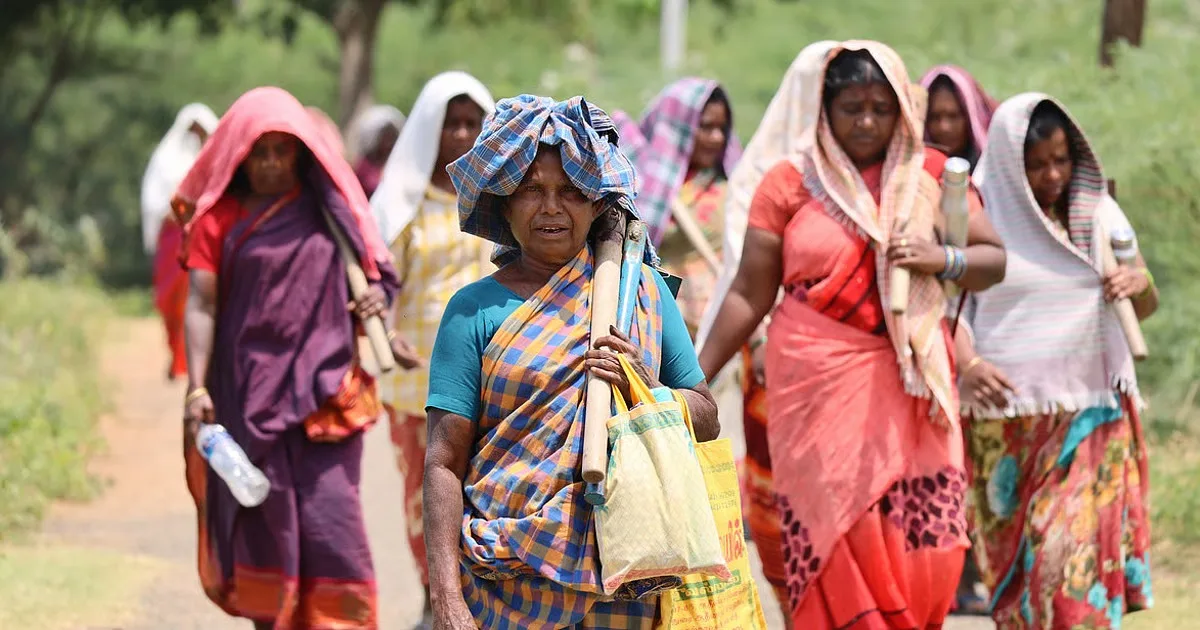
Women accounted for 61.65 per cent of participation during 2026-27. The figure highlights the significant participation of women in rural employment under the programme.
Employment had been provided on demand to more than 2.81 crore workers belonging to around 2.23 crore rural households. This demand-based component remains central to the employment guarantee because rural households can seek work when they require it.
The scale of works being implemented was also substantial. Around 97.17 lakh works were under execution, while another 73.24 lakh approved works were available to meet future employment demand.
At the worksite level, around 20.16 lakh worksites were operational. Nearly 2.31 lakh Gram Panchayats were executing works across the country.
These numbers illustrate the administrative scale involved in implementing the framework across rural India. From worker registration and employment demand to worksite monitoring and wage payments, the programme requires coordination between village-level institutions, State governments and the Central government.
Digital payments form another important part of the new framework. During 2026-27, VB-G RAM G recorded 3.76 crore Direct Benefit Transfer transactions.
The average wage rate stood at Rs 283.24 per day per person. A total of 15.17 crore Gramin Rozgar Guarantee Cards had also been issued.
The use of Direct Benefit Transfer is intended to ensure that wages reach beneficiaries through formal banking channels. It also creates a digital record of transactions, allowing payments to be monitored through the programme’s digital systems.
For rural households, timely wage payments remain an important part of the employment guarantee. The effectiveness of any employment programme depends not only on the availability of work but also on the ability of workers to receive their wages through a reliable payment system.
The financial structure for implementing VB-G RAM G has also been established for the current financial year.
A total of Rs 93,841 crore has been allocated to States and Union Territories as an interim allocation for 2026-27. Of this amount, a Mother Sanction of Rs 25,880 crore was issued as the first instalment to States and Union Territories.
The allocation is intended to support the implementation of employment and rural development works under the new framework. Since the programme operates across a large number of Gram Panchayats and involves millions of rural workers, financial planning is a crucial component of its functioning.
The availability of funds also needs to be matched with employment demand and the implementation of approved works at the local level. The VGPP process is intended to provide the planning framework through which these resources can be directed towards identified village priorities.
One of the most significant features of VB-G RAM G is the extensive use of digital technology. Technology is being incorporated into several stages of the programme, including worker verification, attendance, monitoring, measurement and payments.
e-KYC, Face Authentication and biometric authentication are being used for worker verification and attendance. These systems are intended to strengthen the authenticity of records and improve transparency in programme implementation.
At worksites, geo-tagging is being used to record the location of assets and works. Digital measurement and electronic Measurement Books, or e-MBs, are being used to record and monitor the progress of works.
Mobile-based monitoring provides another layer of oversight. It allows information from worksites to be captured digitally and made available for monitoring.
The payment system is supported by Direct Benefit Transfers, while dashboards provide information for monitoring implementation. Spatial technology can support planning by showing where infrastructure exists and where gaps remain.
AI-enabled analytics are also part of the broader digital architecture. Such tools can assist in analysing large volumes of programme information and identifying areas that may require attention or corrective action.
The use of technology is therefore not limited to payments. It extends from the identification of workers and recording attendance to planning, asset mapping, worksite monitoring and reporting.
Convergence is another defining feature of VB-G RAM G. Rural development is rarely dependent on a single type of intervention. A village may simultaneously require water infrastructure, roads, livelihood facilities, housing support, agricultural assets and measures to deal with extreme weather.
The VGPP approach seeks to bring these requirements together within a common planning framework. Assets created through different government programmes can be mapped, while gaps can be identified and addressed through new interventions.
This approach is intended to reduce fragmentation in rural development planning. Instead of viewing every scheme separately, the objective is to understand how different interventions can complement one another.
For example, an asset created through one programme can potentially support another development intervention. Similarly, infrastructure gaps identified through asset mapping can be incorporated into future village plans.
The role of Gram Panchayats is important in this model because they are closest to the communities that use these assets. Local participation can help identify priorities that may not always be visible through centralised planning.
The participation of Gram Sabhas gives the new framework a strong local planning component. Rural development plans are expected to reflect the requirements identified by people at the village level.
The Gram Sabha can recommend and approve priorities, while the Gram Panchayat plays the role of preparing and implementing the plan.
This process can also create greater visibility around the works being undertaken in a village. When plans, assets and works are identified at the local level, communities have a clearer framework through which they can participate in the development process.
The approach places the village at the beginning of the planning chain rather than treating it merely as the final destination of a centrally designed programme.
Although planning begins at the Gram Panchayat level, the framework is designed to connect local plans with larger administrative levels.
VGPPs are consolidated at the Block, District, State and National levels. This creates a system through which local infrastructure requirements can feed into broader rural development planning.
The consolidated plans contribute to the Viksit Bharat National Rural Infrastructure Stack. In this way, information generated at the village level can become part of a larger national picture of rural infrastructure and development requirements.
This structure also provides an opportunity to understand rural infrastructure gaps at different administrative levels. Local planning and national planning are therefore intended to operate as parts of the same system.
VB-G RAM G represents a broader shift in how rural employment is positioned within government policy. Its core promise remains employment for rural households, but the framework attempts to connect that employment with the creation of durable assets and village-level infrastructure.
The 125-day statutory employment guarantee provides the employment component. The VGPP process provides the local planning component. The four thematic areas provide the development priorities, while technology provides tools for implementation, monitoring and transparency.
The framework also seeks to bring together different government schemes and departments through convergence. This creates a model in which rural employment is not treated separately from infrastructure development, livelihood support and climate resilience.
Its implementation will ultimately depend on how effectively these elements work together on the ground. The scale of the programme means that the functioning of Gram Panchayats, the participation of Gram Sabhas, the availability of funds, the quality of assets and the reliability of digital systems will all remain important to its functioning.
For millions of rural workers, the most immediate element remains access to employment and timely wages. For villages, the larger question is whether the works undertaken through the programme create assets that remain useful over the long term.
The early figures show a programme operating at considerable scale, with 10.88 crore active workers, more than 31.69 crore person-days generated and 97.17 lakh works under execution as of September 24, 2026. Women accounted for more than 61 per cent of participation, while millions of rural households had received employment on demand.
VB-G RAM G is therefore being positioned not simply as a rural employment programme, but as a framework that connects jobs, village planning, infrastructure and technology. Its central idea is straightforward: employment provided today can also create assets that support rural communities tomorrow.
By placing Gram Panchayats and Gram Sabhas at the centre of planning, linking employment with four major development priorities and using digital tools for implementation and monitoring, the framework seeks to make rural employment part of a larger village development process. The stated objective is to move from employment generation alone towards a system in which rural jobs contribute directly to building more resilient, better-connected and better-equipped villages.
