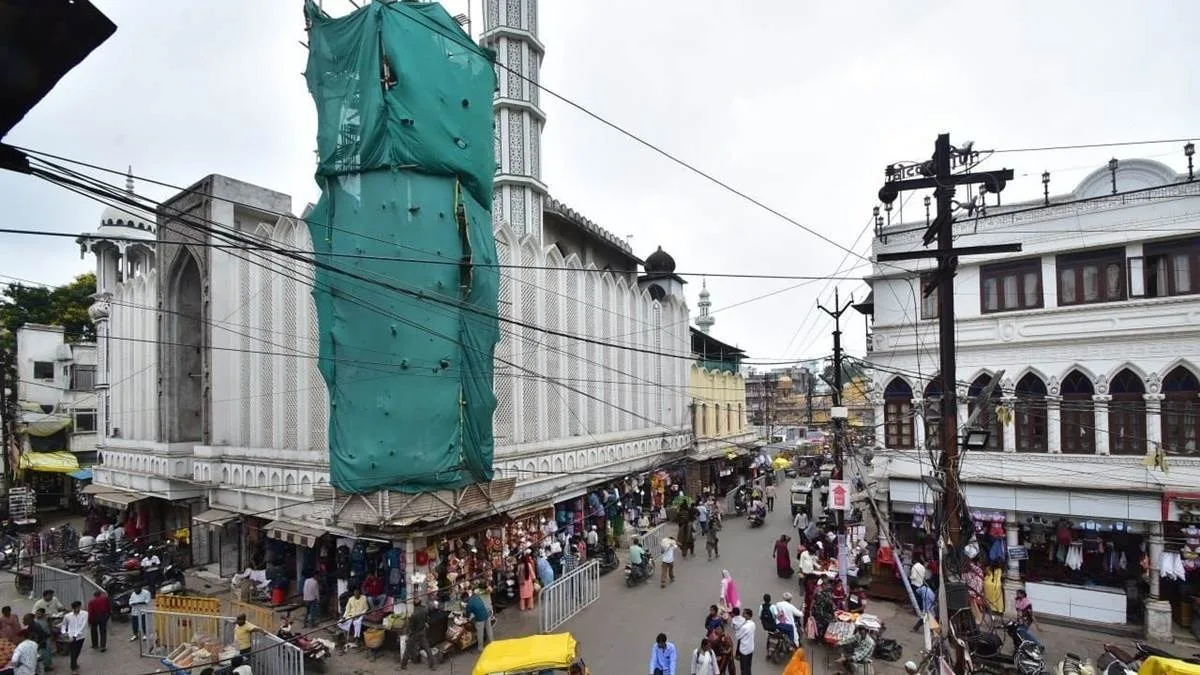
The claim that the Madhya Pradesh government has ordered the complete demolition of Shahi Masjid is not supported by the court record.
The Ujjain Municipal Corporation issued notices on August 14, August 25 and August 27, followed by a final notice/order dated September 1, 2026. The notices concern the removal of the portion of the mosque that obstructs the proposed road widening at Chatri Chowk. The road is planned to be widened to 15 metres under the Ujjain Development Plan 2035.
The mosque management challenged the notices before the Madhya Pradesh High Court, seeking to stop any coercive action, including demolition of any part of the mosque.
On September 9, Justice Sandeep N. Bhatt of the Indore Bench dismissed two connected petitions. The order did not direct the demolition of the entire mosque. Instead, it refused to interfere with the municipal action concerning the obstructing portion.
What is being removed?
The mosque management told the court that the proposed action would affect part of the prayer hall, a reported 120-foot minaret and Mazhar Chouk Shahi.
The petitioners also argued that the property is registered as Waqf property and that alternative land could be used for the road expansion.
The High Court, however, rejected the petitions after examining the municipal action and the objections raised by the mosque’s representatives.
The court noted that the Ujjain Municipal Corporation had followed the relevant statutory procedure and had provided an opportunity for objections and hearing.
High Court backs road-widening action
The September 9 judgment is central to understanding the dispute.
The court considered the requirements of the Ujjain Development Plan 2035, the location of the mosque and the expected crowds during Simhastha Kumbh 2028.
The judgment noted that the mosque is almost opposite the Mahakaleshwar Temple and close to the Kshipra River. The court said the expected arrival of large numbers of devotees made traffic management, public safety and public facilities relevant considerations.
The court also rejected the argument that the religious structure should receive special treatment in the road-widening exercise.
Importantly, the judgment recorded that portions of 10 temples and one mosque on the same road had already been removed as part of the widening exercise. The court also referred to action against around 80 religious structures across the city.
Why is the road being widened?
The road-widening project is connected to the city’s long-term development plan and preparations for Simhastha 2028, when Ujjain is expected to receive very large numbers of pilgrims.
The Shahi Masjid is located in a strategically busy area near the Mahakaleshwar Temple and Kshipra River.
The High Court specifically referred to traffic management and public safety in the context of the upcoming religious gathering.
Reports have also noted that the proposed road alignment affects multiple properties in the area rather than being an isolated action against the mosque. The court’s reference to other religious structures already being affected is significant in assessing the wider context.
Sit-in at mosque raises law and order concerns
The dispute returned to the ground on September 28 after community members gathered inside and around the Shahi Masjid to oppose the proposed removal of the portion falling within the road-widening alignment.
Reports from September 27-28 said that large numbers of people remained at the mosque, with some staying overnight and others joining in shifts. Several companies of police were deployed in the area as the administration prepared to implement the municipal action. Ujjain Superintendent of Police Pradeep Sharma said the administration was trying to resolve the matter through dialogue and had, for the time being, not proceeded with the demolition.
The development has also raised concerns over whether continued occupation of the site could create a law and order situation and turn a local civic and legal dispute into a larger public spectacle. The mosque is not facing demolition in its entirety; the municipal action concerns only the portion that falls within the proposed 15-metre road alignment. The Madhya Pradesh High Court had already declined to stay that partial removal on September 9 after finding that the statutory procedure had been followed.
Continuing to physically prevent the administration from carrying out an action that has survived a High Court challenge could unnecessarily escalate tensions and attract wider attention, including from international media. The protesters are deliberately seeking to create a global media spectacle out of this and play victim card.
Mosque’s age remains disputed
There are also conflicting public claims about the age of the Shahi Masjid.
Some reports describe it as more than a century old, while community representatives have claimed that it dates back much further, including claims of 1390 and an age of more than 600 years. Recent reports have repeated the 636-year claim, but that historical assertion should not be treated as independently established merely because it appears in reports.
The September 9 High Court judgment primarily dealt with the legality of the municipal notices and road-widening action, rather than granting the mosque protection on the basis of a heritage listing.
The factual position is clear: the Ujjain Municipal Corporation is seeking removal of the portion of Shahi Masjid that falls within the planned 15-metre road widening, and the Madhya Pradesh High Court has declined to stop that action.
The court found that the statutory process had been followed and cited the public-interest requirements associated with traffic management and Simhastha 2028. It also noted that other religious structures on the same road had already been affected.