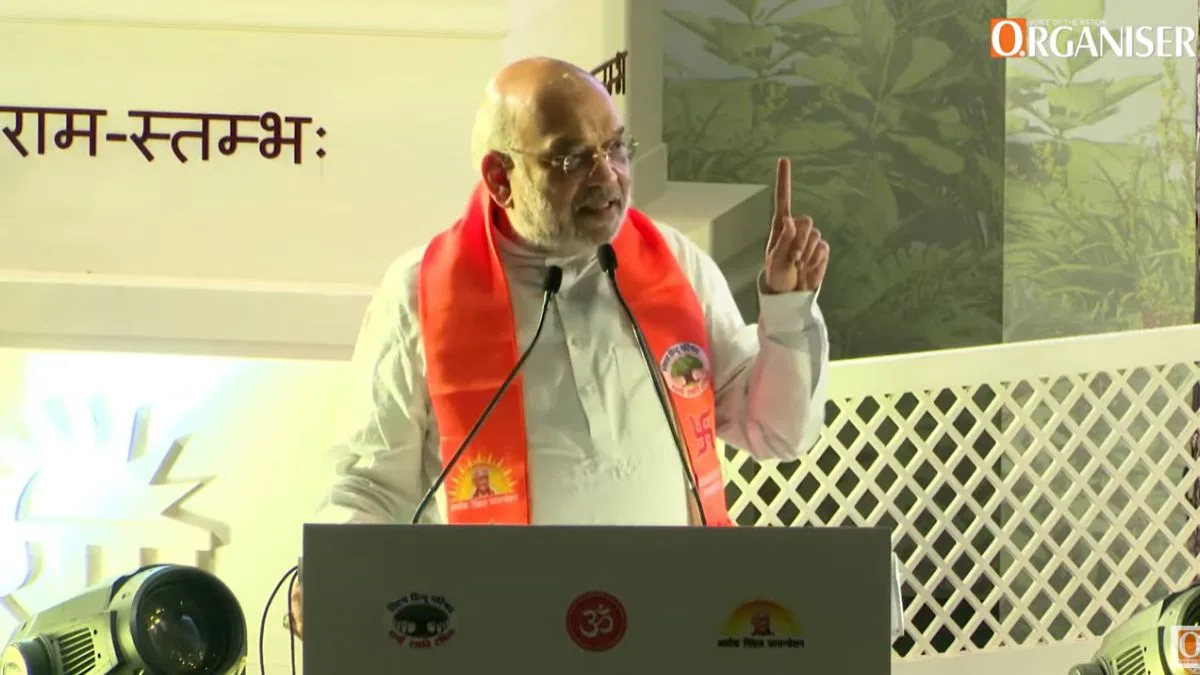
New Delhi, September 27, 2026: Union Home Minister Amit Shah on Sunday described late Vishva Hindu Parishad (VHP) leader Ashok Singhal as a rare personality whose life embodied renunciation, simplicity, exceptional patriotism, devotion to dharma, the spirit of a swayamsevak, and relentless struggle, as he inaugurated the birth centenary celebrations of the revered leader.
Addressing the gathering at Bharat Mandapam, Shah said it was a matter of immense pride for all present to participate in the inauguration of the birth centenary of Ashok ji, who was born 100 years ago and remained exceptional at every stage—as a student, swayamsevak, pracharak, and later as the dedicated leader of the VHP after the Meenakshipuram conversions, living a life devoted to Hindutva until his last breath. Beginning his address with the chants of “Jai Shri Ram,” Amit Shah said that being a part of Ashok Singhal’s birth centenary celebrations is a moment of immense pride for him. He remarked that Ashok Singhal remained exceptional at every stage of his life.
“Friends, such personalities are seen very rarely,” Shah said. “Renunciation, simplicity, exceptional patriotism, devotion to dharma, the spirit of a volunteer, and struggle—in a way, Ashok ji’s life flourished through all these virtues.”
Shah recalled Singhal’s affluent family background and shared a personal anecdote from his teenage years. When a 15-year-old Shah saw the family’s grand car arrive to pick up Ashok ji travelling from Ahmedabad to Udaipur, he naively asked about the need for such a vehicle. Singhal laughed and replied that it was the family’s car, not his own choice.
Despite this background, Singhal lived with extraordinary simplicity. During Shah’s three years of hardship in Delhi—when he was jailed by the then Congress government—he frequently visited Singhal at the VHP office. There, in a mere 20-square-metre room that served as kitchen, bathroom, and bed, the towering leader resided for years. “No one could fathom such simplicity in a person of such stature; I witnessed it personally,” Shah said. That same room now serves as an exhibition space for young workers, marking the 20 years Singhal spent there.This sacrifice, Shah noted, has borne fruit in the construction of the Ram Janmabhoomi temple in Ayodhya—the culmination of over 550 years of struggle, sacrifice.
Amit Shah said that patriotism was one of the greatest hallmarks of Ashok Singhal’s life. He continued his work without seeking any publicity or glorification. He added that Singhal believed Hindu dharma, the Vedas, and the Upanishads embody the spirit of welfare for the entire universe.
Amit Shah stated that the room where Ashok Singhal spent 30 years of his life is worthy of being preserved as an exhibition. His patriotism was exemplary. He noted that Ashok Singhal believed only Hindu dharma, the Vedas, and the Upanishads could ensure the welfare of the entire cosmos, as a Hindu seeks the well-being of the whole universe. Amit Shah mentioned that he worked without any personal glorification or publicity. Ashok Ji’s very identity was forged in struggle. It was his conviction that the stain of servitude in Ayodhya should be erased and a magnificent temple be constructed in its place.
To even question Ashok ji’s devotion to dharma would be meaningless, for he held profound reverence for Hindu dharma, the Vedas, the Upanishads, Sanskrit, Indian culture, and the ascetic monastic traditions of the Sant Parampara, dedicating his entire life to them with unwavering focus and deep commitment. When once asked why devotion to Hindutva mattered so greatly, he replied simply that if anything could secure the welfare of the entire universe, it was Hindu dharma, embodied in the Vedas and the Upanishads. Enhancing the prestige of Hindu dharma, establishing its rightful standing, and carrying its message across the world was therefore not merely an act of identity as Hindus, but a recognition that Hinduism alone seeks the well-being of the entire cosmos—a truth he illustrated by citing the Shanti Mantra, while also recalling Guruji’s teaching that the foundation of all such work must rest solely on selfless and pure love.
