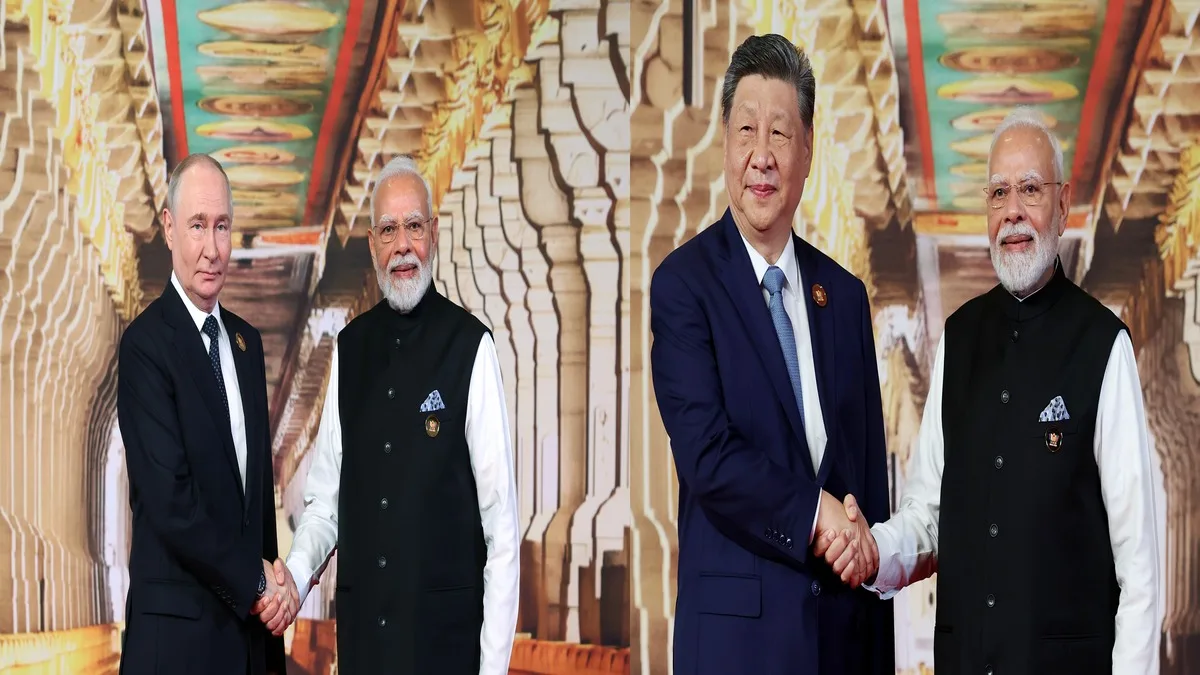
(Left) Prime Minister Narendra Modi and Russian President Vladimir Putin (Right) Prime Minister Narendra Modi and Chinese President Xi Jinping in the backdrop of the Rameshwaram temple corridor in the backdrop of the BRICS 2026 summit
NEW DELHI: September 13, 2026: The sacred and architectural grandeur of Sri Ramanathaswamy Temple at Rameswaram once again found a place in Bharat’s diplomatic imagery as Prime Minister Narendra Modi welcomed world leaders at the 18th BRICS Summit at Bharat Mandapam in New Delhi. The temple backdrop reflects a recurring feature of India’s diplomatic outreach under the Modi government — presenting Bharat’s contemporary global engagement alongside its civilisational and cultural identity.
On September 12, Modi welcomed several prominent BRICS leaders against the backdrop of the iconic Rameswaram temple, including Russian President Vladimir Putin, Chinese President Xi Jinping, Indonesian President Prabowo Subianto, South African President Cyril Ramaphosa and Egyptian President Abdel Fattah el-Sisi. Abu Dhabi Crown Prince Sheikh Khaled bin Mohamed bin Zayed Al Nahyan was also among the leaders photographed against the backdrop. Xi Jinping was seen taking a closer look at the temple image as Modi explained its significance.
The magnificent corridor of Ramanathaswamy Temple
The visual prominence of Rameswaram was particularly significant because the backdrop showcased the temple’s celebrated pillared corridors, among the finest examples of Tamil temple architecture.
The Ramanathaswamy Temple is renowned for its vast corridors lined with intricately carved granite pillars. Its famed third corridor has 1,212 pillars, each contributing to the extraordinary symmetry and scale of the structure. The corridor extends approximately 197 metres from east to west and 133 metres from north to south, making it one of the most remarkable temple corridors in the world.
The long rows of pillars, elaborate stone craftsmanship and monumental proportions represent centuries of Tamil architectural tradition. The corridor is not merely an architectural marvel; it remains part of a living sacred space through which devotees proceed towards the sannidhi of Bhagwan Ramanathaswamy.
Rameswaram occupies a unique position in Bharat’s sacred geography. The Ramanathaswamy Temple is one of the 12 Jyotirlinga kshetras and one of the four Char Dham pilgrimage centres.
Its spiritual significance is deeply connected with the Ramayana tradition. According to the traditional account, Bhagwan Sri Rama worshipped Bhagwan Shiva at Rameswaram after his victory over Ravana. The kshetra consequently carries a profound connection with both the traditions of Bhagwan Sri Rama and Bhagwan Shiva.
The temple’s very identity as Ramanathaswamy — Bhagwan Shiva associated with Rama — reflects this civilisational continuity.
For centuries, pilgrims have travelled to Rameswaram not merely to witness its architecture but to experience its sacred traditions. The temple, its corridors, the 22 theerthams and the surrounding sacred geography together form an important part of Bharat’s pilgrimage civilisation.
The Rameswaram backdrop at the BRICS Summit acquires a larger significance in this context.
As leaders of major emerging powers gathered in New Delhi to discuss global governance, economic cooperation, technology, development and strategic issues, the image of a centuries-old Tamil temple stood prominently behind them.
The juxtaposition was unmistakable: modern diplomacy in the foreground, Bharat’s civilisational heritage in the background.
This approach has increasingly become visible in India’s diplomatic engagements. During the BRICS proceedings, Modi also presented Putin with a Russian translation of the Thirukkural, carrying the wisdom of the Tamil classic across linguistic and national boundaries.
The Rameswaram temple backdrop similarly placed Tamil Nadu’s cultural heritage within a global diplomatic setting.
For Tamil Nadu, the symbolism is especially important. From the sacred island of Rameswaram, the architectural legacy of Tamil civilisation was projected before leaders from Russia, China, Indonesia, South Africa, Egypt and other nations.
The image therefore represented more than a temple backdrop. It conveyed a broader message about Bharat’s engagement with the world — a nation confident in its contemporary diplomatic and economic role while remaining rooted in its civilisational memory.
The BRICS Summit brought together leaders to deliberate on the challenges and opportunities of the contemporary world. Behind them stood the long corridor of Rameswaram — built by generations of Tamil rulers and craftsmen, sustained by generations of devotees and now visible to the world as part of Bharat’s cultural identity.
The photographs of world leaders at BRICS 2026, with the Ramanathaswamy Temple as the backdrop, will resonate across the global media as a powerful reflection of Bharat’s enduring civilisational identity. Its assertion on today’s geopolitical stage is not merely a message—it is an identity carried forward with unwavering confidence. Bharat is presenting its cultural heritage to the world with pride, showing that its ancient civilisation remains deeply relevant in the modern age and stands far ahead of the narrow lens through which contemporary civilisation is often viewed.
Most major world meetings feature backdrops showcasing the Earth’s natural and territorial beauty, or monuments and structures symbolising victory, power, authority and historical achievements. What Bharat chose for BRICS 2026, however, was different.
The backdrop of the Ramanathaswamy Temple showed the world what Bharat’s civilisation and society stand for — a living tradition rooted in Dharma, where the epics, Puranas, temples and sacred traditions continue to shape civilisational consciousness.
The link between Kashi and Rameswaram beautifully sums up the Bharatiya understanding of life — Dharma, Artha, Kama and Moksha. A pilgrimage to these sacred kshetras is not merely a journey across geography; it is a spiritual journey towards Moksha.
That is the message Bharat placed before the world leaders at BRICS 2026: a civilisation that does not merely display its history, but continues to live by it — carrying its timeless Dharmic identity with confidence onto the global stage.
