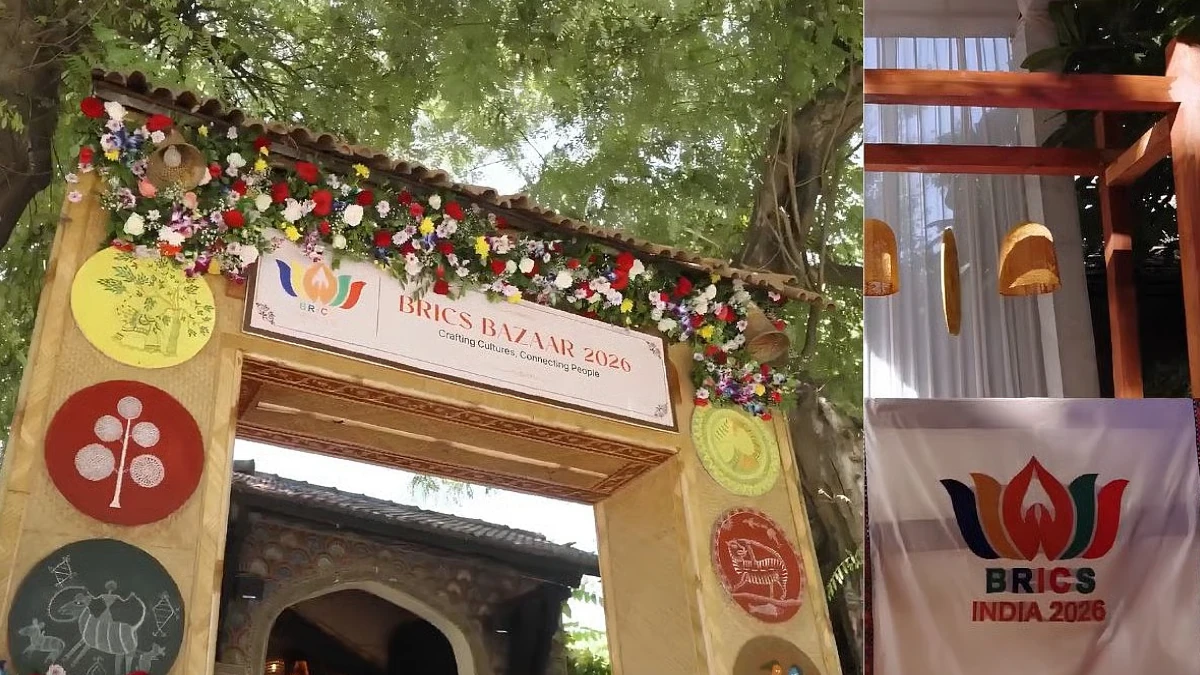
NEW DELHI: As the leaders of the expanded BRICS grouping gathered at Bharat Mandapam for the 18th BRICS Summit, diplomacy in the national capital extended well beyond conference rooms, closed-door meetings and geopolitical negotiations. At the nearby National Crafts Museum & Hastkala Academy, India opened another window into its influence through its artisans, textiles, handicrafts and centuries-old cultural traditions.
The BRICS Bazaar, organised as part of the cultural programme surrounding the summit, brings together artisans, designers and creative enterprises from member and partner countries. Running from September 10 to September 15, the exhibition has transformed the National Crafts Museum into a meeting point for traditions from across the expanded BRICS family.
The Bazaar brings together representatives from 18 BRICS member and partner countries, offering visitors an unusually diverse glimpse into the creative traditions of the expanded grouping.
From China’s Suzhou embroidery and Indonesia’s traditional weaving to Nigeria’s wood and calabash art and South Africa’s Zulu leather craft, the exhibition presents handicrafts not merely as commercial products but as repositories of collective memory.
Brazilian clay art represents one of the Americas’ oldest living craft traditions, while Belarus brings the ancient practice of willow weaving. Kazakhstan showcases silver jewellery combining traditional influences with contemporary design. Iran is represented through the traditional art of Balochi embroidery.
The exhibition therefore functions as something considerably larger than a conventional handicraft fair. It presents BRICS through the lived cultures of its people through the objects they make, the techniques they preserve and the traditions passed from one generation to another.
In an era when international diplomacy is increasingly conducted through competing narratives and competing visions of global order, cultural heritage has become another form of influence.
India puts its artisans at the centre
India’s representation is particularly extensive. Four Indian artisans Riyaz Ahmad, known for Kashmiri papier-mâché; Mohammed Bilai Khatri, associated with block printing; Karan Singh, known for terracotta craft; and Shadab Ahmed, a lac-bangle artisan are conducting live demonstrations.
Six additional Indian artisans are participating in the exhibition. They include young entrepreneur and eco-printing artisan Chawla Shubham; traditional weaver and 2025 recipient of the Kamaladevi Chattopadhyay Award, Jyoti Bhuyan; Solapuri handloom portrait weaver Rajendra Ankam; shawl handweaver and India Book of World Records holder Farhan Rahi; Manipuri weaver Kshetrimayum Indira Devi; and rosewood inlay and marquetry artisan Mohan Kumar.
Traditions travelling across borders
The international exhibits tell equally powerful stories.
Belarusian willow weaving, for instance, transforms flexible willow branches into baskets, furniture, household utensils and decorative objects, preserving techniques that have survived for generations. Belarusian artisan Lana Slastsion, recognised as a People’s Master of the Republic of Belarus, represents the Verbachka folk crafts collective.
Brazilian ceramic artisan and sculptor Cleziania Ribeiro de Lima Paiva brings another ancient tradition to Delhi. Indigenous techniques of shaping riverbank clay were subsequently influenced by Portuguese and African traditions, producing distinctive forms of Brazilian clay art.
Kazakhstani artist-jeweller Serik Rysbekov combines silver, natural stones and hot enamel with traditional Kazakh influences, demonstrating how heritage can evolve without losing its identity.
Iranian artist Nadia Karimi represents Balochi embroidery, a tradition deeply connected to the cultural identity of Balochi women. The intricate motifs are hand-stitched with silk thread, with techniques traditionally passed from mothers to daughters.
These traditions reveal an important aspect of the expanded BRICS framework: behind the statistics of population, GDP and trade are societies with distinct histories and cultural identities.
Diplomacy beyond the conference table
Zahra Pezeshkian, daughter of Iranian President Masoud Pezeshkian, visited the BRICS Bazaar in New Delhi on September 12, along with her husband, Hassan Majidi. She was accompanied by Union Minister for Women and Child Development Annapurna Devi, who took the Iranian guests through the exhibition and the Indian Pavilion.
A cultural connect at the BRICS Bazaar in New Delhi 🇮🇳🇮🇷
Zahra Pezeshkian, daughter of Iranian President Masoud Pezeshkian, and her husband Hassan Majidi visited the BRICS Bazaar, accompanied by Union Minister for Women & Child Development Annapurna Devi.
They explored… pic.twitter.com/vSsDYnMWpP
— DD News (@DDNewslive) September 12, 2026
The visit brought a distinctly cultural dimension to the Iranian President’s first participation in the BRICS Summit as Iran’s President. It also offered a striking illustration of how India is using the summit not merely as a platform for economic and strategic engagement, but as an opportunity to project its cultural identity to an increasingly influential international audience.
Pezeshkian and Majidi toured pavilions featuring traditional crafts, textiles, handlooms and artisanal products. They interacted with artisans, examined craft displays and witnessed demonstrations showcasing the painstaking skills behind several of the exhibits.
The Indian Pavilion was a particular focus of the visit. Annapurna Devi introduced the Iranian guests to regional handlooms, eco-friendly handicrafts and products created by women artisans from rural communities.
At a summit dominated by conversations over trade, finance, strategic autonomy, global power equations and security, India placed its artisans and cultural heritage alongside the formal diplomatic agenda.
For Zahra Pezeshkian, the visit came at a particularly significant moment. Her father, President Masoud Pezeshkian, arrived in New Delhi a day earlier for the BRICS Summit, marking his first participation in the grouping as Iran’s President.
Iran became a full BRICS member as part of the major expansion of the grouping in 2024, alongside Egypt, Ethiopia, the United Arab Emirates and Saudi Arabia. Indonesia joined in 2025.
The expanded grouping now includes 11 members, while Belarus, Bolivia, Kazakhstan, Cuba, Malaysia, Nigeria, Thailand, Uganda, Uzbekistan and Vietnam have joined as partner countries.
BRICS beyond economics
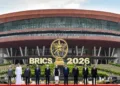
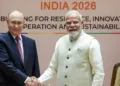
The BRICS Summit is taking place on September 12 and 13 at Bharat Mandapam, with Russian President Vladimir Putin, Chinese President Xi Jinping, Iranian President Masoud Pezeshkian, South African President Cyril Ramaphosa and other leaders attending.
India assumed the BRICS chairship on January 1 and is hosting the 18th summit in a year that also marks two decades since the grouping’s establishment.
Over those 20 years, BRICS has in both membership and ambition. The grouping now represents around half of the world’s population and a substantial share of global economic activity and trade.