G7, BRICS and the Rise of the Global South
October 2, 2026
  • Read Ecopy
  • Circulation
  • Advertise
  • Careers
  • About Us
  • Contact Us
Android AppiPhone AppArattai
Organiser
  • ‌
  • Bharat
    • Assam
    • Bihar
    • Chhattisgarh
    • Jharkhand
    • Maharashtra
    • View All States
  • World
    • Asia
    • Europe
    • North America
    • South America
    • Africa
    • Australia
  • Editorial
  • International
  • Opinion
  • RSS @ 100
  • More
    • World Hindu Congress 2026
    • Op Sindoor
    • Analysis
    • Sports
    • Defence
    • Politics
    • Business
    • Economy
    • Culture
    • Special Report
    • Sci & Tech
    • Entertainment
    • G20
    • Azadi Ka Amrit Mahotsav
    • Vocal4Local
    • Web Stories
    • Education
    • Employment
    • Books
    • Interviews
    • Travel
    • Law
    • Health
    • Obituary
  • Subscribe
    • Subscribe Print Edition
    • Subscribe Ecopy
    • Read Ecopy
  • ‌
  • Bharat
    • Assam
    • Bihar
    • Chhattisgarh
    • Jharkhand
    • Maharashtra
    • View All States
  • World
    • Asia
    • Europe
    • North America
    • South America
    • Africa
    • Australia
  • Editorial
  • International
  • Opinion
  • RSS @ 100
  • More
    • World Hindu Congress 2026
    • Op Sindoor
    • Analysis
    • Sports
    • Defence
    • Politics
    • Business
    • Economy
    • Culture
    • Special Report
    • Sci & Tech
    • Entertainment
    • G20
    • Azadi Ka Amrit Mahotsav
    • Vocal4Local
    • Web Stories
    • Education
    • Employment
    • Books
    • Interviews
    • Travel
    • Law
    • Health
    • Obituary
  • Subscribe
    • Subscribe Print Edition
    • Subscribe Ecopy
    • Read Ecopy
Organiser
  • Home
  • Bharat
  • World
  • Operation Sindoor
  • Editorial
  • Analysis
  • Opinion
  • Culture
  • Defence
  • International Edition
  • RSS @ 100
  • Magazine
  • Read Ecopy
Home World

G7 and BRICS: How the global economic balance is shifting from western world to a rising global south

The G7 and BRICS represent two contrasting centres of global power, with their economic weight, population, resources and growth revealing a rapidly changing world order

Dr Vishnu AravindDr Vishnu Aravind
Sep 12, 2026, 02:00 pm IST
inWorld, International Edition
Follow on Google News
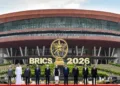
The shifting economic weight of G7 and BRICS reflects the emergence of a more multipolar global order.

The shifting economic weight of G7 and BRICS reflects the emergence of a more multipolar global order.

Facebook
Twitter
WhatsAppTelegramEmail

As New Delhi takes centre stage with India hosting the 2026 BRICS Summit, the gathering highlights the shifting balance of economic and geopolitical power across the world. With major emerging economies coming together under the BRICS framework, the summit provides a significant backdrop for assessing how the global economic order is evolving and how the influence of the Global South is expanding.

The G7 and BRICS now represent two major centres of global influence. The G7 brings together Canada, France, Germany, Italy, Japan, the United Kingdom and the United States, while BRICS has expanded to eleven full members comprising Brazil, Russia, India, China, South Africa, Egypt, Ethiopia, Iran, Saudi Arabia, the United Arab Emirates and Indonesia.

GDP: G7 retains the nominal advantage

In terms of nominal GDP measured at market exchange rates, the G7 remains substantially larger. The United States alone had a GDP of about $30.8 trillion in 2025, according to World Bank data, while India stood at about $4.0 trillion, China at$ 19 trillion and Brazil at $2.3 trillion.

The G7’s economic strength is concentrated in highly developed economies, with the US accounting for the largest share. BRICS, however, combines several of the world’s largest emerging economies, particularly China and India, alongside major commodity producers such as Russia, Brazil, Saudi Arabia and the UAE.

Read More: BRICS Summit 2026: President Putin takes swipe at G7; BRICS drives 40% of Global GDP while west contributes only 18%

The G7 countries collectively account for around US$54.5 trillion in nominal GDP, compared with more than US$32 trillion for the 11 BRICS members; together, the two groupings represent over US$86 trillion in economic output.

At the 2026 BRICS Summit in New Delhi, the 11 BRICS members are joined by 10 partner countries, forming a 21-country BRICS family that collectively represents around 40 per cent of global GDP and nearly half of the world’s population.

Purchasing Power: BRICS moves ahead

The picture changes dramatically when GDP is measured by purchasing power parity (PPP), which adjusts for differences in domestic prices and provides a better measure of the volume of goods and services that economies can purchase within their own markets. According to IMF data for 2025, the 11 BRICS members accounted for 40.7% of global GDP in PPP terms, compared with 28.4% for the G7.

In absolute PPP terms, the BRICS economies together generated approximately US$80.4 trillion, compared with around US$58.6 trillion for the G7 in 2025. Thus, while the G7 retains a significant advantage in nominal GDP, BRICS has a substantially greater weight in the global economy when output is measured according to purchasing power.

Population: A decisive BRICS advantage

Population is perhaps the clearest area in which BRICS outmatches the G7. The 11-member BRICS represents around 48.5% of the world’s population, according to BRICS data.

The G7, by contrast, represents a much smaller share of humanity. Its economies are predominantly ageing advanced societies, while BRICS includes India, China, Indonesia, Ethiopia and Egypt, countries with enormous consumer and labour markets.
This gives BRICS a potentially powerful advantage in terms of future consumption, workforce expansion and market size.

Trade: BRICS expands its global footprint

BRICS countries account for approximately 24% of global trade, according to official BRICS data.
The G7 nevertheless remains deeply embedded in global trade and financial networks. Its members possess sophisticated manufacturing, financial-services and technology sectors and retain major positions in international investment and global supply chains.

The difference is increasingly one of structure that G7 strength is concentrated in high-value services, advanced manufacturing and finance, while BRICS combines manufacturing giants with energy, minerals, agriculture and other commodities.

Energy and natural resources: BRICS holds the edge

BRICS has a particularly strong position in the global energy system. The expanded grouping accounts for approximately 43.6 per cent of global oil production, 36% of natural-gas production and 78.2% of mineral-coal production, according to BRICS data citing the International Energy Agency.

Russia, Saudi Arabia, Iran and the UAE strengthen the bloc’s energy position, while Brazil adds major agricultural and energy resources. This gives BRICS considerable strategic relevance at a time when energy security and critical minerals have become central to global geopolitics.

Military Power: G7 still holds major advantages

The military balance is more complicated. The United States remains by far the world’s largest military spender. SIPRI estimates that the US spent $954 billion in 2025, accounting for 33% of global military expenditure. China spent about $336 billion and Russia $190 billion.

The G7 also benefits from the broader military strength of its Western alliance networks, particularly NATO. Consequently, G7 countries retain a substantial advantage in defence technology, military alliances, global basing and power projection, even though China, Russia and India are among the world’s largest military powers.

Growth: BRICS economies generally have greater momentum

Growth rates also distinguish the two blocs. The IMF’s 2026 projections put India’s growth at 6.4 per cent, Indonesia at 5.0 per cent, China at 4.6 per cent and Brazil at 2.4 per cent. By comparison, the US is projected to grow by 2.3 per cent, Canada by 1.1 per cent, the UK by 1.0 per cent, Japan by 0.6 per cent, France by 0.6 per cent, Germany by 0.7 per cent and Italy by 0.5 per cent.

Based on the IMF’s 2026 real GDP growth projections, the seven G7 economies have an average growth rate of about 1.0%, compared with approximately 3.1 per cent for the 11 BRICS members, highlighting the stronger growth momentum of the expanded BRICS grouping.

Global Influence: Two different models

The G7 and BRICS ultimately represent different approaches to global governance. The G7 is a compact forum of advanced economies that seeks coordinated action on economic stability, security, technology and global challenges.

BRICS, meanwhile, presents itself as a platform for Global South cooperation and reform of international institutions. Its stated objectives include increasing the representation of developing countries in institutions such as the UN, IMF, World Bank and WTO.

The comparison does not produce a simple winner. The G7 leads in nominal economic power, financial influence, advanced technology, military capabilities and institutional reach. BRICS leads in population, PPP-based economic weight, energy resources and the potential of emerging consumer markets.

With BRICS now comprising 11 members and representing nearly half of the world’s population, its expansion signals a broader shift in the distribution of global economic power. The G7 remains a formidable concentration of wealth and technological capability, but the rise of BRICS demonstrates that the global economy is becoming more geographically diverse and increasingly multipolar.

 

Topics: World BankG7BRICS 2026
Dr Vishnu Aravind
Dr Vishnu Aravind
Dr Vishnu Aravind is a researcher, political commentator and writer based in New Delhi, with a PhD from Jawaharlal Nehru University (JNU). His areas of interest include international politics, Indian foreign policy, electoral politics, election analysis, political developments, and cultural affairs. [Read more]
Share
Tweet
SendShareSend
✮ Subscribe Organiser YouTube Channel. ✮
✮ Join Organiser's WhatsApp channel for Nationalist views beyond the news. ✮
Previous News

Modernity belongs to tools and technology, not culture; culture moves through continuity: Mukul Kanitkar

Next News

BRICS Summit: PM Modi flags maritime security, seafarers safety with Iran President; Holds series of bilateral talks

Related News

PM Modi’s Tamil Diplomacy: How Thirukkural Is Taking Tamil Wisdom to the World | BRICS 2026

PM Modi’s Tamil Diplomacy: How Thirukkural Is Taking Tamil Wisdom to the World | BRICS 2026

BRICS New Delhi Declaration 2026

BRICS New Delhi Declaration 2026: Science, technology, energy & human capital for resilient global south

BRICS after New Delhi declaration: A strategic makeover

PM Modi and Russian president Vladimir Putin during BRICS summit 2026 in New Delhi

India-Russia big nuclear push at BRICS 2026: Rosatom offers reactors, SMRs and critical minerals cooperation

BRICS 2026: Brick by Brick

(Left) Prime Minister Narendra Modi and Russian President Vladimir Putin (Right) Prime Minister Narendra Modi and Chinese President Xi Jinping in the backdrop of the Rameshwaram temple corridor in the backdrop of the BRICS 2026 summit

Bharat’s civilisational pride at BRICS 2026: Rameswaram temple corridor frames world leaders

Load More

Latest News

Cocroach Abhijit Dipke

CJP wants the Election Commission to answer tough questions, but who will answer questions about CJP’s funding?

Russian President Vladimir Putin and PM Modi(File Photo)

“PM Modi has very good ideas to end Russia-Ukraine conflict”; President Putin thanks PM Modi for peace efforts

RSS shakha in Aravanchal in Cherupuzha Khand of Payyannoor Sangh zilla, Kannur, Keralam

Keralam: Swayamsevaks respond to CPM attack with increased attendance from 15 to 50 at RSS shakha in Kannur

Flydubai Attack: “Hanuman Chalisa gave me strength”, Smit Machchhar tells PM Modi as Indian pilot’s bravery saved lives

Delhi SIR exercise (A representative image)

Delhi SIR exposes voter list anomalies: 6.4 percent notices for siblings less than 9 months gap – But that’s not all

Indian Express Investigation vs Official Verification: Will the newspaper apologise?

Goa Chief Election Officer fact-checks ‘97 valid voters’ claim by Indian Express; 3 among 97 had Portuguese passports

PM Modi speaks to Captain Smit Machchhar; Wishes speedy recovery

PM Modi speaks to Smit Machchhar, Indian pilot hails PM as “biggest idol”; Footage reveals 9/11-style crash attempt

Keralam High Court

Keralam HC rejects Pakistani wife’s visa plea, says marriage to Indian citizen gives no right of entry

VB-G RAM G: A New Rural Jobs Framework

VB-G RAM G: How India’s new rural employment framework links jobs with village development

USS
Theodore Roosevelt

West Asia Conflict: US sends third carrier USS Theodore Roosevelt with 10K troops as Trump weighs next move on Iran

Load More
  • Privacy
  • Terms
  • Cookie Policy
  • Refund and Cancellation
  • Delivery and Shipping

© Bharat Prakashan (Delhi) Limited.
Tech-enabled by Ananthapuri Technologies

  • Home
  • Search Organiser
  • Bharat
    • Assam
    • Bihar
    • Chhattisgarh
    • Jharkhand
    • Maharashtra
    • View All States
  • World
    • Asia
    • Africa
    • North America
    • South America
    • Europe
    • Australia
  • Editorial
  • Operation Sindoor
  • Opinion
  • Analysis
  • Defence
  • Culture
  • Sports
  • Business
  • RSS @ 100
  • Entertainment
  • More ..
    • Sci & Tech
    • Vocal4Local
    • Special Report
    • Education
    • Employment
    • Books
    • Interviews
    • Travel
    • Health
    • Politics
    • Law
    • Economy
    • Obituary
  • Subscribe Magazine
  • Read Ecopy
  • Advertise
  • Circulation
  • Careers
  • About Us
  • Contact Us
  • Policies & Terms
    • Privacy Policy
    • Cookie Policy
    • Refund and Cancellation
    • Terms of Use

© Bharat Prakashan (Delhi) Limited.
Tech-enabled by Ananthapuri Technologies