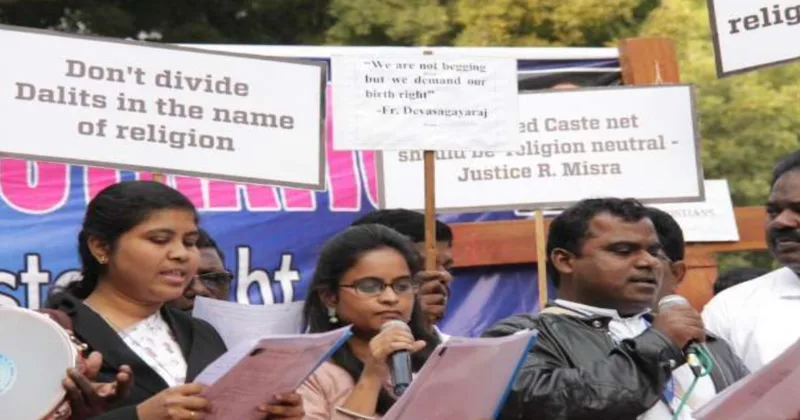
Representative Image
NEW DELHI: Keralam Chief Minister VD Satheesan’s assurance that his government would examine the demand for reservation benefits for Dalit Christians has reopened an old political question. Constitutionally, however, the first question is simpler: what kind of reservation is being proposed?
Indian reservation law does not treat every quota as one common pool.
In Indra Sawhney v. Union of India, the Supreme Court described reservations for Scheduled Castes, Scheduled Tribes and Other Backward Classes as “vertical” reservations. Horizontal reservations, by contrast, cut across those social categories—for example, reservations for women or persons with disabilities. The distinction was subsequently explained in cases including Rajesh Kumar Daria and Saurav Yadav.
That distinction matters here because “Dalit Christian” is not naturally a horizontal category comparable to women or persons with disabilities. If the proposal is to confer Scheduled Caste status, a State Government cannot achieve that through an executive order or by labelling it a horizontal reservation.
Article 341 gives the President the power to specify Scheduled Castes for each State, while Article 341(2) reserves to Parliament the power to include or exclude communities from that list. Order 3 of the Constitution (Scheduled Castes) Order, 1950 presently provides that a person professing a religion other than Hinduism, Sikhism or Buddhism shall not be deemed a member of a Scheduled Caste.
The Supreme Court in Soosai v. Union of India rejected a challenge to the exclusion of Christian converts on the material then placed before it. More recently, the seven-judge decision in State of Punjab v. Davinder Singh permitted States, subject to constitutional requirements, to sub-classify communities already within the Scheduled Caste list for more equitable distribution of benefits. But sub-classification is not the same as adding a new group to the Presidential List. A State cannot rewrite Article 341 by itself.
There is another important Keralam-specific fact. Scheduled Caste converts to Christianity (SCCC) are already recognised in the State’s reservation framework as an Other Backward Class group. Kerala Public Service Commission rules provide them a place within the OBC rotation—two out of every 40 OBC appointments in Last Grade Service and one out of 40 in other direct recruitment.
Therefore, a promise of “reservation” requires legal precision. Is the Government proposing Scheduled Caste status? An enhanced OBC share? A separate backward-class measure based on fresh data? Or non-reservation welfare benefits?
Each route has a different constitutional test.
For an Article 16(4) employment reservation, backwardness and inadequate representation remain relevant. Indra Sawhney also laid down the ordinary 50 per cent ceiling for such vertical reservations, subject to constitutional developments that followed, including the separate EWS framework upheld in Janhit Abhiyan.
None of this means that social disabilities experienced by Dalit Christians cannot be studied or addressed. They can—and any serious policy should begin with evidence.
But sympathy for Dalit Christians cannot override constitutional provisions and thereby become “misplaced sympathy.” If the proposal concerns the Scheduled Caste list, Keralam can recommend and advocate; Parliament may consider the proposal, but it may also decline to act. If it concerns OBC reservation, the State must justify its classification and allocation within the existing equality framework.
Before political promises are made, the category, source of power and effect on existing beneficiaries must therefore be stated clearly.
