Kerala CM Deletes Post on Kanthapuram’s Misogyny After Muslim League Outrage; Sunni Group Meets Satheesan
What began as a show of firm resolve by Kerala Chief Minister V.D. Satheesan against Kanthapuram A.P. Aboobacker Musliyar’s misogynistic remarks lasted only a few hours.Satheesan had publicly rejected the Sunni scholar’s call for women to remain confined to their homes, calling it a 19th-century mindset and a misinterpretation of Islam unfit for progressive Kerala. He reinforced the standby posting a critical video on his official Facebook page, citing the public roles of the Prophet’s wives Khadijah and Aisha.
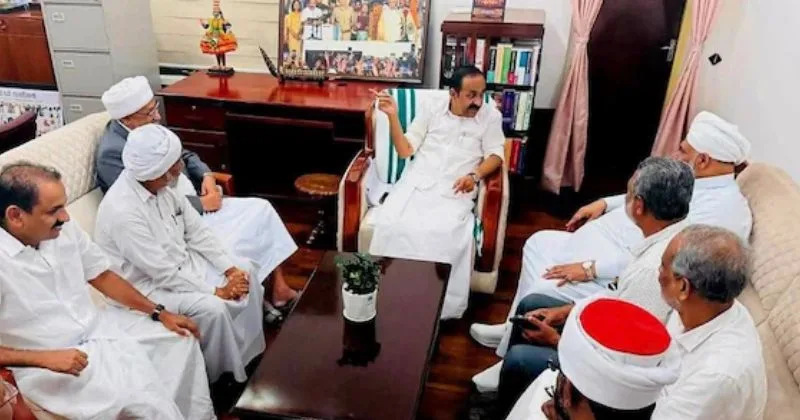
The post did not survive the day.Leaders of the Kanthapuram (AP) faction of Samastha arrived at Cliff House. Among those present were Khalil Bukhari, Vandoor Abdurrahman, Perot Abdurrahman, Saifuddin, Ali Abdullah, Seitalavi Chengara and Siddique. The meeting conveyed sharp resentment. Sources said the leaders claimed the Chief Minister had misinterpreted Kanthapuram’s words and demanded a correction.
Pressure also came from the Indian Union Muslim League. The IUML publicly objected to Satheesan’s post, maintaining that Kanthapuram’s remarks came from a religious leader and that nobody had the right to confront him in this manner. As a major partner in the UDF with significant influence in the government, the League is widely seen as having applied sustained pressure on the Chief Minister. These dynamic carries added weight because Satheesan’s elevation as CM had faced resistance from sections within the Congress itself.
Soon afterwards the Facebook post vanished. The Chief Minister’s office described the removal as a “technical glitch” and insisted the government’s stand remained unchanged. The timing told a different story. The deletion came amid growing pressure from sections of the Muslim community and visible discomfort within the Indian Union Muslim League, a crucial UDF ally that had already softened its response to the original remarks by suggesting they stemmed from concern for women’s safety.
The deletion followed direct engagement with the very faction that felt targeted, amid growing unease from the Indian Union Muslim League, a key UDF ally that had already softened its response to Kanthapuram’s original comments.What was projected as a progressive stand against confining women was quickly dialled back once organised pressure arrived at the Chief Minister’s door. In Kerala’s coalition arithmetic, firm words on gender equality proved remarkably short-lived.
The episode lays bare the limits of progressive rhetoric when confronted with organised community pressure and coalition arithmetic. A public rejection of confining women was issued, amplified online, and then quietly erased after a closed-door meeting. In Kerala’s politics, the Chief Minister’s anti-misogyny stand proved remarkably short-lived.
A progressive rejection of confining women was issued, amplified online, and then withdrawn. In practice, the call to smash patriarchy met its limits the moment organised political realities asserted themselves.
Rahul Gandhi’s much publicised “smash the patriarchy” campaign increasingly looks less like a genuine commitment to women’s empowerment and more like political posturing. The real test of such rhetoric is not what is said on the national stage, but whether it is backed by action when patriarchal attitudes emerge within the party’s own political ecosystem.
In Keralam, that test appears to have exposed a glaring contradiction. While Rahul Gandhi calls on women to challenge patriarchy and reject restrictive traditions, his own party’s government appears to have stepped back from confronting openly misogynistic remarks when coalition equations and community pressures came into play.
So what does “smash the patriarchy” really mean if the Congress leadership is unwilling—or unable—to confront patriarchal voices within its own political alliances? If the rhetoric disappears when electoral interests are at stake, Rahul Gandhi’s “Smash Patriarchy” campaign risks looking less like a serious battle against patriarchy and more like an eyewash designed for political optics to target a special community: bold slogans for public consumption, but selective silence when those slogans collide with vote-bank calculations.
