New Delhi: The issue of Hindu minority persecution in Bangladesh has drawn international attention, with members of the Hindu diaspora staging protests across the United States and the United Kingdom over the killing of Hindus and continuing concerns about attacks on minority communities.
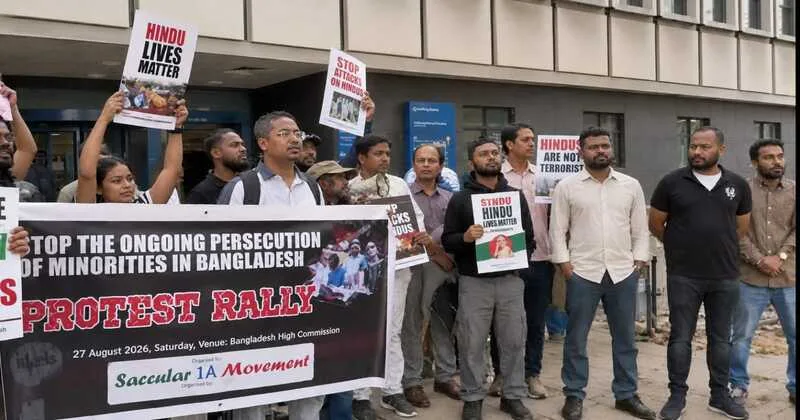
On August 28, 2026, Hindu diaspora groups held demonstrations in New York City and London, demanding stronger action to protect Hindus and other religious minorities in Bangladesh. In Jackson Heights, a major South Asian diaspora hub in New York, protesters raised concerns over the safety and security of Hindus in Bangladesh and called for immediate measures against Hindu persecution and minority persecution. Demonstrators carried placards reading “Stop attacks on Hindus”, “Protect Hindu Communities”, “Hindu lives matter” and “Stop ongoing persecution of minorities in Bangladesh”.
The diaspora protest followed the shocking murder of four members of a Hindu family in Rangpur in Bangladesh. Retired teacher Ganapati Chakraborty, his wife Pritilata Chakraborty, daughter Agami Chakraborty and 12-year-old son Priyam Chakraborty were found dead at their home after the killings, reported to have occurred around August 20–21, 2026. The case has become a major symbol of the growing anxiety surrounding the safety of the Hindu minority in Bangladesh.
At the New York protest, speakers expressed deep frustration over what they described as repeated failures to adequately address attacks and Hindu minority persecution in Bangladesh. One demonstrator said Hindus could no longer remain passive in the face of violence, declaring that “symbolic protests alone will not work” and calling on the community to organise and resist threats to its safety. The remarks reflected an increasingly assertive tone among sections of the Hindu diaspora in the USA and UK.
Rangpur murders and questions over police investigation
The Rangpur killings have also generated intense controversy inside Bangladesh. Police arrested two suspects and initially presented a narrative linking the murders to an alleged confrontation over yaba consumption. However, questions surrounding the police investigation have continued to grow.
On August 29, 2026, the Rangpur City Nagorik Committee publicly raised 19 questions about the police investigation and demanded a judicial inquiry. The committee pointed to inconsistencies and called for greater scrutiny of CCTV evidence, the cutting of the electricity connection, unidentified motorcycles near the house, stolen cash and jewellery, and other aspects of the investigation.
Protest in London against the killing of Hindus in Rangpur, Bangladesh 🇧🇩.#RangpurHinduGenocide https://t.co/XT1hPVg2XY pic.twitter.com/xdICXd2Q92
— Voice Of BD Hindus 🇧🇩 (@HinduUnityBD) August 28, 2026
The committee said the police version should not be accepted solely on the basis of confessional statements and called for CCTV footage, forensic evidence, mobile-phone data and eyewitness accounts to be independently cross-checked. The Rangpur Bar Association also announced that, for the time being, it would not represent the accused because of the brutality of the killings, while maintaining that its position could be reconsidered as the investigation developed.
Bangladeshi police have maintained that the suspects confessed to killing the four members of the family after Ganapati Chakraborty discovered them consuming yaba. Subsequent police briefings revised elements of the reconstruction, while forensic and other evidence remained under examination. Reports have also highlighted the concerns raised by relatives and local citizens over the condition of the bodies and other unanswered questions.
The sharply different interpretations of the case have intensified the debate over Hindu minority persecution in Bangladesh. While some reports and fact-checking organisations have rejected claims that the available evidence has established a communal motive, Hindu organisations and activists argue that the wider context of attacks and insecurity faced by Hindu communities cannot simply be ignored. The crucial question, they insist, is whether the investigation can establish the full truth through independently verifiable evidence.
A louder Hindu diaspora and a growing global concern
The protests in the USA and UK underline the increasingly global nature of concerns surrounding Hindus in Bangladesh. Hindu diaspora organisations are using demonstrations, advocacy campaigns and political engagement to draw international attention to killings, attacks on minority communities and Hindu persecution.
🚨 BREAKING: Hindus came out on the streets demanding justice for the Rangpur Hindu killings.
Jihadi police of Bangladesh stopped their procession. They will not even allow Hindus to protest.#SaveBangladeshHindus #RangpurMassacre pic.twitter.com/07b9Sg8OM4— Voice Of BD Hindus 🇧🇩 (@HinduUnityBD) August 29, 2026
The issue has also emerged amid greater mobilisation of the Indian and Hindu diaspora in the United States. On August 29, 2026, images of RSS Sarsanghchalak Dr Mohan Bhagwat carrying the message “Resolve, Harmony and Dialogue” appeared on Times Square billboards ahead of a major diaspora event at Madison Square Garden. The event, organised around the principle of Vasudhaiva Kutumbakam, reflected the wider visibility and organisational confidence of Hindu and Indian communities abroad.
For protesters in New York and London, however, the immediate message was more urgent that the Hindu minority in Bangladesh must receive protection, serious crimes must be investigated transparently, and minority persecution must not disappear from international attention. The Hindu diaspora protest across the USA and UK has therefore transformed the Rangpur killings into a wider international demand for justice, accountability and security for vulnerable Hindu communities in Bangladesh.