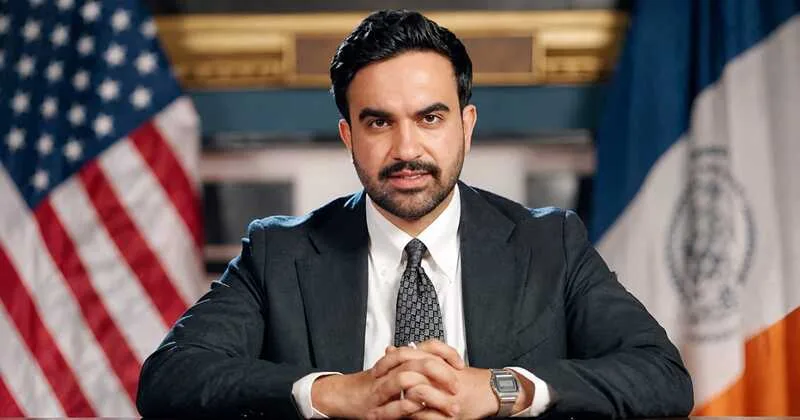
New Delhi: New York City Mayor Zohran Mamdani is facing growing scrutiny after appointing an 18-member Mayor’s Advisory Committee on the Judiciary (JAC) without including a single Jewish attorney, former judge or Jewish legal professional, despite Jews reportedly accounting for around 50 percent of the city’s lawyers.
Jewish legal organizations say the complete absence of Jewish representation from the influential judicial advisory committee raises serious questions about Mamdani’s commitment to diversity and his administration’s promise to build institutions that are “truly reflective of New York City.”
The Mayor’s Advisory Committee on the Judiciary plays a significant role in New York City’s judicial selection process, screening and recommending candidates for appointment to New York City courts. Jewish attorneys had served on the panel under previous administrations. Mamdani’s newly constituted 18-member JAC, however, contains no Jewish member, according to the coalition challenging the appointments.
Jewish legal groups challenge Mamdani’s 18-member judiciary committee
A coalition of prominent Jewish legal organizations condemned the appointments, arguing that Mamdani’s 18-member judicial advisory committee excludes one of New York City’s largest religious and ethnic communities from a body responsible for helping shape the city’s judiciary.
“Your recent announcement of appointees to the Mayor’s Advisory Committee on the Judiciary has left us deeply disappointed,” the organizations wrote. “Not a single Jewish attorney, former judge, or legal professional was appointed to a committee your administration described as one that would be ‘truly reflective of New York City.’”
The Jewish legal groups described the omission as part of what they called “a troubling pattern,” arguing that many Jewish New Yorkers have increasingly felt marginalized under Mamdani’s political approach. They pointed to his rejection of the International Holocaust Remembrance Alliance’s definition of antisemitism and the omission of Jewish neighbourhoods from an administration map highlighting immigrant enclaves.
The organizations stressed that Jewish representation on the Mayor’s Advisory Committee on the Judiciary is particularly significant at a time when New York City continues to record high levels of antisemitic violence and anti-Jewish hate crime. The issue, they argued, is therefore not merely about political disagreement but about whether the city’s most influential institutions adequately reflect the communities they serve.
Anti-Jewish hate crimes dominate New York city statistics
The dispute over Mamdani’s judicial advisory committee has emerged against the backdrop of alarming New York City hate-crime statistics. During the first half of 2026, the NYPD recorded 178 confirmed anti-Jewish hate crimes, accounting for 55.3 percent of all confirmed hate crimes citywide. Jews comprise roughly 10 percent of New York City’s population.
By comparison, police recorded 21 anti-Muslim hate crimes and 33 hate crimes targeting people on the basis of sexual orientation. The 178 confirmed anti-Jewish incidents therefore outnumbered the 21 anti-Muslim incidents by more than eight to one.
Jewish organizations also cited a recent Upper West Side attack in which two people, including one visibly Jewish person, were stabbed without apparent provocation. Police are investigating claims that the alleged assailant shouted “Allahu Akbar” during the attack.
Against this background, the absence of even one Jewish legal professional from Mamdani’s 18-member JAC has intensified concerns about whether the administration is sufficiently attentive to the fears and representation of New York City’s Jewish community.
City Hall has not said that Jewish candidates were excluded because of their religion. The Mamdani administration has defended the appointments by arguing that the committee was assembled to represent a broad range of legal backgrounds and perspectives while making the New York City judicial-selection process more transparent.
However, Mamdani’s critics argue that an 18-member committee with no Jewish attorney, former judge or legal professional is difficult to reconcile with the administration’s stated commitment to a body “truly reflective of New York City”.
The controversy also comes amid Mamdani’s long-running tensions with pro-Israel and Jewish organizations. Throughout his political career, he has faced criticism over his support for the Boycott, Divestment and Sanctions (BDS) movement and his repeated accusations that Israel is committing “genocide” in Gaza.
Mamdani has also declined to affirm that Israel should continue to exist as a Jewish state. During his mayoral campaign, he initially resisted condemning the slogan “Globalize the Intifada,” which many Jews view as an incitement to violence, before later saying he would discourage activists from using the phrase.
The latest dispute could further damage Mamdani’s standing among Jewish voters. A Honan Strategy Group poll conducted in June found that 72 percent of Jewish New Yorkers disapproved of his performance.
For the Jewish legal organizations challenging the appointments, the exclusion of Jewish professionals from the 18-member Mayor’s Advisory Committee on the Judiciary goes beyond electoral politics. They contend that meaningful diversity must include religious diversity and that the absence of Jewish representation from a committee evaluating candidates for New York City courts undermines confidence in an institution expected to represent the full diversity of the city.