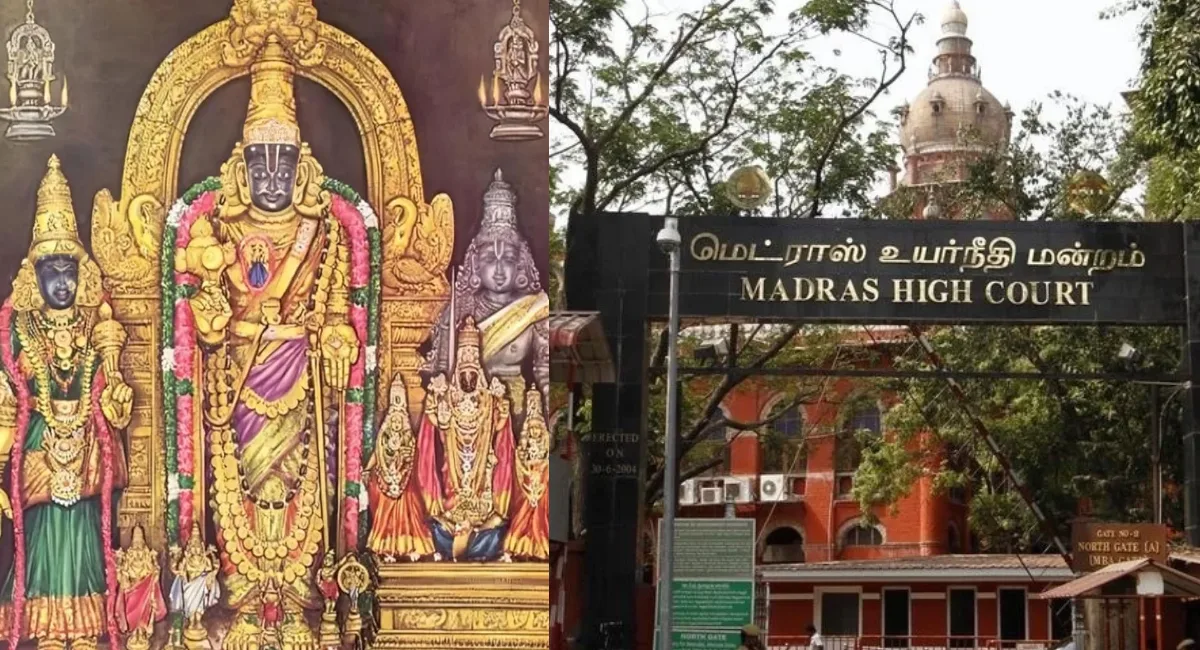
The Madras High Court has held that Executive Officers (EOs) appointed by the Hindu Religious and Charitable Endowments (HR&CE) Department cannot interfere with the religious activities, customary practices and traditions of temples, and that temple administration must vest with the Board of Trustees.
The Division Bench of Justices G.R. Swaminathan and V. Lakshminarayanan delivered the judgment on May 29, 2026, in W.P. No.20764 of 2026, filed by temple activist T.R. Ramesh against the State of Tamil Nadu, the Commissioner of HR&CE and the Fit Person/Executive Officer of Sri Parthasarathy Swamy Temple, Triplicane.
Temple Activist, T.R. Ramesh welcomed this judgement and in a post on X, he said
https://x.com/trramesh/status/2091178275372699663?s=20
Reacting to the verdict, T.R. Ramesh in a post on X said: “No more TN HR &CE Dept Executive Officer doubling as ‘fit person’ in temples as a routine posting should end, describing the ruling as a step towards temples being run by trustees rather than bureaucrats.
The case focused on three issues: whether the Triplicane temple could continue under an EO-cum-Fit Person, whether an EO could double as a Fit Person, and what the limits of an EO’s powers under Section 45 of the Tamil Nadu Hindu Religious and Charitable Endowments Act, 1959, are.
1. EO cannot permanently function as Fit Person
The Court rejected the continuation of the EO-cum-Fit Person arrangement at Sri Parthasarathy Swamy Temple on the basis of a May 11, 1982 interim order. That order had directed the existing EO to continue and also act as Fit Person while restraining the appointment of trustees.
The Bench held that the 1982 order was only an interim order in an appeal, which had itself been disposed of in 1991. Therefore, the interim order ceased to operate once the main appeal ended.
The Court categorically held that temple administration cannot continue under an Executive Officer-cum-Fit Person by relying on that order.
It further ruled that the administration of a temple has to vest in the Board of Trustees. An EO can also act as Fit Person only in exceptional circumstances and for a very brief period. A Fit Person is essentially an interim, ad hoc arrangement.
The Court said the Government or HR&CE Commissioner ought not to vest Fit Person powers in the EO of the same temple and, where such an arrangement is unavoidable, it should be terminated at the earliest. Combining both roles, the Bench said, removes the statutory system of checks and balances.
2. EO’s powers confined to temple properties
The Court then clarified the statutory role of an EO under Section 45(2) of the HR&CE Act, 1959.
It held that an EO can exercise powers only in relation to the administration of temple properties, including movable and immovable properties and temple income. The word “only” in the statutory provision was significant, the Bench said, as it excludes other areas of temple administration.
3. Religious affairs are a “no-go zone” for EOs
In one of the key observations of the judgment, the Bench said: “An area even slightly tinged with religious elements is a no-go zone for the Executive Officer.”
The Court specifically referred to Kumbhabisekam, holding that its date, timings and manner of conducting the consecration are purely religious matters. Anything directly connected with worship falls within the realm of religion.
The Court therefore made it clear that an EO cannot interfere with religious activities, customary practices or traditions of a temple. Such matters must be handled by persons well versed in the customs and traditions of the concerned temple.
What the judgment means
The judgment establishes three key principles for the functioning of HR&CE-administered temples:
Temple administration should vest with Trustees, not permanently with an EO-cum-Fit Person.
An EO’s statutory authority is confined to temple property administration.
Religious worship, rituals, customs and traditions are outside the EO’s authority.
The judgment, however, arose from the specific dispute concerning Sri Parthasarathy Swamy Temple, Triplicane. While its interpretation of Section 45(2) and the principles governing EOs are stated in general terms, the order does not expressly direct the immediate removal of every EO-cum-Fit Person across all Tamil Nadu temples. It instead establishes the legal limits within which such officers must function.
The writ petition was accordingly disposed of on May 29, 2026, with no order as to costs.