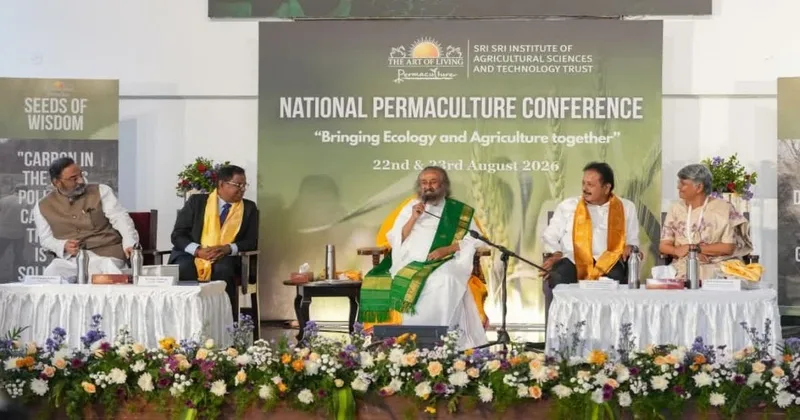
Ramanagara: The growing concerns over chemical residues in food, declining soil health, water scarcity and rising agricultural input costs came under the spotlight at a two-day National Permaculture Conference organised by the Art of Living near Bengaluru.
The conference, held at the Art of Living International Centre in Ramanagara, brought together farmers, agricultural experts, permaculture practitioners, environmentalists and other stakeholders to discuss the need for sustainable and regenerative farming practices. Gurudev Sri Sri Ravi Shankar inaugurated the conference, which focused on creating greater awareness about the challenges facing modern agriculture and exploring sustainable alternatives.
Held under the theme ‘Bringing Ecology and Agriculture Together’, the conference sought to examine the fundamental changes required in the way agriculture is approached. Discussions centred on moving away from farming systems that depend heavily on chemical inputs and seek to control natural processes towards methods that work with nature and make use of its ecological intelligence.
Addressing the gathering, Sri Sri Ravi Shankar said the transition towards natural and regenerative agriculture should not be seen merely as a change in farming techniques. It required a broader change in human consciousness and a greater respect for nature.
He said agricultural development should not be driven by human greed at the cost of natural resources. The health of the soil, availability of water, quality of food and overall human well-being were interconnected and needed to be considered while making decisions related to farming.
“Nature has its own intelligence and we need to respect it rather than trying to dominate it,” he said, stressing the need to develop agricultural practices that work in harmony with ecological systems.
Sri Sri Ravi Shankar said agriculture could not be treated as an isolated activity. It was connected to a much larger ecosystem involving water resources, farmers, consumers, markets, financial institutions, government agencies and human health.
He stressed the importance of bringing different stakeholders together to strengthen the agricultural ecosystem. The Art of Living, he said, sought to connect people and institutions and create platforms where farmers, consumers, financial institutions and producers could work together.
He cited the need to connect banks with farmers and producers with consumers. Such linkages, he said, could help create a more sustainable system in which each stakeholder understood and supported the others. “When we connect everyone, society benefits,” he said.
The spiritual leader also spoke about the significance of the practice of offering a prayer before meals. He said the practice was a reminder that every meal represented the efforts of a long chain of people, beginning with the farmer who grows the food and extending to those involved in transportation, distribution and preparation.
He said consumers should recognise the contribution of farmers and others involved in bringing food to their tables. Greater awareness among consumers, he added, could encourage more responsible choices and strengthen demand for sustainable agricultural products.
The conference also focused on the increasing dependence on chemical-based farming and its potential long-term impact on soil health and food systems. Experts discussed ways to restore soil fertility through natural processes and reduce dependence on chemical fertilisers and other external inputs.
Agriculture Minister N. Cheluvarayaswamy, who participated in the conference, stressed the need to look beyond the immediate returns offered by chemical-intensive agriculture. He said the short-term benefits of chemical fertilisers and other inputs should be assessed against their possible long-term impact on soil and human health. Farmers and policymakers, he said, needed to take a broader view of agricultural productivity and sustainability.
Cheluvarayaswamy said the transition towards natural and regenerative agriculture was not simply about replacing chemical fertilisers with natural alternatives. It involved a change in the overall approach towards farming and required greater awareness among farmers, consumers and other stakeholders.
The minister emphasised that agricultural policies and practices should focus not only on immediate production but also on preserving soil fertility and natural resources for future generations. The conference provided an opportunity for farmers and practitioners to share experiences related to natural farming, permaculture and regenerative agricultural systems. Participants discussed the importance of maintaining healthy soil ecosystems, conserving water, protecting biodiversity and reducing the use of chemicals in agriculture.
Water scarcity was identified as one of the major challenges confronting farmers. With increasing pressure on groundwater and changing weather patterns, experts emphasised the need for farming practices that use water efficiently and improve the ability of soil to retain moisture.
Soil degradation was another major issue discussed during the conference. Experts noted that declining soil health can affect crop productivity and increase farmers’ dependence on fertilisers and other inputs. Regenerative practices, they said, could help restore soil structure and fertility while improving the resilience of farms.