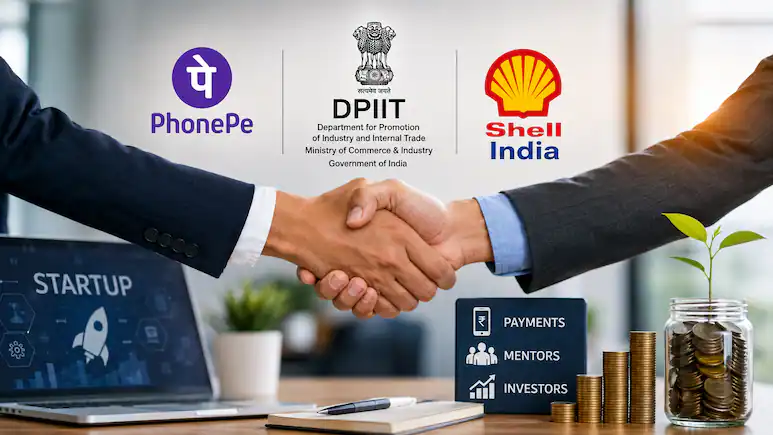
The Department for Promotion of Industry and Internal Trade (DPIIT) under the Ministry of Commerce and Industry has signed separate Memoranda of Understanding (MoUs) with PhonePe and Shell India to strengthen support for DPIIT-recognised startups and promote innovation across key sectors.
The agreements, signed on August 19, 2026, are aimed at expanding startups’ access to technology, digital infrastructure, mentorship, market opportunities, investment networks and industry expertise.
The partnerships are part of efforts to strengthen the country’s startup ecosystem and create an environment in which emerging companies can develop, scale and compete in domestic and international markets.
While the PhonePe partnership focuses largely on digital infrastructure, fintech capabilities and business growth, the Shell India collaboration is targeted at startups working in energy and climate technology.
PhonePe partnership to provide digital and business support
Under its partnership with DPIIT, PhonePe will provide DPIIT-recognised startups with access to a range of digital and business support services.
The company will offer transaction credits through its Payment Gateway, allowing eligible startups to access payment infrastructure as they build and scale their businesses.
Startups will also receive access to the Indus AppStore, along with dedicated onboarding and support services.
The partnership will additionally provide opportunities for startups to improve their brand visibility and connect with a wider digital ecosystem.
For early-stage companies, access to reliable digital infrastructure can be particularly important as they seek to acquire customers, process transactions and expand their operations.
The collaboration is therefore intended to reduce some of the technology and market-access barriers faced by startups during their growth phase.
Masterclasses to focus on fintech, sales and business scaling
The PhonePe partnership will also include regular masterclasses and webinars for startups.
The sessions will cover areas such as: Fintech, sales, go-to-market strategies, business scaling, digital payments, growth and customer acquisition
The objective is to provide founders and startup teams with practical knowledge that can help them improve their business capabilities.
Go-to-market strategy, for instance, can be critical for startups seeking to convert innovative products into commercially viable businesses.
Similarly, expertise in sales, payments and scaling can help companies build sustainable operations as their customer base expands.
The partnership therefore goes beyond providing access to technology and seeks to provide startups with knowledge and practical guidance to support business growth.
Shell India partnership targets energy and climate technology
The second MoU, signed with Shell India, focuses on startups operating in the energy and climate technology sectors.
Under the partnership, Shell India will provide selected startups with mentorship and strategic guidance aimed at helping them develop and scale innovative solutions.
Startups will also receive opportunities to connect with investors and incubators, potentially giving emerging companies greater access to capital and industry networks.
The partnership will also create opportunities for startups to participate in the Shell E4 Smart Energy Track.
The programme is expected to help startups working on energy-related technologies gain exposure to industry expertise and potential growth opportunities.
Supporting India’s clean energy transition
The Shell India partnership comes against the backdrop of growing interest in technologies related to energy efficiency, clean energy and climate solutions.
Startups can play a role in developing technologies and business models that address challenges associated with the energy transition.
Through mentorship, investor connections and access to industry networks, the collaboration is intended to help promising companies move from early-stage innovation towards commercial deployment.
The partnership is also expected to support the development and scaling of solutions that can contribute to India’s broader clean energy transition.
For startups operating in climate technology, access to established industry players can provide opportunities to understand market requirements, test solutions and develop partnerships.
Knowledge-sharing to strengthen the climate-tech ecosystem
The Shell India collaboration will also focus on broader ecosystem development and knowledge-sharing.
The partnership will promote the development and dissemination of:
Sectoral success stories
White papers
Policy briefs
Industry landscape reports
Case studies
Emerging technology insights
These resources are intended to document innovations and best practices emerging in the energy and climate-tech startup ecosystem.
Such knowledge-sharing can help startups, investors, policymakers and industry stakeholders better understand developments in the sector.
It can also highlight successful business models and technologies that may have potential for wider adoption.
Expanding market and investment opportunities
One of the key challenges faced by startups is moving from innovation to sustainable commercial growth.
DPIIT said the partnerships with PhonePe and Shell India are intended to address this challenge by improving startups’ access to market linkages, investment opportunities, technology and industry expertise.
For startups, access to established companies can create opportunities that may otherwise take significant time and resources to develop independently.
Industry partnerships can provide exposure to potential customers, investors, technology platforms and business networks.
The agreements therefore seek to connect startups more closely with established corporate ecosystems.
Focus on DPIIT-recognised startups
The initiatives will specifically benefit DPIIT-recognised startups.
DPIIT recognition provides eligible startups access to various government initiatives and support mechanisms aimed at encouraging entrepreneurship and innovation.
The latest partnerships add private-sector resources to this support ecosystem.
By linking recognised startups with companies such as PhonePe and Shell India, the government is seeking to combine public policy support with private-sector expertise and infrastructure.
The approach is intended to create more pathways for startups to move from the early stages of development towards sustainable growth.
Digital infrastructure as a growth enabler
The PhonePe partnership highlights the growing importance of digital infrastructure for startups.
Payment systems, app distribution, digital onboarding and customer acquisition are increasingly central to the operation of businesses across sectors.
For startups, especially those operating in consumer-facing and technology-driven markets, the ability to quickly integrate payment systems and reach users can influence their ability to scale.
The transaction credits, Payment Gateway access and Indus AppStore support offered under the MoU are intended to give DPIIT-recognised startups additional digital tools as they expand.
The accompanying masterclasses will further focus on helping startups use these tools effectively as part of their broader business strategies.
Industry expertise for emerging companies
The Shell India partnership highlights another component of startup development: access to established industry expertise.
Startups working in energy and climate technology often operate in sectors that require technical knowledge, regulatory understanding, significant investment and long development cycles.
Mentorship and strategic guidance from an established energy company can therefore help emerging businesses understand industry requirements and identify potential pathways to commercialisation.
Connections with investors and incubators can also help startups access funding and business support.
The Shell E4 Smart Energy Track will provide another platform for participating startups to gain exposure and explore opportunities for growth.
Building a more connected startup ecosystem
DPIIT said the two partnerships would strengthen the overall startup ecosystem by connecting emerging companies with technology providers, established industry players, mentors, investors and markets.
The objective is to create an ecosystem in which startups have access to support at different stages of their development.
At the early stage, companies may require technology infrastructure and mentoring. As they grow, they may need market access, investment, strategic partnerships and sector-specific expertise.
The latest MoUs seek to address several of these requirements through partnerships with companies operating in different sectors.
PhonePe brings expertise in digital payments and technology, while Shell India provides access to the energy and climate-tech ecosystem.
Supporting innovation across key sectors
The partnerships also reflect the government’s focus on encouraging innovation across multiple areas of the economy.
The PhonePe collaboration is particularly relevant to the digital economy, fintech and technology-enabled businesses.
The Shell India partnership focuses on energy and climate technologies, areas that are increasingly important as India works to expand clean energy capacity and develop solutions for a changing energy landscape.
Supporting startups in these sectors can contribute to the development of new technologies, business models and services.
The government expects stronger startup-industry linkages to help companies develop solutions that can address domestic needs while also creating opportunities in international markets.
From startup recognition to business growth
DPIIT’s startup recognition framework provides an entry point for eligible companies to access government support.
However, recognition alone does not guarantee commercial success.
Startups still need access to technology, talent, customers, capital and business expertise.
The MoUs with PhonePe and Shell India are designed to strengthen these links.
Under the PhonePe partnership, startups can gain access to digital infrastructure, transaction credits, app distribution and business-oriented learning.
Under the Shell India partnership, startups in energy and climate technology can access mentorship, strategic guidance, investors, incubators and sector-specific programmes.
The combined approach is intended to help startups move from recognition and early innovation towards sustainable business growth.
Public-private partnerships in the startup ecosystem
The agreements also underline the increasing role of public-private partnerships in supporting entrepreneurship.
Government programmes can create policy frameworks, recognition systems and enabling conditions, while private companies can contribute technology, infrastructure, expertise and market connections.
Bringing these capabilities together can provide startups with a wider range of support than either side could provide independently.
For the government, partnerships with established companies also offer a way to connect policy initiatives with practical business requirements.
For companies, working with startups can provide access to emerging technologies, new business models and innovative solutions.
Strengthening India’s innovation and self-reliance goals
DPIIT said the two collaborations would contribute to the development of an inclusive and self-reliant startup ecosystem.
The partnerships are intended to help startups innovate, scale sustainably and contribute to India’s economic growth and technological advancement.
The focus on Indian startups and access to domestic digital and industry networks also aligns with the broader objective of strengthening India’s capabilities across technology-intensive sectors.
In the energy and climate-tech space, the focus on indigenous innovation could also contribute to the development of solutions suited to India’s specific requirements.
What the two partnerships mean for startups
Taken together, the two MoUs provide support across several areas of startup development.
For startups seeking to expand their digital operations, the PhonePe partnership offers payment infrastructure, app distribution, onboarding support and business-focused learning.
For companies developing energy and climate solutions, the Shell India partnership provides access to mentorship, strategic guidance, investors, incubators and specialised industry programmes.
Both collaborations also aim to strengthen market access and industry networks.
The underlying objective is to ensure that promising startups do not remain isolated from the larger business ecosystem but have opportunities to connect with companies, investors, customers and experts.
A wider push to help startups scale
The DPIIT partnerships with PhonePe and Shell India come as India’s startup ecosystem continues to expand across technology, fintech, energy, climate solutions and other sectors.
The government’s focus is increasingly shifting from simply encouraging the creation of startups to helping promising companies scale sustainably and compete in larger markets.
Technology access, mentorship, market linkages and investment networks can play an important role in this process.
The latest MoUs seek to bring these elements together through targeted private-sector partnerships.
The collaboration with PhonePe will strengthen digital and fintech-related capabilities, while the Shell India partnership will support innovation in energy and climate technology.
Together, the initiatives are intended to give DPIIT-recognised startups greater access to the infrastructure, expertise and networks required to turn innovative ideas into commercially viable businesses.
The government expects the partnerships to contribute to a stronger and more connected startup ecosystem, promote innovation across emerging sectors and support India’s broader goals of economic growth, technological advancement and self-reliance.