The question is one of faith. With the strength of faith, a person can accomplish even what appears impossible. A lack of faith gives rise either to despair or to rebellion. It is generally said that adverse circumstances give birth to disbelief. To some extent this may be true, but faith is fundamentally a matter of sanskars. If the mind has been nurtured with emotional and positive values, it does not abandon faith even in the most adverse circumstances.
Today, an atmosphere of distrust is visible in society. Trust between individuals is steadily declining. It has become a tendency of the present-day media ecosystem to generalise the faults of a few individuals and portray them as representative of an entire class. As a result, a large section of the youth is being engulfed by deep mistrust and loss of faith. However, reality is not as discouraging as today’s youth often perceive it to be. Even today, if one proceeds with the right approach, patience and sustained effort, justice can be attained. The system may have shortcomings, but the possibilities for change have not disappeared.
When faith breaks down, a person can no longer see any path ahead. Every available institutional mechanism appears ineffective. In such a situation, expressing one’s anger on the streets seems to be the easiest course of action. This is why such protests are becoming increasingly common today, as the patience required for sustained effort is often lacking.
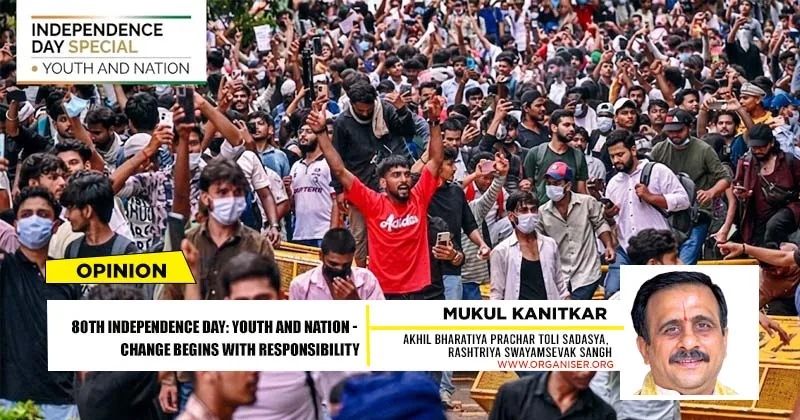
The recent protest by youth at Jantar Mantar was also a reflection of this broader state of mind. Thousands of young people gathered there over concerns regarding irregularities in examinations, demands for transparency and anxiety about their future. Their anger was genuine. In a democracy, every citizen has the right to express his or her views peacefully. At the same time, an equally important question arises: is protest alone the ultimate means of bringing about change? Unless movements are accompanied by organisation, study, dialogue, lawful struggle and long-term social participation, momentary anger cannot be transformed into lasting change.
Foundation of Constructive Action
Such emotional outbursts are often temporary. Many who participate derive satisfaction merely from the feeling that “at least we did something.” The unfortunate consequence of venting frustration in this manner is that the energy which could have become the foundation of constructive work gradually gets exhausted. Real change comes not merely by blaming others, but by accepting responsibility oneself. Holding the Government accountable is fundamental to democracy, but expecting every problem to be solved solely by the Government, without reflecting upon one’s own responsibilities, cannot become the path to change.
The guiding principles for effective transformation can be found in the life of Swami Vivekananda. Anyone who seeks to bring about a revolution must begin with oneself. Swami Vivekananda never accepted anything merely because someone had said it. He undertook his own experiments in search of truth. He travelled across the entire country and understood its people firsthand. The circumstances during his time were even more difficult and adverse than those of today. One can imagine the state of mind of that twenty-nine-year-old youth after travelling throughout the country. Yet he did not allow the turmoil within him to turn into chaotic rebellion. Before awakening and enlightening society, he prepared himself with complete patience. He realised the purpose of his life and the plan to fulfil it.
Let us, on this occasion of national reflection, resolve to awaken faith within society. Like Swami Vivekananda, let us strive to awaken within ourselves the experience of Bharat. This cannot be achieved merely through slogans
His meditation on the Sripada Shila (Rock) at Kanyakumari in December 1892 became the defining turning point of his life. It was not merely an act of personal spiritual practice, but a meditation upon the nation, in which he experienced Bharat within himself. It was an experience of the living spirit of Bharat, a realisation of the eternal national consciousness flowing through the ages. Only through such realisation does one earn the authority to enlighten others. It was during this meditation upon the nation that Swami Vivekananda experienced the unique character of Bharat. He recognised the fundamental principles that had made Bharat what it is. He understood that Bharat’s life mission is to provide all humanity with a scientific, blissful, eternal and universally beneficial vision of life. This is the very foundation of Bharat’s identity as Jagadguru.
Therefore, even under the most difficult circumstances, he never belittled Bharat’s Dharma, society, culture, traditions or literature. He recognised their inherent nobility and realised that making Bharat aware of its own greatness was the mission of his life. For the next ten years, he dedicated his entire life to that mission. A clear realisation of one’s life purpose is the first step of every revolution. For this, faith is indispensable. The inner strength born of faith alone can transform anger into the energy of constructive revolution.
Let us, on this occasion of national reflection, resolve to awaken faith within society. Like Swami Vivekananda, let us strive to awaken within ourselves the experience of Bharat. This cannot be achieved merely through slogans. It requires self-reflection, patience, discipline and sustained spiritual practice. Realisation alone gives one the authority to enlighten others.
To today’s angry youth, only this much needs to be said: do not allow your anger to dissolve into futile lamentation. Let it mature within you through discipline and introspection. Only when that energy is united with wisdom, patience and faith will it become the foundation of new creation. A voice raised on the streets becomes a force capable of changing history only when it is joined with character, organisation and a resolve for nation-building.