When Congress MP Priyanka Gandhi Vadra called IIT Madras Director Prof V Kamakoti a “gaumutra expert” during the debate on examination reforms, it probably landed exactly as intended — as a laugh line, a moment of political theatre. But watch it again, and something more troubling comes into focus. It reflects a habit we have slipped into: whenever an indigenous tradition or a civilisational symbol enters public discourse, ridicule often precedes reason.
The irony is that Parliament was meant to be addressing a serious issue that day. After a string of paper-leak scandals had shaken public trust in Bharat’s examination system, the country needed a substantive discussion on institutional accountability, technological safeguards, transparency and reform. Instead, millions of students watching the proceedings were presented with a spectacle built around a sarcastic remark aimed at one member of the examination reform committee.
Let us first be clear about one thing: no one is above scrutiny in a scientific society, and Prof Kamakoti is no exception. If he has made claims about the medicinal properties of Gaumutra, those claims must stand the test of evidence, reproducibility, peer review and the entire, often unglamorous, machinery of scientific validation. That standard applies whether a claim emerges from a laboratory or a Vedic text. Nothing deserves acceptance—or rejection—simply because it is ancient. Yet there is a distinction between criticism and mockery that is increasingly being overlooked. Prof Kamakoti has repeatedly maintained that his remarks were not expressions of faith; he has referred to published literature, including international studies, which he interprets as indicating antibacterial, antifungal and anti-inflammatory properties of preparations derived from indigenous cow products. If that evidence is considered inadequate, it should be challenged with stronger evidence. Scientific understanding advances as new data emerges. The proper response to a claim is a better claim, not a punchline delivered across the floor of the Lok Sabha.
It is also worth considering who is being reduced to a one-line joke. Prof Kamakoti did not earn national recognition because of a single controversial remark. He is one of the country’s leading computer scientists, the Director of IIT Madras, a former Chairman of the Joint Entrance Examination (JEE), and an academic who has spent decades contributing to Bharat’s technological and educational landscape. He was appointed to the examination reform task force because of that record—his expertise in higher education, technology and institutional administration. We cannot ask accomplished experts to step into public life and then ridicule them the moment they express views that differ from our own. Do that often enough, and the message to Bharat’s finest academics becomes unmistakable: remaining silent is safer than participating in public debate. That would be a far greater loss for our institutions than any policy disagreement.
The Symbol Behind the Sarcasm
But the target of the remark was not really Prof V Kamakoti alone. It was also the cow—a symbol that has occupied a central place in Bharatiya civilisation for thousands of years, yet one that is now discussed largely through an ideological lens, stripped of the historical context that shaped its significance. That history is mostly material, not mystical. Bharat eternally emphasised on agriculture, and the cow was the center of that economy — milk for households, bullocks for the fields, dung for fuel and fertiliser. Reverence for the cow grew out of understanding its importance as much as devotion. It was gratitude towards an animal that quite literally kept the civilisation fed.
You can trace this through the literature. The Rig Veda calls the cow Aghnya which means ‘not to be killed.’ The Atharva Veda ties cattle to prosperity and shared welfare. The Mahabharat treats the protection of cows as part of what makes a king righteous. The Puranas describe the cow as a stand-in for abundance itself. None of this is an isolated religious rule that can be shrugged off as quaint. It is a civilisation working out, long before the term “ecological balance” existed, how agricultural sustainability and human prosperity were tied together and encoding that understanding into what it chose to hold sacred.
Underneath all of it sits the idea of Dharma, a term often inadequately translated as “religion.” Dharma is closer to the principle that holds order and balance together, between rights and duties, between people and the natural world they depend on, between what you are free to do and what you owe to others. It says, in effect, that prosperity without restraint eventually collapses, and that no civilisation survives for long once it forgets its correlation with nature. Reverence for rivers, forests, and animals flows naturally out of that worldview. The cow became one of its central symbols not by accident, but because it embodied nourishment without exploitation.
Professor V Kamakoti: A National Asset
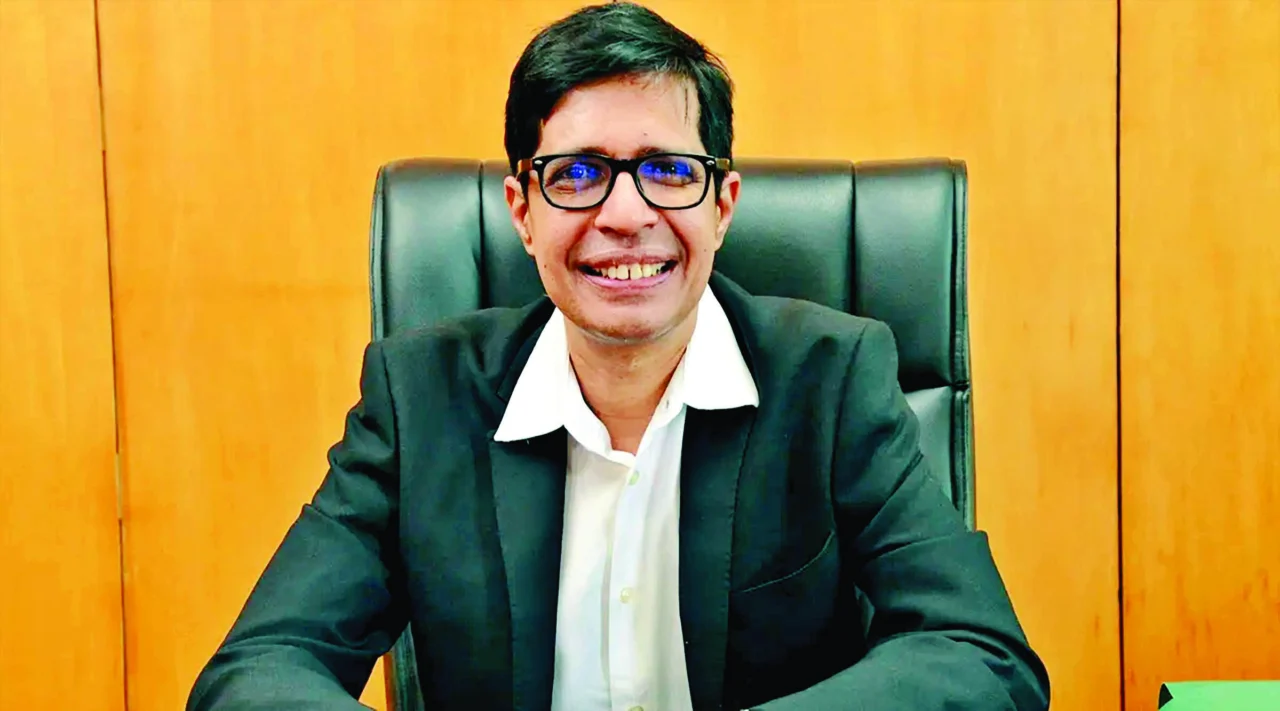
Professor Kamakoti was conferred the Padma Shri for his pioneering contributions to SHAKTI, Bharat’s first indigenous microprocessor, as well as for his work in telecommunications security and cybersecurity.
Education
Professor V Kamakoti earned both his Master of Science (MS) and PhD in Computer Science and Engineering from IIT Madras. He joined the institute as a faculty member in 2001 and has been associated with the premier institution for more than two decades. In January 2022, he assumed office as the Director of IIT Madras.
Career And Areas Of Expertise
Professor Kamakoti is widely recognised for his work in computer architecture, information security, and VLSI design. During his academic career, he has led several high-impact technology initiatives, including the Microprocessor Development Programme and the Information Security Education and Awareness Programme, both supported by the Ministry of Electronics and Information Technology (MeitY), Government of Bharat.
Role In National Policy And Technology
Apart from his academic responsibilities, Professor Kamakoti has contributed to several national technology and security initiatives. He is a member of the National Security Advisory Board (NSAB) and previously served as the Chairman of the Artificial Intelligence Task Force constituted by the Ministry of Commerce and Industry, Government of Bharat. He has also served on technical committees of the National Stock Exchange (NSE) and the Reserve Bank of India (RBI), contributing his expertise to technology policy and governance.
Research Contributions
Professor Kamakoti has made significant contributions to computer science research. He has authored more than 150 research papers published in international journals
Awards And Honours
Professor Kamakoti has received several prestigious honours for his contributions to education, research, and technology, including:
- DRDO Academic Excellence Award
- Indian Electronics and Semiconductor Association (IESA) Techno Visionary Award
- Abdul Kalam Technology Innovation National Fellowship
- ACCS Lifetime Achievement Award
- IBM Faculty Award
- VASVIK Industrial Research Award
One of the most forceful modern defenders of cow protection was not a religious hardliner, it was Gandhi ji. He called cow protection “the gift of Hindu Dharma to the world” and once wrote that “the cow to me means the entire sub-human world.” For Gandhi ji, this was not majoritarian politics; it was an argument about compassion and responsibility towards creatures that cannot advocate for themselves. It is hard to square that understanding with how casually the subject now gets tossed around as material for a punchline.
The relationship between the Congress and cow protection is far more nuanced than contemporary political discourse often suggests. Long before the issue became deeply polarised, many of the party’s tallest leaders openly recognised the cow as a symbol of Bharat’s civilisational ethos and rural economy. Madan Mohan Malaviya, Bal Gangadhar Tilak and Lala Lajpat Rai similarly viewed the protection of the cow as integral to Bharat’s cultural life. Even after Independence, the Constituent Assembly, in which the Congress enjoyed overwhelming influence, incorporated Article 48 into the Directive Principles of State Policy, directing the State to prohibit the slaughter of cows, calves and other milch and draught cattle. The provision was not inserted as a theological mandate but as a recognition of the cow’s economic, agricultural and cultural significance.
Knowledge Tradition of Bharat
None of this sits in tension with Bharat’s tradition of inquiry, it is quite the opposite. The Vedic line “Ā no bhadrāḥ kratavo yantu viśvataḥ” (let noble thoughts reach us from every direction), comes from a civilisation confident enough to take ideas from anywhere. The Upanishads are built as a chain of relentless questions, not a catechism. The Nyaya school built out formal logic and epistemology centuries before comparable European developments. The Charaka Samhita insisted that physicians pair scripture with direct observation. The Sushruta Samhita documents surgical techniques that were, for their time, remarkably advanced. Shastrartha, structured public debate between rival schools of thought and was institutionalised precisely because truth was assumed to emerge from argument, not obedience.
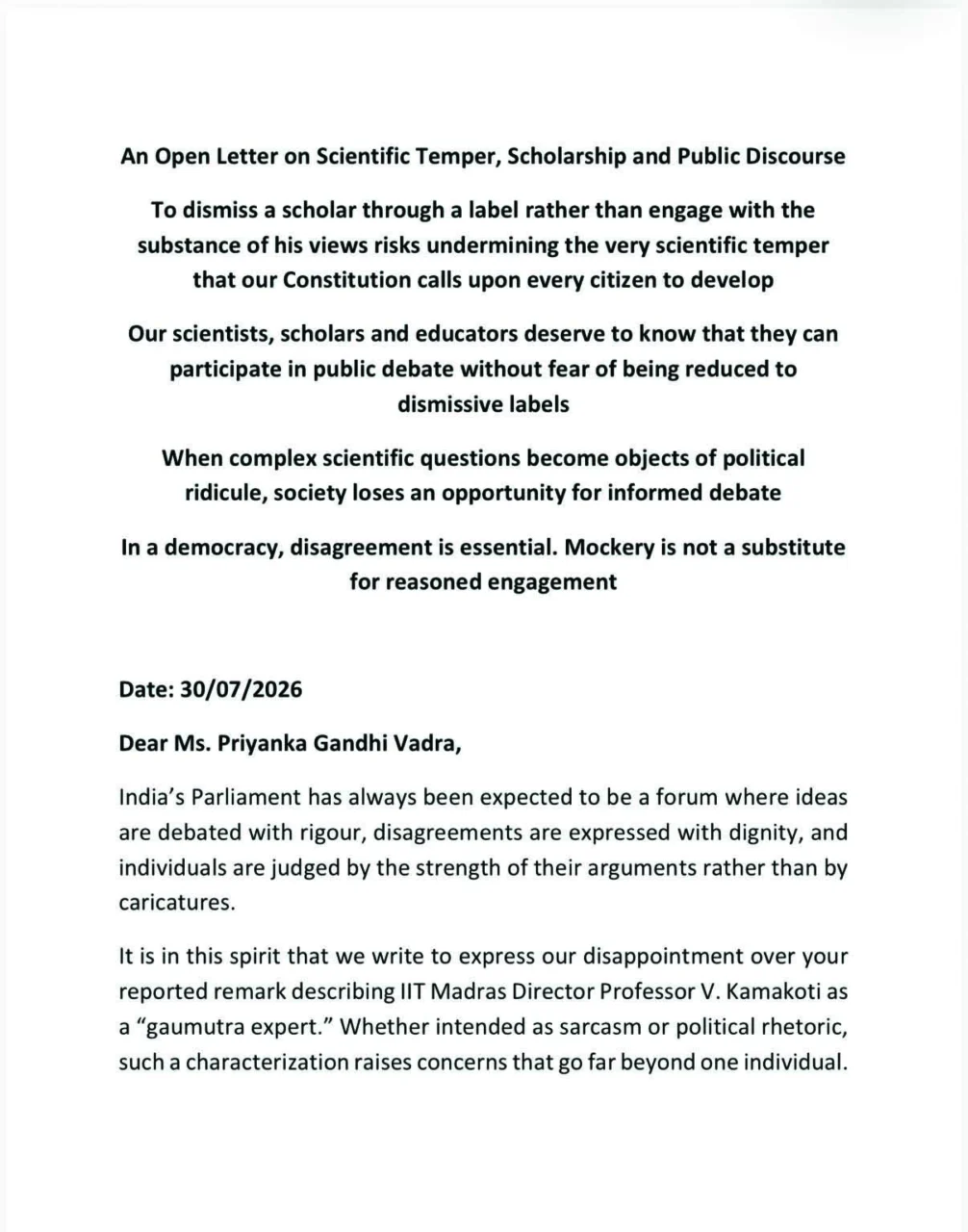
So the idea that Bharatiya civilisation ever treated science and tradition as enemies does not really hold up historically. The same civilisation that revered the cow also gave the world Aryabhatta’s astronomy, Panini’s grammar, Baudhayana’s geometry, and Sushruta’s surgery. Rational inquiry and civilisational confidence grew up side by side here, not as rivals. Testing a claim that happens to come from an indigenous tradition is entirely in keeping with that inheritance. Dismissing it without testing is not scientific either, it is just prejudice wearing a lab coat.
Prof V Kamakoti’s specific reading of the evidence might hold up, might partly hold up, or might turn out to be wrong. That is for science to settle, not Parliament. What Parliament owes the country is different: a culture of reasoned debate, protection for academic seriousness, and basic respect for its own institutions. When it turns accomplished scholars into caricatures and civilisational symbols into punchlines, it does not diminish them. It diminishes itself.