When Prime Minister Narendra Modi chose Varanasi, his own constituency, to launch a national power scheme in September 2015. The Integrated Power Development Scheme (IPDS) was notified by the Union Ministry of Power on 3 December 2014 with a national outlay of Rs 32,612 crore, of which Rs 25,354 crore was central budgetary support. It was the Indian flagship instrument for fixing the neglected last mile of urban electricity. Nowhere would its ambition be tested more severely than in Uttar Pradesh, a state whose distribution network was in parts, losing more power than it delivered. A decade on, the scheme fingerprints run from the ghats of Kashi to the reborn grid of Ayodhya.
What IPDS is set out to do
IPDS was not a generation scheme; it targeted the wires, meters and substations of urban India, the segment where losses hide, and reliability is won or lost. Its three declared objectives were the strengthening of sub-transmission and distribution networks in urban areas, the metering of distribution transformers, feeders and consumers and the IT enablement of the distribution sector, carrying forward the unfinished work of the earlier R-APDRP. Underground and aerial bunched cabling, solar panels on government buildings and end-to-end energy accounting were folded in. The Power Finance Corporation was made the nodal agency and received central grants of 60 per cent, with a further 15 per cent linked to milestones such as verified reductions in Aggregate Technical and Commercial (AT&C) losses tied money to measurable results rather than mere expenditure.
Prime Minister Narendra Modi, addressing Varanasi in September 2015, said he was happy to launch this nationwide project from the city and urged residents to switch to LED bulbs so that electricity bills can be slashed and homes better lit. He restated his government’s larger pledges to bring power to every village and every household in India by 2022, the seventy-fifth year of Independence. The scheme, in his telling, was one plank of a promise of 24×7 power for all a phrase that would recur across the decade of distribution reform that followed.
The scheme’s least visible component was arguably its most consequential. IT enablement meant that every input point and outgoing feeder in a covered town would be metered with downloadable meters, so that the quantum of power entering an area could be reconciled against the quantum billed. Where that reconciliation is possible, loss ceases to be an abstraction and becomes a number attached to a specific feeder, specific transformer, specific locality, and a number that can be tracked is a number that can be brought down. This is the quiet discipline behind the headline: cabling works not burying wires, but building an accounting system in which electricity can no longer disappear unnoticed between the substation and the meter.
Varanasi, the first city with IPDS
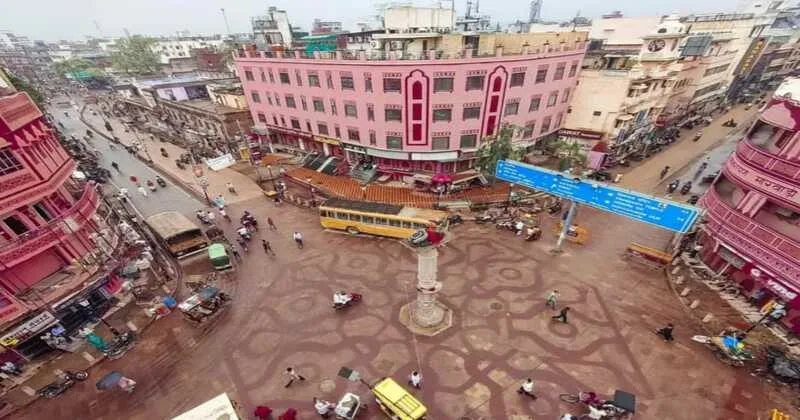
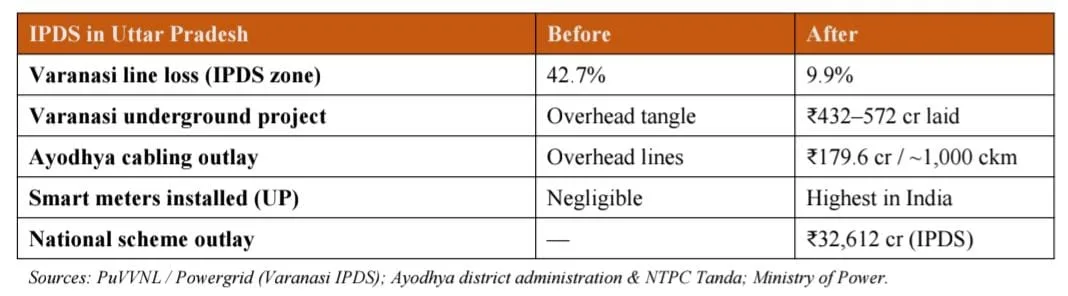
The clearest evidence that IPDS could transform a genuinely difficult network came from Varanasi itself. A Rs 432-crore underground cabling project for the city’s allocation later cited at around Rs 572 crore set out to bury the dangling overhead lines that had hung over the old city for the better part of a century. Powergrid engineers laid underground lines across a 16-square-kilometre stretch serving some 50,000 consumers through serpentine lanes and congested markets, the project manager candidly rated it among the most complicated cabling environments they had encountered anywhere. Eleven old substations were modernised and two new ones built.
“Line loss in the area covered by IPDS has come down to 9.9 per cent from 42.7 per cent.” as per the MD of Purvanchal Vidyut Vitaran Nigam Limited.
Where nearly forty-three paise of every rupee of power had been bleeding away through technical loss and the ease of theft on exposed lines, the loss fell to under ten paise once the network went underground and metered. Consumer complaints dropped in step. A recovery of vast quantities of electricity that had simply never reached a paying meter.
Ayodhya and the wider urban footprint
Ayodhya became the scheme’s second showcase, and its treatment was significant enough that the Revamped Distribution Sector Scheme (RDSS), which subsumed IPDS, made special provision to fund Ayodhya’s IPDS works until March 2023, beyond the general cut-off. Underground and aerial bundled cabling was rolled out at an outlay of about Rs 179.6 crore, with roughly a thousand circuit-kilometres of cable planned to strip the temple town of its overhead clutter ahead of its emergence as a global pilgrimage centre. The work sat alongside a new 220 kV substation and associated high-tension lines, knitting a modern grid beneath a city being rebuilt above ground.
Beyond these two marquee cities, Uttar Pradesh was among the largest beneficiaries of IPDS nationally. Underground cabling reached parts of the state’s temple and pilgrimage circuit, thousands of new distribution transformers were commissioned to firm up urban supply, and the state recorded the highest number of smart meters installed of any state in India under the associated metering drive. Each smart meter closes the same gap that the Varanasi cables closed between the power that flows and the power that is billed by removing human discretion from the reading and making tampering visible.
From IPDS to a state transformed
IPDS urban gains were mirrored by its rural counterpart, through the Deendayal Upadhyaya Gram Jyoti Yojana, and by Saubhagya’s household electrification drive. Together, they laid the physical and commercial foundations on which the Yogi Adityanath government built the supply expansion of recent years. The state’s own account of that period of Uttar Pradesh, in the government’s words, was “once known for power shortages, unscheduled outages and a weak electricity infrastructure,” and has since established “a new identity in power generation and supply.” Between 2014 and 2017, consumers could not get power to match demand despite tariffs rising steeply, the state by 2026 was meeting record peak demand while extending supply beyond the fixed roster.
Part of what made the difference was coordination between a Union scheme and a state administration pulling in the same direction. A centrally sponsored programme like IPDS can sanction funds and set milestones, but the laying of cable, the acquisition of substation land, the clearing of encroached rights of way and the enforcement against theft all fall to the state and its distribution companies. The alignment of central financing with sustained state execution—what the government describes as the double-engine model- lets projects that might elsewhere have stalled move from a detailed project report to an energised line. Ayodhya’s extended funding window and the concentration of effort in Varanasi both reflect that alignment at work.
“Uninterrupted electricity supply is being ensured across all regions of the state despite extreme heat and steadily rising demand.”- Yogi Aadityanath.
The supply roster fixed under the state government 24 hours for district headquarters, 21.5 hours for tehsil headquarters and 18 hours for rural areas, now functions as a floor rather than a ceiling, with towns and cities receiving near-continuous power and villages drawing between 22 and 22.5 hours daily. The scheme that began as buried cable in Varanasi thus reads, in hindsight. As the opening chapter of a longer distribution turnaround, first fix the network, then meter it honestly, and only then can a round-the-clock supply be promised without embarrassment.
Honesty about the unfinished parts strengthens rather than weakens the record. Loss reduction on the scale achieved in the Varanasi IPDS zone has not been uniform across every town, and citizen grievances about outages persist in pockets. A reminder that a fixed network still demands continuous maintenance. The distribution companies carry heavy accumulated deficits, and the financial turnaround of the utilities trails the physical one. It is also fair to note that Varanasi and Ayodhya received concentrated attention as flagship cities; the task ahead is to spread that same rigour to every district headquarters and beyond.
In the city of Kashi, where light has been a sacred idea for millennia, the removal of the overhead tangle and the recovery of stolen power was a quiet act of restoration of order, dignity and promise. IPDS will be remembered less for its acronym than for what it demonstrated that with political will, verified metering and honest engineering, even India’s most burdened distribution networks can be made to keep the light on. That is the enduring lesson Uttar Pradesh has written, cable by buried cable, from Varanasi to Ayodhya.