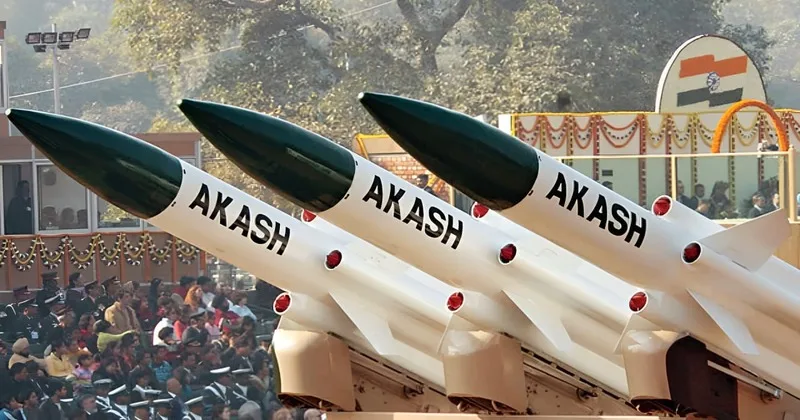
Operation Sindoor boosts global confidence in India's indigenous Akash missile family as export momentum gathers pace
New Delhi: India’s indigenous Akash air defence missile family is witnessing a fresh wave of international interest, with three countries exploring potential acquisitions following the system’s reported operational success during Operation Sindoor. According to the report published by Indian Defence Research Wing, two of the interested nations are evaluating the next-generation Akash-NG, while a third country has expressed interest in the more affordable Akash-1S variant equipped with an indigenous seeker. Armenia, already an operator of the Akash-1S system, is among the countries considering the advanced Akash-NG, reflecting growing confidence in India’s air defence capabilities after their combat validation.
Armenia has emerged as one of the most significant overseas customers for India’s Akash missile family. Its association with the system began in 2022 when it signed a contract worth approximately $720 million (around ₹6,000 crore) for 15 Akash systems. The first battery was delivered in November 2024, while a second consignment followed after July 2025.
The initial delivery, executed by Bharat Electronics Limited (BEL), included four launchers carrying three missiles each, along with the Rajendra fire-control radar. The programme has been jointly executed by Bharat Dynamics Limited (BDL), Larsen & Toubro (L&T), and Tata Advanced Systems, highlighting the collaborative nature of India’s defence manufacturing ecosystem.
Armenia has already inducted the Akash-1S, an upgraded version fitted with an indigenously developed active seeker that significantly enhances the probability of intercepting aerial threats such as fighter aircraft, cruise missiles and drones. The system is capable of engaging targets at ranges of up to 30 kilometres.
Sources indicate that Armenian defence officials have since received detailed briefings on the capabilities of the Akash-NG and have shown strong interest in acquiring the next-generation system once it becomes operationally available. Their interest forms part of a broader defence modernisation effort that also includes discussions with India on Pralay tactical ballistic missiles and upgrades for Armenia’s Su-30 fighter aircraft, aimed at building a stronger deterrence posture amid evolving regional security challenges.
The renewed export momentum has been linked to Operation Sindoor, during which the Akash family reportedly demonstrated seamless interoperability alongside India’s MR-SAM and S-400 air defence systems. According to the sources, the operation provided the system with genuine combat validation, significantly increasing international interest in India’s indigenous air defence architecture.
The Akash system, which features 96 per cent indigenous content, attracted attention from countries including Armenia, Brazil, Vietnam and the UAE after its operational performance during the conflict.
The technological improvements incorporated into Akash-NG have also strengthened its export appeal. A key enhancement is the integration of an Active Electronically Scanned Array (AESA) radar, offering substantially superior detection and target-tracking capability compared to earlier Akash variants.
By comparison, the Akash-1S currently supplied to Armenia employs an active radar homing seeker, enabling more accurate interceptions at ranges of 30 kilometres and altitudes of 18 kilometres. Although the upgraded seeker significantly improves effectiveness, some regional defence analysts have described the Akash-1S as an intermediate step when measured against the more capable Akash-NG, which is designed to counter increasingly sophisticated aerial threats.
This capability gap explains why existing Akash-1S operators such as Armenia are reportedly interested in complementing their current inventories with the newer NG variant instead of merely expanding existing Akash-1S holdings.
Former DRDO Chairman Dr Samir V. Kamat has also underlined the importance of Operation Sindoor in strengthening global confidence in the Akash programme. He noted that the system’s operational performance, particularly its demonstrated effectiveness against swarming drones and other advanced aerial threats, has enhanced its credibility in international markets as low-cost unmanned systems become increasingly prominent in modern warfare.
Unlike many competing air defence systems that rely primarily on manufacturer specifications and controlled testing data, Akash can now point to performance under actual conflict conditions. Defence analysts believe this distinction carries significant weight for prospective buyers assessing air defence systems for national security requirements.
India’s defence export ambitions extend beyond Armenia. The government has already confirmed exports of the Akash system to Tajikistan and Turkmenistan, marking an important breakthrough in Central Asia, where both countries have traditionally depended on Russian military hardware. Tajikistan’s importance is further underscored by the presence of a Russian military base on its territory.
According to Dr Samir V. Kamat, India’s overall defence exports remain on course to reach ₹50,000 crore by 2028-29, with the growing international acceptance of indigenous systems such as Akash expected to contribute significantly toward that target.
Armenia’s expanding inventory of Indian military equipment also reflects a broader strategic shift. Alongside Akash-1S systems, the country has inducted Pinaka multi-barrel rocket launchers and six ATAGS howitzers supplied by Bharat Forge in 2023. These Indian-origin platforms were prominently displayed during Yerevan’s 2026 military parades, signalling the deepening defence partnership between New Delhi and Yerevan.
Analysts observe that Armenia’s security calculations are shaped by its strategic environment, particularly the Turkey-Azerbaijan-Pakistan alignment, which openly supported Islamabad during Operation Sindoor. This geopolitical context has encouraged Armenia to diversify its defence procurement and strengthen military cooperation with India.
Meanwhile, the reported interest from a third, unnamed country specifically in the Akash-1S with seeker highlights a different segment of the international market. While the Akash-NG offers advanced capabilities through its AESA radar and improved threat engagement, not every military requires, or can afford, the higher-end configuration. For smaller air forces and budget-conscious defence establishments, the combat-proven Akash-1S offers a cost-effective yet highly capable upgrade over legacy air defence systems.
This dual demand, one group of countries seeking the cutting-edge capabilities of Akash-NG and another opting for the more economical Akash-1S, positions India to compete across multiple segments of the global air defence market. Rather than catering to a single capability or price bracket, the Akash family now offers export customers a wider range of options, strengthening India’s position as an emerging supplier of reliable, indigenous and combat-proven air defence systems.
