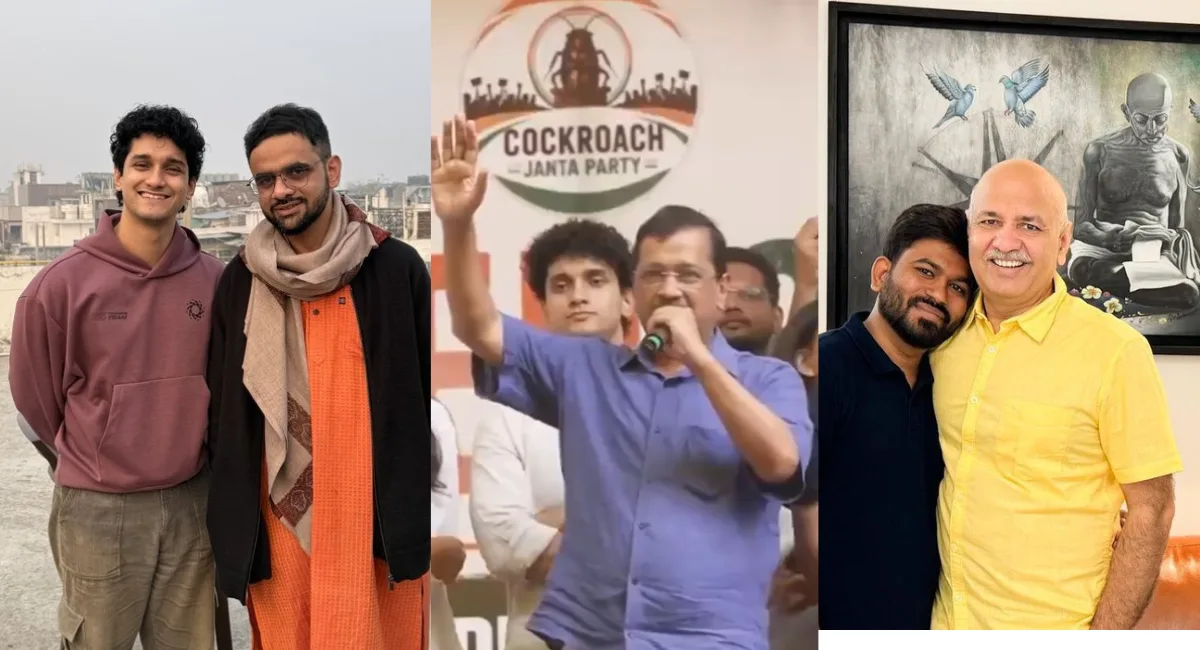
In the turbulent landscape of Indian opposition politics, few outfits have blurred the lines between satire, youth activism, and proxy warfare as shamelessly and effectively as the Cockroach Janta Party (CJP).
Founded by Abhijeet Dipke and prominently fronted by Saurav Das as chief spokesperson along with Ashutosh Ranka, CJP presents itself as a fresh Gen-Z movement born from exam reform protests.
Yet a deeper examination reveals it as a thinly veiled extension of Aam Aadmi Party (AAP) tactics and ideology, with its leaders functioning as Arvind Kejriwal’s loyal foot soldiers in a sustained campaign against the Indian judiciary.
Thank you for everything, @msisodia sir.
I’m truly grateful for all the opportunities you provided me while working with you.
Leaving for Boston with your guidance as my compass. No distance will ever weaken my commitment to AAP. #TeamManishSisodiaForever pic.twitter.com/O0TWWGo34z
— Abhijeet Dipke (@abhijeet_dipke) August 24, 2024
Abhiji Dipke, a part of the Aam Aadmi Party’s Social Media cell had tweeted in August 2024 before leaving for the US that he was “truly grateful for all the opportunities you (Manish Sisodia) provided me while working with you… Leaving for Boston with your guidance as my compass. No distance will ever weaken my commitment to AAP.”
Ranka, Dipke, and Das are political foundlings or orphans or organic eruptions but nurtured in the nursery of AAP.
They do not merely criticize court decisions, they insult judges, question institutional integrity, endorse litigant boycotts of benches, and issue “my way or the highway” ultimatums backed by threats of nationwide riots, all while drawing directly from Kejriwal’s playbook of confrontational “Satyagraha” against perceived biased institutions.
This pattern is not occasional rhetoric but a deliberate strategy rooted in their AAP-aligned past.
Kejriwal’s long history of attacking judges, demanding recusals, and framing the judiciary as compromised finds seamless continuation in CJP’s operations.
When courts rule against their allies or protesters, these figures respond not with legal recourse alone but with public shaming, selective outrage, and mobilization that risks eroding public faith in the rule of law.
India, which widely recognizes the judiciary’s cautious approach in sensitive cases involving riot instigators and breaking-India forces, sees through this orchestrated assault.
Saurav Das’s Vicious Assault on the Judiciary in the Umar Khalid and Sharjeel Imam Cases
The most glaring and inflammatory example of Saurav Das’s contempt for the judiciary centres on the prolonged yet valid detention of Umar Khalid and Sharjeel Imam in the 2020 Delhi riots larger conspiracy case under UAPA.
Despite serious charges linked to orchestrating violence that claimed dozens of lives and tore apart the national capital, Das has consistently portrayed these individuals as victims of judicial malice rather than beneficiaries of due process in a grave matter.
After a personal meeting with Umar Khalid, Das gushed: “Mulaqat with the bravest, Umar Khalid. 5 years in jail over false, frivolous charges—a permanent blot on India’s judiciary. Mad respect for him and his undying spirit.” This was no neutral commentary—it directly branded the judiciary as having inflicted a “permanent blot,” implying systemic failure or malice in keeping riot-related accused behind bars.
Mulaqat with the bravest, Umar Khalid. 5 years in jail over false, frivolous charges—a permanent blot on India’s judiciary. Mad respect for him and his undying spirit. ❤️🩹 pic.twitter.com/UprQEBoPfy
— Saurav Das (@SauravDassss) December 30, 2025
When the Supreme Court rejected Khalid and Imam’s bail pleas in January 2026, Das’s language crossed into outright insult. He declared the apex court had acted in the “MOST CRUEL manner,” not only denying bail but restricting further applications for a year.
When Justices Aravind Kumar and N.V. Anjaria in their judgment rejected bail for Umar Khalid, Das wrote an article for the Frontline magazine of The Hindu group and tweeted that “… was not an adjudication governed by precedents or long-followed bail jurisprudence. It was adjudication by whim, where the conclusion was foregone, at least for some from the beginning, and the reasoning engineered to fit it.” A very audacious and derogatory allegation at the bench.
Justices Aravind Kumar and N.V. Anjaria's judgment rejecting bail for Umar Khalid and one other was not an adjudication governed by precedents or long-followed bail jurisprudence. It was adjudication by whim, where the conclusion was foregone, at least for some… pic.twitter.com/VPSTSfvukb
— Saurav Das (@SauravDassss) January 7, 2026
“What a terrible, terrible day for democracy. SHAME! SHAME! SHAME!” he posted.
The Supreme Court of India has acted in the MOST CRUEL manner in the bail plea of Umar Khalid. It has not just rejected his plea, but also, effectively, RESTRICTED him from applying for bail for the next ONE YEAR! What a terrible, terrible day for democracy.
SHAME! SHAME! SHAME!
— Saurav Das (@SauravDassss) January 5, 2026
He argued that five years of incarceration had not yet crossed any “constitutional impermissibility,” accusing the bench (including Justice Aravind Kumar) of absurd reasoning that prioritized UAPA restrictions over liberty.
#UmarKhalidBailPlea: Can you fathom the absurdity of this? The Supreme Court of India says "continued detention has not crossed constitutional impermissibility to override the statutory embargo as against them" in the case of Umar Khalid and Sharjeel Imam.
In other words,…
— Saurav Das (@SauravDassss) January 5, 2026
Das went deeper in analytical posts, labelling the judgment “adjudication by whim” rather than constitutional principles. He compared it to a “khap panchayat,” claimed the bench had “engineered” reasoning to fit a foregone conclusion, and accused it of dangerously expanding the “moral universe of terrorism.”
He explicitly questioned judicial consistency, contrasting the denial with other rulings by the same bench.
On the Delhi High Court’s earlier rejection, he spoke of the “rot in the judiciary” becoming far greater than imagined, calling the decision “complicity” in indefinite detention on “frivolous” charges.
Umar Khalid and others have been denied bail by the Delhi High Court, despite, five years or so of incarceration. Many of us fail to see it, but the rot in the judiciary has become far greater than we imagine. Today’s dismissal of the bail pleas, by a bench of Justices Navin…
— Saurav Das (@SauravDassss) September 2, 2025
The institution, he claimed, had “forgotten its own constitutional role” and normalized suspicion to justify jailing activists.
These attacks are particularly egregious because large sections of Indian public opinion view the judiciary as rightly firm in such cases.
The 2020 Delhi riots represented a breakdown of social harmony with clear evidence of larger conspiracy, and UAPA provisions exist precisely to handle threats to national integrity.
By repeatedly insulting the courts as cruel, rotten, whim-driven, and complicit while championing Khalid and Imam, Das undermines the very judicial caution that prevents premature release of accused in sensitive riot and terror-related matters.
His personal friendship and advocacy for these figures, as highlighted by critics like Mahesh Jethmalani, further expose motivated bias rather than principled legal critique.
Meet the cockroach who was sold to India as the voice of its students. Cockroaches thrive in darkness.
Saurav Das is not some politically innocent youngster who spontaneously emerged from an examination protest.
🫵 Friends with Umar Khalid, he has repeatedly championed both… pic.twitter.com/bBVCJeg0p2
— Mahesh Jethmalani (@JethmalaniM) July 28, 2026
The AAP Roots and Kejriwal Boycott Echo Chamber
This judicial hostility did not emerge in isolation. It mirrors and amplifies Arvind Kejriwal’s own confrontations.
In the Delhi liquor policy case, Kejriwal boycotted Justice Swarana Kanta Sharma’s court, citing bias and conflict of interest, framing it as Satyagraha.
Saurav Das praised this lavishly: “Seeing a politician not budge and take on a High Court judge… is something to watch.” He defended the principle that justice must be seen to be done and amplified similar boycotts by other defendants. He even accused her (Justice Swarna Kanta Sharma) of harbouring an agenda and placing herself in the chair to execute some kind of pre-charted verdict by deviating “… from her usual pattern of hearing cases and shown a special kind of interest in Kejriwal’s case, all strengthening the case for her recusal.”
As former Delhi Chief Minister Arvind Kejriwal appears in the Delhi High Court to argue his application seeking Justice Swarana Kanta Sharma’s recusal, read my last column where I revealed how Justice Sharma has completely deviated from her usual pattern of hearing cases and… https://t.co/9e17aUvc5P
— Saurav Das (@SauravDassss) April 6, 2026
Abhijeet Dipke, the fellow “cockroach” and in fact the founder of the Cockroach Janta Party hideous meme went further, calling Kejriwal’s move “a blueprint for the opposition on how to take on compromised institutions.”
Arvind Kejriwal choosing not to pursue the case is a sign that with judges like Swarna Kanta on the bench, there is no hope left for the opposition from the judiciary, and nothing reflects worse on an institution than the loss of hope in it.
In times like these, when trust over… https://t.co/Z4DdVNIcpH
— Abhijeet Dipke (@abhijeet_dipke) April 27, 2026
He likened the judiciary to colonial powers, Kejriwal to Mahatma Gandhi, and declared “no hope left for the opposition from the judiciary” under judges perceived as RSS-linked.
Dipke portrayed such boycotts as exposing institutional erosion and bias toward BJP.
The justice refused to recuse by reminding Kejriwal that the court was not a theatre of assumptions.
Kejriwal’s foot soldiers rushed in to back him up.
Ashutosh Ranka adds intellectual heft to the assault. He has stated that when “judiciary enters politics, politics needs to enter judiciary” and described the institution as rotten with corruption and nepotism.
If there is one issue on which AAP-BJP-Congress and the entire political spectrum will align on, is the rotten state of judiciary in India. The judiciary which is at the helm of corruption, nepotism and has complete lack of any transparency in its conduct. https://t.co/C9544QnI7x
— Ashutosh Ranka (@AshutoshRanka) March 11, 2026
Ranka – while praising Kejriwal even taunted their on-and-off ally Rahul Gandhi, calling out his cowardice and labelling him “a spoon-fed prince”.
Arvind Kejriwal and Mamta Bannerjee have shown the spoon-fed prince and other opposition leaders how to fight it out with BJP.
When judiciary enters politics, politics needs to enter judiciary. pic.twitter.com/TkBwxAIa7V
— Ashutosh Ranka (@AshutoshRanka) April 13, 2026
In CJP’s protest ecosystem, Ranka helps bridge policy critiques with judicial attacks, demanding accountability and transparency while aligning with Das and Dipke’s narratives.
The trio’s coordinated defense of Kejriwal’s tactics confirms CJP as AAP Team B, using youth branding to launder and intensify the parent party’s anti-judiciary stance.
Together, the trio operationalizes AAP’s irrational but confrontational style: Kejriwal’s direct boycotts and Satyagraha become CJP’s street protests and social media campaigns. This proxy structure allows plausible deniability, and meanwhile, AAP maintains distance while benefiting from youth energy and pressure on institutions handling cases against its leaders.
Recent Escalation: Threatening Agitation Against Supreme Court Orders
In July 2026, amid CJP protests over examinations, the pattern repeated. After verbal assurances on FIR withdrawals, a Supreme Court interim order permitted investigations into existing cases.
#WATCH | Delhi | Cockroach Janta Party Chief Spokesperson Saurav Das says, "The government gave us a guarantee that all FIRs filed against students and protesters so far would be withdrawn and that no action would be taken against any protester in the future, not just in Delhi,… pic.twitter.com/CVGFBkDXQu
— ANI (@ANI) July 28, 2026
Das rejected this outright, demanding written government guarantees that no action would proceed. He warned of “massive betrayal of the country’s youth” and threatened renewed nationwide protests if the executive did not comply, effectively asking political authorities to sidestep or override judicial directions.
“Centre must not use SC order to justify continuing protest-related FIRs,” he insisted.
This “my way or the highway” approach, questioning judicial orders, insulting benches in high-profile cases like Khalid/Imam, and mobilizing streets, exemplifies their strategy. Das has also highlighted “selective urgency, selective silence, and selective roster control” that supposedly weaponizes the judiciary, further corroding trust.
Funding Questions, Background, and Jethmalani’s Exposé
Senior Advocate Mahesh Jethmalani aptly summarized the concerns: Das is no innocent youth voice but an “old hand” with ties to Khalid and Imam, grants from foreign entities like the Pulitzer Center, and operations from a lavish South Delhi base.
Meet the cockroach who was sold to India as the voice of its students. Cockroaches thrive in darkness.
Saurav Das is not some politically innocent youngster who spontaneously emerged from an examination protest.
🫵 Friends with Umar Khalid, he has repeatedly championed both… pic.twitter.com/bBVCJeg0p2
— Mahesh Jethmalani (@JethmalaniM) July 28, 2026
“Cockroaches thrive in darkness,” Jethmalani noted, questioning funding sources. This backdrop raises doubts about whether CJP’s judicial attacks serve genuine youth interests or larger anti-national and political agendas.
The Dangerous Consequences for Indian Democracy
The combined actions of Das, Dipke, and Ranka represent a multi-front war on judicial authority. In the Umar Khalid and Sharjeel Imam context, their insults directly challenge the judiciary’s role in safeguarding against riot instigators and forces threatening social fabric.
By demanding overrides, boycotting judges, and threatening riots, they prioritize political outcomes over constitutional processes. Their AAP lineage (viz. Kejriwal’s history of similar clashes) makes CJP a proxy vehicle for continuing that legacy under a youth-friendly mask.
This risks contempt of court, public disorder, and erosion of institutional credibility. Genuine accountability requires respectful engagement, not venomous labels like “cruel,” “rotten,” “whim-driven,” or “complicit.”
If there is one issue on which AAP-BJP-Congress and the entire political spectrum will align on, is the rotten state of judiciary in India. The judiciary which is at the helm of corruption, nepotism and has complete lack of any transparency in its conduct. https://t.co/C9544QnI7x
— Ashutosh Ranka (@AshutoshRanka) March 11, 2026
As India navigates complex security and protest challenges, such proxy warriors betting on Gen-Z energy and Kejriwal-style cover threaten the delicate balance of powers.
The judiciary has rightly maintained firmness in cases like the Delhi riots larger conspiracy, where premature releases could embolden break-India elements. Das and company’s relentless attacks, rooted in AAP’s confrontational DNA, expose not judicial failure but their own intolerance for any institution that refuses to bend to their narrative.
Das even went to the extent of accusing the security forces that came to Jantar Mantar as evil ones who had arrived with a predetermined motive of smashing skulls of students and molesting children.
Frankly speaking RAF & Delhi Police should sue Saurav Dass for this libellous statement
How dare he say that the forces came to Jantar Mantar with a predetermined motive of smashing skulls of students and molesting children?
This is Peter Pettigrew’s 🧠 pic.twitter.com/f5s1wzytG7
— Sameer (@BesuraTaansane) July 28, 2026
The Cockroach Janta Party’s lawyer argued in court that the police should not record protestors in a public place because it allegedly violates their “privacy” and their “fundamental right” to air their grievances without being treated like criminals. That translates to the belief that the agitating rioters have a right to privacy at a public protest, even as videos from the protest show abuse being hurled and incidents of violence.
https://twitter.com/MrsGandhi/status/2082073515361189895
Before flying back to his hometown Chhatrapati Sambhajinagar in Maharashhtra, Abhijit Dipke warned the government of another agitation if the court’s orders to pursue FIRs is not overturned and FIRs are not withdrawn. “…The youth were protesting for their future. They were not getting any thrill out of it, they braced lathis on 20th July. If the Govt is not satisfied with just that, with that bloodshed and if it continues to harass students, we will hit the streets soon,” he said.
#WATCH | Delhi: Cockroach Janta Party (CJP) Founder Abhijeet Dipke says, "…The youth were protesting for their future. They were not getting any thrill out of it, they braced lathis on 20th July. If the Govt is not satisfied with just that, with that bloodshed and if it… pic.twitter.com/7TiKCpN8xQ
— ANI (@ANI) July 29, 2026
As threats of fresh agitation loom, authorities and citizens must recognize CJP for what it is: AAP Team B in activist disguise, insulting the judiciary while demanding supremacy over it.