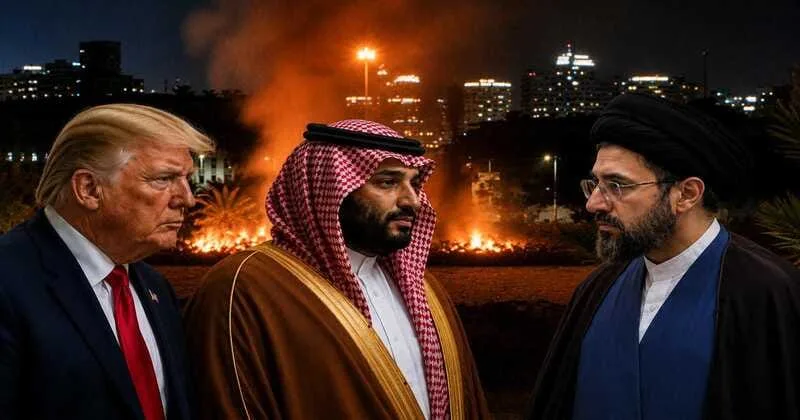
US President Donald Trump, Saudi Arabian Crown Prince Mohammed bin Salman, and Iranian cleric Mojtaba Khamenei
New Delhi: The United States and Saudi Arabia launched coordinated airstrikes on Iran-backed Shia militia positions across eastern Iraq, killing at least 20 fighters of the Popular Mobilisation Forces (PMF) and wounding 32 others, in a major escalation of the expanding regional conflict. The strikes came as Iran claimed responsibility for firing ballistic missiles at a US military base in Jordan and reaffirmed its control over the strategically vital Strait of Hormuz.
According to the US Central Command (Centcom), the joint operation targeted multiple logistics hubs and weapons sites used by Iran-aligned groups that were allegedly directed by the Islamic Revolutionary Guard Corps (IRGC) to launch drone attacks against US forces and Saudi energy infrastructure. Centcom said the strikes were carried out in response to more than 30 drone attacks over the past 72 hours, all of which it claimed had been intercepted or had failed.
Saudi Arabia said its participation followed repeated drone attacks on oil facilities in the country’s Eastern Province. Riyadh maintained that its air defences had successfully intercepted the drones and stressed that while it did not seek further escalation, it would respond firmly to any aggression targeting its territory.
The PMF, an umbrella organisation of predominantly Shia militias formally integrated into Iraq’s security forces, condemned the joint operation as a “dangerous escalation” and a violation of Iraq’s sovereignty. Several of the group’s constituent militias maintain close ties with Iran and have frequently targeted US military installations in Iraq since the outbreak of renewed hostilities between Washington and Tehran.
Hours before the US-Saudi strikes, Iran’s Islamic Revolutionary Guard Corps announced that it had launched ballistic missiles at a US air base and command centre in Jordan. Jordanian authorities said their air defence systems intercepted five incoming missiles targeting the kingdom, while the US military stated that all projectiles aimed at its forces had been successfully intercepted.
The IRGC described the attack as retaliation against what it called “acts of aggression” by US forces and vowed to continue its “resistance” as long as American military operations against Iranian interests persisted.
Iran also claimed that its naval forces had struck three oil tankers in the Strait of Hormuz after the vessels allegedly ignored warnings and sailed through what Tehran described as an “unsafe and illegal route”. The incident underscored growing tensions around one of the world’s busiest energy shipping lanes.
Separately, a senior Iranian official said Tehran had rejected an Omani proposal for joint regional management of the Strait of Hormuz, accusing the United States and Saudi Arabia of pressuring Muscat to advance an “unrealistic” plan. Iran insisted that it would retain full control over inbound maritime traffic through the waterway.
An Iranian defence official also denied any direct involvement in the drone attacks on Saudi oil facilities, warning that attempts to blame Tehran for every attack on US interests in the region amounted to a “major miscalculation”.
The latest military exchanges have effectively ended a brief pause in fighting that followed US President Donald Trump’s decision to halt a planned two-week bombing campaign earlier this month. Meanwhile, Trump and Israeli Prime Minister Benjamin Netanyahu held talks at the White House, with US officials describing the discussions as “positive and productive”, amid expectations of further decisions on Washington’s strategy towards Iran.
