ब्रह्मानन्दं परमसुखदं केवलं ज्ञानमूर्तिं, द्वन्द्वातीतं गगनसदृशं तत्त्वमस्यादिलक्ष्यम् ।
एकं नित्यं विमलमचलं सर्वधीसाक्षिभूतं, भावातीतं त्रिगुणरहितं सद्गुरुं तं नमामि ॥
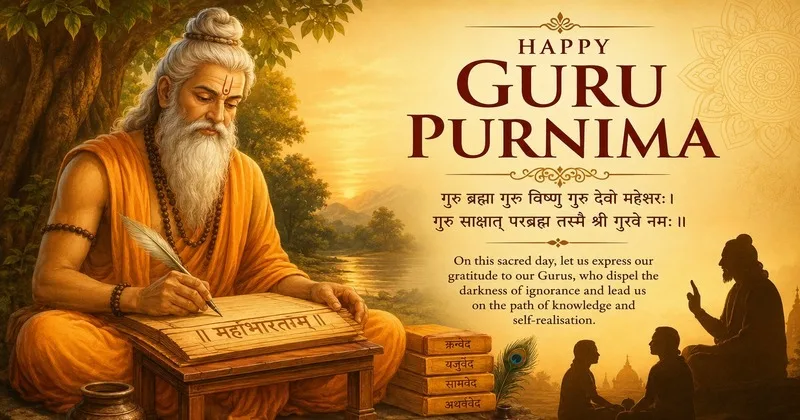
This holy day of Ashadh Shukla Purnima is a great festival of worship of Guru-tattva in the Indian Sanatan Vedic tradition. It is not just a celebration of the birth or memory of any great man, but a day of gratitude towards the ancient knowledge tradition through which the nectar of Shruti, the light of self-knowledge and the true form of the path of salvation have been flowing uninterruptedly from Guru to disciple from age to age. For this reason, this day is also famous by the name of ‘Guru Purnima’ as well as ‘Vyaspurnima’.
The foundation of Indian philosophy is that the real nature of man is not the mortal body, fickle mind or limited intellect, but the eternal, pure, enlightened and liberated soul. But due to ignorance since time immemorial, the living being forgets its own form and remains bound in the cycle of worldly happiness-sorrow, attachment-aversion and birth-death. The whole purpose of Vedanta is to eliminate this ignorance. This is why the Upanishads declare, “Tadvigyanartham sa Gurumevabhigacchet.” Knowledge of the soul is not possible without a Guru.
The work of the Guru is not to impart any new truth to the disciple. Truth is always proven. The Guru only removes the veil of ignorance from the disciple’s conscience through scriptural evidence and logical teachings. When Avidya is removed, then the same living being experiences his Brahma form. Therefore, in Vedanta, the Guru has been called the representative of Parabrahman and the true embodiment of the light of Brahmavidya.
This stream of knowledge flowing from Bhagwan Shri Narayan has been flowing continuously through Brahma, Maharishi Vashishtha, Shakti, Parashar, Bhagwan Vedvyas, Shri Gaudpadacharya, Shri Govind Bhagwatpadacharya and Adi Jagadguru Bhagwan Shri Shankar Bhagwatpadacharya. This uninterrupted Guru-tradition preserved the true meaning of the Vedas and established Brahmavidya as a living tradition before the world.
Bhagwan Vedvyas’ place in Indian spirituality is unique. He divided the Vedas and gave them a systematic form, formulated the principles of the Upanishads through the Brahma Sutra and connected religion with public life through the Mahabharata and Puranas. That is why Vyas is considered not just a Maharishi but the embodiment of the entire Vedic knowledge tradition.
With the passage of time, when the true form of Vedanta started getting covered with diverse opinions, the Adi Jagadguru Lord Shri Shankar Bhagwatpadacharya, the incarnation of Bhawan Sadashiva, re-established Advaita Vedanta through his unique commentaries on the Brahma Sutra, Srimad Bhagavad Gita and major Upanishads. He propounded that salvation is not the result of any particular action; rather, it is the cessation of ignorance obtained from the knowledge of the self. By establishing Amnaya Peethas in all four directions of India, he provided a strong foundation to the Guru-disciple tradition and made arrangements to keep the unbroken light of religion, philosophy and culture shining from age to age. Reminding us of this truth, it has been said with reverence in the tradition: Vyaso Narayan: Sakshat. Shankar: Shankar: Swayam.
The true message of Guru Purnima lies not merely in worshipping the Guru, but in embodying the Guru’s teachings in one’s life. Reverence is meaningful only when it translates into the study of scriptures; the study of scriptures is successful only when it leads to contemplation and deep meditation (nididhyasana); and spiritual practice (sadhana) is complete only when the realisation of one’s true self becomes the foundation of life. This constitutes the true “Guru-dakshina”, true devotion to the Guru and the genuine honouring of the Indian tradition of sages.
Today, there is a need to re-establish truth, righteousness (Dharma), compassion, self-restraint, self-study and introspection in our lives. Lasting peace in society is achieved not merely through material progress, but through character, virtuous conduct and the knowledge of the Self (Atma-vidya). Only a society that upholds respect for the Guru, faith in the scriptures and devotion to righteousness can preserve its cultural heritage intact.
On this auspicious occasion of Vyasa Purnima (Guru Purnima), may the grace of Bhagwan Sri Dwarkadhish, the Universal Maa Sri Sharadamba, Bhagwan Sri Siddheshwara Mahadeva, the primordial Jagadguru Sri Shankaracharya and Bhagwan Vedavyasa remain ever upon all devotees. May every spiritual seeker cultivate a deep love for the knowledge of the Self, unwavering reverence for the Guru’s feet, firm faith in the scriptures, and a resolute commitment to righteousness.