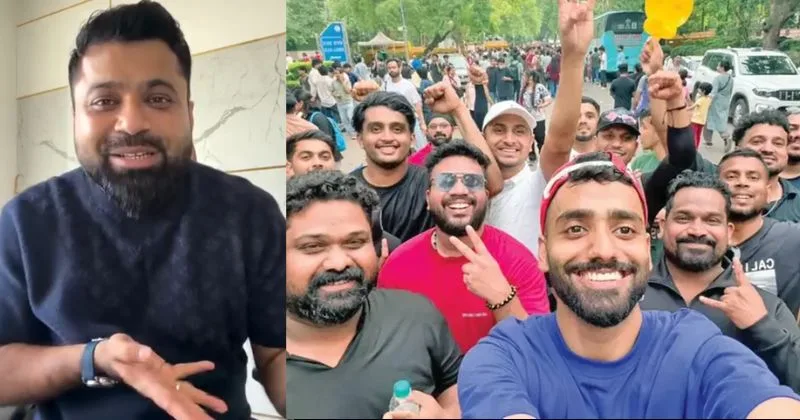
Dubai-based Malayali businessman Mohammad Shaji has suddenly found himself in the spotlight after his 23 employees went viral celebrating what they called the “victory” of the Cockroach Janata Party following the end of the Jantar Mantar agitation.
The 23-member group, led by Irshad, Anfas, and Toyo, was flown from Dubai to Delhi at Shaji’s expense. The businessman allegedly bore the entire cost — including flights, accommodation, food, and extra incentives — to make his and the company’s support in the foreign-funded CJP protest against the Modi government.
All were provided with free travel, accommodation, food, and other expenses, and were promised additional remuneration for taking part in what was presented as a complete “Bharat Package.”
However, the day when the owner of Abreco Freight, Mohammed Shaji send his army to Jantar Mantar, supposed to be the last day of the violent protest of the cockroaches. The group returned ‘with pride’ after the minister’s resignation.
Is Mohammed Shaji enough wealthy to fund 23-employee team?
Sources indicate that Shaji does not come from a visibly wealthy or high-profile business background. Even more concerning are reports that he has been accused in multiple cheque bounce and cheating cases in Dubai. This naturally leads to the big question:
Where did the money to fly 23 employees, accommodate them in Delhi, and pay them extra remuneration come from?
Also Watch: 23 Workers Flown from Dubai’s Abreco Freight to Delhi Protest: Who Paid and Why | Organiser Decodes
Why would a person facing financial legal issues in a foreign country suddenly spend lakhs of rupees to send his workers to participate in a political protest in India? Was this purely an act of ‘solidarity’, or is there a larger, more organised agenda at play?
All the 23 employees were handpicked, funded, and dispatched like a private army. Muhammad Shaji footed the entire bill — flights, accommodation, food turning his workers into participants in a political agitation on Indian soil.
The timing is equally suspicious. The employees were sent at the peak of the CJP agitation, which has been accused by many of being politically motivated and aimed at destabilising the central government.
This incident once again highlights the dangerous trend of foreign funding and external interference in Indian street protests. During the anti-CAA agitation, similar questions were raised about funding and organised support. Now, the same pattern appears to be repeating with the CJP protests.
The authorities must immediately investigate the funding trail behind Muhammad Shaji Nilambur and the 23 employees he sent to Delhi.
Anti-CAA, Shaheen Bagh and Delhi Riot
During the anti-CAA protests of 2019-2020, similar controversies had surfaced over the logistics and funding of long-running demonstrations, particularly at Shaheen Bagh. Those protests continued for months, sustained by a steady supply of food, tents, medical facilities, volunteers, sound systems, and other infrastructure.
The sheer scale of these arrangements triggered intense public and political debate about how such prolonged mobilisations were being financed.
The funding debate gained further momentum when central agencies probed allegations that the Popular Front of India (PFI) had mobilised significant resources to support the anti-CAA agitation. This eventually contributed to the ban on the organisation. That is precisely why the current Dubai episode involving Muhammad Shaji deserves serious attention.