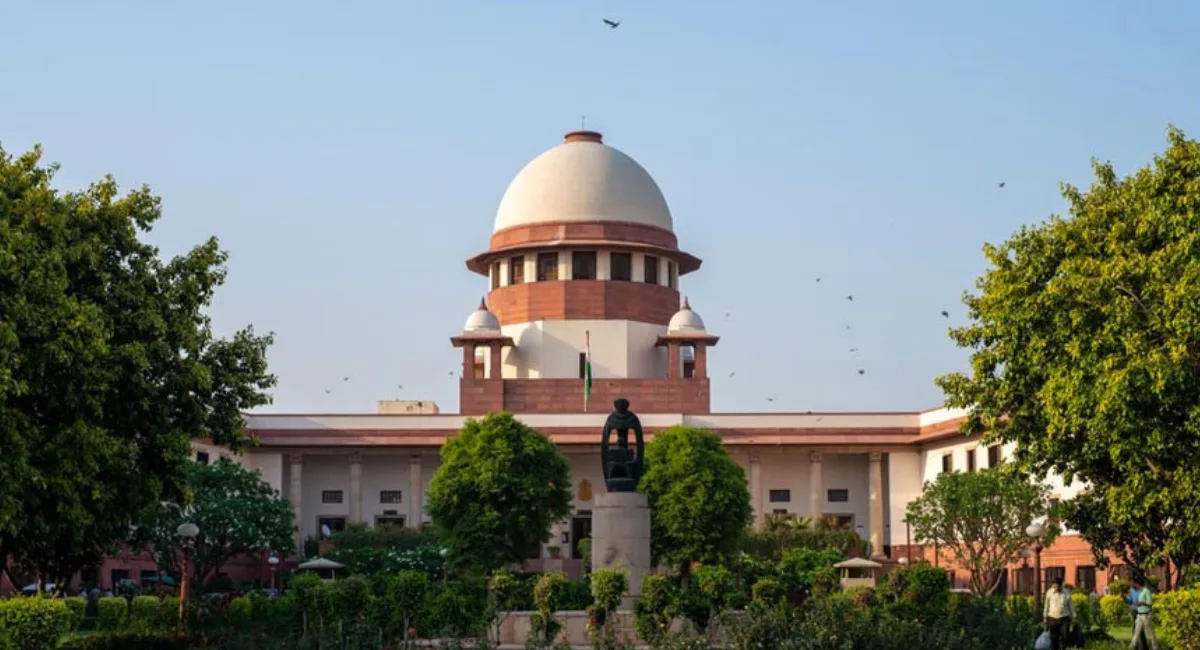
The Supreme Court on July 16 asked the Tamil Nadu government to hold consultations with the Union government regarding the setting up of Jawahar Navodaya Vidyalayas (JNVs) in districts across the state.
A Bench of Justices B V Nagarathna and R Mahadevan said that India was a “federal society”. The Bench observed that the State government should not adopt an adversarial attitude on the issue.
When the court was informed that Tamil Nadu is the only state without any JNVs, the centrally run schools, it said, “Bring to the notice of the Secretaries of the Central government about your Act and how you are going about it. Please have a positive attitude.”
Tamil Nadu has argued that the three-language formula, including the learning of Hindi, followed in JNVs is contrary to the two-language policy followed in the State.
சாதாரண ஏழை மக்கள் இலவசமாக நவீன கல்வி பெற உதவும்
மத்திய அரசின் நவோதயா பள்ளிகளை தமிழகத்தில் திறக்க தமிழக அரசு நடவடிக்கைகள் எடுக்க வேண்டும் pic.twitter.com/wFaT2PKanx
— GANDHI RAJA M.A, BGL, PGDCA (@gandhiraja) July 16, 2026
While hearing a Special Leave Petition filed by the State government against a 2017 order of the Madras High Court, which had directed the State government to allocate land for setting up JNVs, the Bench directed the State to consult with the Central government in this regard. The High Court’s order was passed based on a petition filed by the organisation Kumari Maha Sabha.
The Supreme Court stayed the High Court’s directions in December 2017 in the State’s appeal.
The apex court told the Tamil Nadu government not to view the language policy as an imposition, observing that it is an opportunity for the State’s students, adding: “You can say this is our language policy. They will look into it. The State language has to be taught; English has to be taught and any third language. It doesn’t say Hindi.”
The apex court said it had passed the directions in the interest of students who are entitled to be admitted to JNVs in Tamil Nadu.
The High Court had held that the State’s refusal to permit JNVs curtailed students’ right to choose educational institutions and was inconsistent with the Right of Children to Free and Compulsory Education Act. It also directed the State to provide temporary accommodation for 240 students in each district.
The Bench advised the Tamil Nadu government against rejecting Central schemes merely because they originate from the Union government. “You may have your education system, but don’t prevent the Central government schools… Don’t have this attitude that it is the Union government, so why should we accept it.”
Justice R Mahadevan said that discussions between the Union and the State were still underway regarding the establishment of Navodaya schools.
The Bench said, “Talks have not concluded. If that fails, then only a question of us addressing the merits arises.”
When the Tamil Nadu government sought six months’ time to obtain instructions, counsel for the respondent pointed out that despite an earlier direction requiring the State to identify land for the schools within six weeks, no progress had been made. The court observed that there had been “a change of guard” in the State (TVK came to power after replacing the DMK in May following the Assembly elections). Justice Nagarathna remarked that it remained to be seen what policy approach the new government would adopt. The court posted the matter for further hearing on August 11.
In its affidavit before the Supreme Court, the Union government stated that the National Policy on Education, 1986 envisaged the establishment of JNVs to provide quality residential education to talented rural students. It said 689 JNVs had been sanctioned in 666 districts across the country, but none had been established in Tamil Nadu because the State had not accepted the scheme.
The Tamil Nadu government submitted that if the Union government favoured establishing new JNVs, it should provide financial support to the State’s existing Model Residential Schools or modify the policy framework of the JNV scheme to align with the constitutional, statutory and policy framework prevailing in the State. Following the Supreme Court’s directions on December 15, 2025, a consultation meeting was held on January 5, 2026.
Tamil Nadu has opposed JNVs due to its adherence to the State-mandated two-language policy (Tamil and English) and the Tamil Learning Act, 2006, which excludes Hindi from the curriculum. The State argues that the JNV system’s three-language formula directly conflicts with its regional language preservation laws and educational autonomy.
It is to be noted that the CBSE three-language policy is presently under challenge in separate public interest petitions before a Bench headed by Chief Justice of India Surya Kant. The CJI’s Bench has refused to stay the implementation of the CBSE policy and has posted the matter for hearing next week.