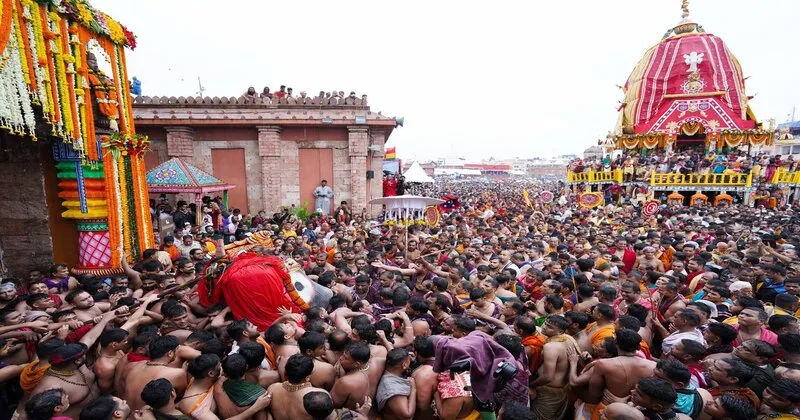
Bhubaneswar: In a remarkable testament to enduring faith and spiritual resilience, lakhs of devotees from across Odisha, various parts of India, and several countries around the world gathered in the sacred town of Puri to witness the grand Rath Yatra 2026. Despite continuous and heavy rainfall that lashed the region since Wednesday evening, the spirit of devotion remained unshaken, transforming adversity into a powerful symbol of collective belief.
The holy town wore a vibrant yet rain-soaked look as pilgrims poured into the city, undeterred by the inclement weather. The continuous downpour, which inundated roads and created waterlogged conditions, failed to diminish the enthusiasm of the devotees. Instead, it seemed to amplify their devotion, as thousands stood patiently along the historic Bada Danda, the Grand Road, awaiting the divine darshan of Mahaprabhu Jagannath, Mahaprabhu Balabhadra, and Devi Subhadra.
The air reverberated with devotional chants of “Jai Jagannath” and “Haribol,” echoing across the city and rising above the sound of rainfall. The rhythmic chants, combined with the beating of traditional instruments, created an electrifying spiritual atmosphere that defined the essence of this centuries-old festival.
Cultural Expressions Flourish Despite Challenging Weather Conditions
Adding to the grandeur of the occasion, devotees and cultural groups displayed unique and creative expressions of faith even under challenging circumstances. Several artists and performers took to the rain-drenched streets to present traditional art forms, including classical Odissi dance, showcasing Odisha’s rich cultural heritage.
These performances, carried out on waterlogged roads, reflected not only artistic dedication but also deep-rooted devotion. The sight of dancers performing gracefully amidst the rain became a powerful visual metaphor for the unbreakable bond between faith and culture in the Jagannath tradition.
Sacred Rituals at Srimandir Begin with Timeless Precision
The Rath Yatra festivities formally commenced at the revered Shree Jagannath Temple, popularly known as Srimandir, with a sequence of meticulously conducted rituals rooted in centuries-old traditions. From the early hours of the day, priests and servitors initiated sacred ceremonies that form the backbone of the festival.
The morning rituals began with the ‘Dhupa’ ceremony at the Bhoga Mandap, followed by a series of preparatory rituals associated with the deities and their majestic chariots. Each ritual is performed with strict adherence to traditional protocols, reflecting the temple’s rich spiritual heritage and disciplined ritualistic framework.
ରଥରେ ଶ୍ରୀବିଗ୍ରହମାନଙ୍କ ଚିତା ଲାଗି ନୀତି ଶେଷ ହୋଇଛି।
The Chita Lagi ritual of the deities was conducted on the Rathas.#Rathayatra2026 #JaiJagannatha #RathaJatra2026 #RathaYatra #ShreeJagannathaDhaam #Puri pic.twitter.com/eqSfGHjtdM
— Shree Jagannatha Temple, Puri (@JagannathaDhaam) July 16, 2026
The entire process is deeply symbolic, representing the transition of the deities from their sanctum to the outside world, where they bless millions of devotees irrespective of caste, creed, or social status.
Pahandi Procession Marks the Grand Exit of the Mahaprabhu
One of the most anticipated and visually striking rituals of the Rath Yatra is the Pahandi procession, which signifies the ceremonial procession of deities from the sanctum sanctorum. This grand procession is marked by rhythmic movements, devotional chants, and the resonating sounds of traditional instruments such as ghanta, kahali, and telingi baja.
During the Pahandi, the deities are carried in a swaying motion, symbolizing a divine journey filled with grace and grandeur. The Deities are then placed on their respective chariots Nandighosa for Mahaprabhu Jagannath, Taladhwaja for Mahaprabhu Balabhadra, and Darpadalana for Devi Subhadra each intricately designed and richly decorated.
ବଡ଼ଠାକୁର ଶ୍ରୀବଳଭଦ୍ରଙ୍କ ଦିବ୍ୟ ପହଣ୍ଡିର ଅପୂର୍ବ ଦୃଶ୍ୟ।#Rathayatra2026 #JaiJagannatha #RathaJatra2026 #RathaYatra #ShreeJagannathaDhaam #Puri pic.twitter.com/gVzU5s6K95
— Shree Jagannatha Temple, Puri (@JagannathaDhaam) July 16, 2026
The ritual is not merely a physical movement but a profound spiritual event that signifies the accessibility of the divine to humanity. It embodies the belief that Mahaprabhu Jagannath steps out of his sanctum to be among his devotees, reinforcing the inclusive nature of the festival.
Deep Symbolism Embedded in the Tradition of Pahandi Bije
The Pahandi ritual, anchored in the concept of ‘Pahandi Bije,’ holds deep cultural and linguistic significance. Derived from the Sanskrit term ‘Padamundam,’ the ritual represents a slow, deliberate stepping motion, symbolizing progression and divine movement.
Accompanied by traditional musical instruments and chanting, the procession reflects a harmonious blend of devotion, rhythm, and spiritual symbolism. The term ‘Bije’ denotes a ceremonial procession typically associated with royalty or divinity, highlighting the regal stature of the deities during their journey.
ଦେବୀ ସୁଭଦ୍ରା ଧାଡ଼ି ପହଣ୍ଡିରେ ଦର୍ପଦଳନ ରଥକୁ ବିଜେ କରୁଥିବାର ମନୋହର ଦୃଶ୍ୟ।
Some Captivating Views of the 'Dhadi Pahandi' of ‘Devi Subhadra’ to the 'Darpadalana Ratha.'#Rathayatra2026 #JaiJagannatha #RathaJatra2026 #RathaYatra #ShreeJagannathaDhaam #Puri pic.twitter.com/Gex2gO1rvF
— Shree Jagannatha Temple, Puri (@JagannathaDhaam) July 16, 2026
Temple traditions classify Pahandi into two forms — Dhadi Pahandi and Goti Pahandi. In Dhadi Pahandi, the deities emerge in a continuous sequence, starting with Mahaprabhu Sudarshan, followed by Mahaprabhu Balabhadra, Devi Subhadra, and finally Mahaprabhu Jagannath. This format is observed during major festivals such as Rath Yatra and Bahuda Yatra.
In contrast, Goti Pahandi involves escorting one deity at a time to the destination before bringing out the next, a practice followed during specific rituals like Adapa Mandap Bije and Niladri Bije.
Chhera Pahanra Ritual Reflects Royal Humility and Devotion
A defining moment of the Rath Yatra is the performance of the ‘Chhera Pahanra’ ritual by the Gajapati Maharaja of Puri, Divyasingha Deb. This sacred ritual underscores the principle of humility, demonstrating that even the highest earthly authority is but a servant before the divine.
#Rathayatra2026 #JaiJagannatha #RathaJatra2026 #RathaYatra #ShreeJagannathaDhaam #Puri pic.twitter.com/yPULO3Z4tD
— Shree Jagannatha Temple, Puri (@JagannathaDhaam) July 16, 2026
Dressed in immaculate white attire and carried in a silver-plated palanquin, the Gajapati Maharaja arrived at the chariots to perform the ritual. Using a golden-handled broom, he ceremonially swept the floors of the chariots, while priests chanted Vedic hymns and sprinkled flowers and fragrant water.
Spiritual Significance Elevates the Festival Beyond Rituals
The Chhera Pahanra ritual holds immense spiritual significance for devotees. It is believed that witnessing this act of humility by the Gajapati Maharaja purifies the soul and brings divine blessings. The ritual emphasizes the idea that all individuals, regardless of their status, are equal in the eyes of the divine.
Similarly, the entire Rath Yatra festival is seen as an opportunity for spiritual renewal and collective devotion. The journey of the deities from the temple to the Gundicha Temple symbolizes a divine outreach, allowing devotees from all walks of life to experience the presence of the Mahaprabhu .
Chhera Pahanra Followed by Grand Commencement of Chariot Pulling
Following the completion of the sacred Chhera Pahanra ritual performed by Gajapati Maharaja Divyasingha Deb, the much-awaited pulling of the chariots began amid an atmosphere filled with devotion and spiritual energy. Resonating chants of “Jai Jagannath” and “Haribol” marked the beginning of the procession as Mahaprabhu Balabhadra’s chariot, Taladhwaja, was the first to be pulled by devotees.
This was followed by the pulling of Devi Subhadra’s chariot, Darpadalana, and finally, Mahaprabhu Jagannath’s chariot, Nandighosa, was drawn forward with deep reverence. As per tradition, Mahaprabhu Balabhadra’s Taladhwaja Rath led the procession, symbolising the commencement of the annual journey of the Mahaprabhu Jagannath to the Gundicha Temple.
Delay in Schedule Due to Inclement Weather
The ceremonial pulling of the chariots began at approximately 5:10 PM, more than an hour behind schedule due to persistent heavy rainfall in Puri. The delay occurred after the completion of the Chhera Pahanra ritual, a significant ceremony in which the Gajapati Maharaja, regarded as the foremost servitor of Mahaprabhu Jagannath, performs the symbolic sweeping of the chariots.
Procession Halted Midway as Night Falls
As darkness descended over the pilgrim city, the chariot pulling was halted midway on Thursday. The deities will resume their journey towards the Gundicha Temple on Friday, July 17.
Mahaprabhu Balabhadra’s Taladhwaja chariot came to a halt at Market Square, while Devi Subhadra’s Darpadalana chariot stopped at Marichikote Square. Meanwhile, Mahaprabhu Jagannath’s Nandighosa chariot moved only a short distance from the Lion’s Gate of the Srimandir before the procession was suspended for the day.
Traditionally, the presiding deities undertake a nine-day sojourn to the Gundicha Temple during Rath Yatra, travelling on their respective chariots through the Grand Road.
Strong Participation from Devotees and Officials
The chariot pulling began around 5 PM with Mahaprabhu Balabhadra’s Taladhwaja chariot, followed by Darpadalana and Nandighosa. Servitors of the 12th-century shrine, along with thousands of devotees and police personnel, actively participated in the procession, ensuring both devotion and order were maintained.
In a notable display of public participation, Odisha Chief Minister Mohan Majhi, Governor Hari Babu Kambhampati, and several state ministers joined the devotees in pulling the chariots. Their involvement highlighted the inclusive nature of the festival, where people across all sections of society unite in service and devotion.
Adapa Bije Ritual Deferred Due to Delay
In light of the delay in the procession, the Shree Jagannath Temple administration announced changes to the ritual schedule. Chief Administrator Aravind Padhee confirmed that the Adapa Bije ritual would not be conducted the following day as originally planned.
He further informed that the chariot pulling would resume at 9:30 AM on the next day. While the Pahandi ritual was conducted as per schedule, Mahaprabhu Jagannath’s procession experienced a halt near the Gumuta area for approximately 45 minutes.
According to the Chief Administrator, such delays are often perceived by devotees as part of the divine will, reflecting the deep spiritual sentiment associated with the Rath Yatra. The disruption has consequently impacted subsequent rituals, including Adapa Bije, which will now be performed at a later stage.
Global Attention and Spiritual Unity Define Rath Yatra 2026
The Rath Yatra of Puri continues to draw global attention, attracting devotees, tourists, and spiritual seekers from around the world. The 2026 edition of the festival has once again demonstrated its universal appeal, transcending geographical and cultural boundaries.
The presence of prominent religious figures, including Jagadguru Shankaracharya Nischalananda Saraswati, added to the spiritual significance of the event. His darshan of the deities seated on the chariots further elevated the sanctity of the occasion.
ଜଗତଗୁରୁ ଶଙ୍କରାଚାର୍ଯ୍ୟ ନିଶ୍ଚଳାନନ୍ଦ ସରସ୍ୱତୀ ରଥାରୂଢ଼ ଚତୁର୍ଦ୍ଧାମୂର୍ତ୍ତିଙ୍କ ଦର୍ଶନ କରିଛନ୍ତି।#Rathayatra2026 #JaiJagannatha #RathaJatra2026 #RathaYatra #ShreeJagannathaDhaam #Puri pic.twitter.com/R6qaAQhi5l
— Shree Jagannatha Temple, Puri (@JagannathaDhaam) July 16, 2026
Rath Yatra 2026 in Puri stands as a powerful reminder of the enduring strength of faith and tradition. Despite challenging weather conditions, the unwavering devotion of lakhs of devotees transformed the festival into a grand spiritual spectacle.
The seamless execution of rituals, the vibrant cultural expressions, and the deep-rooted symbolism of each ceremony collectively highlighted the richness of Jagannath culture. More importantly, the festival reaffirmed the timeless message of unity, equality, and devotion that lies at its heart.