NAGPUR: Bharat is preparing an ambitious push to emerge as a global powerhouse in the Orange Economy, with plans to increase its contribution from the current 3 per cent to 12–15 per cent over the next decade by investing heavily in creative talent, digital storytelling and next-generation technologies.
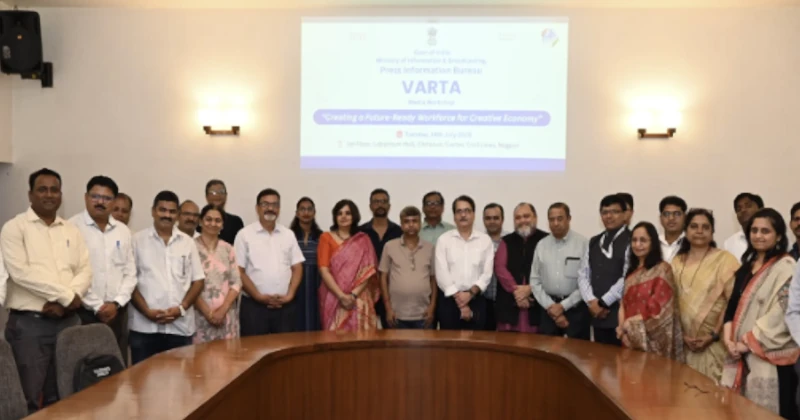
The vision was outlined by Dr Ashish Kulkarni, Member of the Board of Directors of the Indian Institute of Creative Technology (IICT), Mumbai, while addressing a one-day media workshop, ‘Varta’, on “Creating a Future Ready Workforce for Bharat’s Creative Economy”, organised by the Press Information Bureau (PIB), Ministry of Information and Broadcasting, at the Chitnavis Centre in Nagpur.
The workshop was chaired by Smita Vats Sharma, Director General (West Zone), Ministry of Information and Broadcasting, and attended by senior editors and representatives of media organisations from across the region.
Speaking at the event, Dr Kulkarni said Bharat’s centuries-old storytelling tradition, combined with rapidly expanding digital content creation, positions the country to become a leading force in the global creative economy.
He noted that Indian filmmakers, digital content creators, animators, game developers and creative professionals are already producing globally competitive content, significantly strengthening Bharat’s presence in the Orange Economy.
According to Dr Kulkarni, Bharat currently contributes around 3 per cent to the global Orange Economy and is now working towards increasing this share to 12–15 per cent over the coming decade through focused investments in skill development, innovation and creative education.
“The Indian Institute of Creative Technology is working towards achieving this goal,” he said.
To build creative capabilities from the school level, Dr Kulkarni announced that the Indian Institute of Creative Technology (IICT), in collaboration with the National Council of Educational Research and Training (NCERT), will introduce the ‘Kaushal Bodh’ curriculum.
The curriculum aims to nurture creativity, encourage innovation and equip students with practical skills from an early age, preparing them for careers in emerging creative industries.
He emphasised that developing creative thinking alongside technical skills will be critical in preparing Bharat’s youth for future employment opportunities.
In one of the major announcements made during the workshop, Dr Kulkarni revealed that there is a proposal to establish AVGC Content Creator Labs in 15,000 schools and 500 colleges across the country.
These laboratories are expected to provide students with exposure to cutting-edge technologies in Animation, Visual Effects, Gaming, Comics and Extended Reality (AVGC-XR), enabling them to acquire industry-relevant skills while pursuing their education.
The initiative is expected to significantly strengthen Bharat’s talent pipeline for the rapidly expanding global creative and digital entertainment industries.
Highlighting the institute’s growing role, Dr Kulkarni said the Indian Institute of Creative Technology has been functioning as the National Centre of Excellence for the AVGC-XR sector since July 2025 from the National Film Development Corporation (NFDC) complex in Mumbai.
The institute offers skill-based programmes in Animation, Visual Effects, Gaming, Comics and Extended Reality through a Hub-and-Spoke model, ensuring that high-quality training is not limited to metropolitan centres.
Besides its Mumbai headquarters, the programmes will be delivered through regional and semi-urban centres, expanding access to specialised creative education across the country.
Dr Kulkarni also underlined Bharat’s rich heritage of storytelling and indigenous knowledge systems, stating that these are increasingly finding global audiences through digital platforms and modern content formats.
He said various Ministries of the Government of Bharat, in collaboration with film and creative institutions, are developing customised training programmes to meet the rapidly evolving needs of the creative sector.
These initiatives, he noted, are expected to generate new opportunities in skill development, entrepreneurship and capacity building while strengthening Bharat’s global creative footprint.
The workshop was organised by the Press Information Bureau (PIB) under the Ministry of Information and Broadcasting to facilitate discussions on building a workforce equipped for the changing demands of the creative economy.