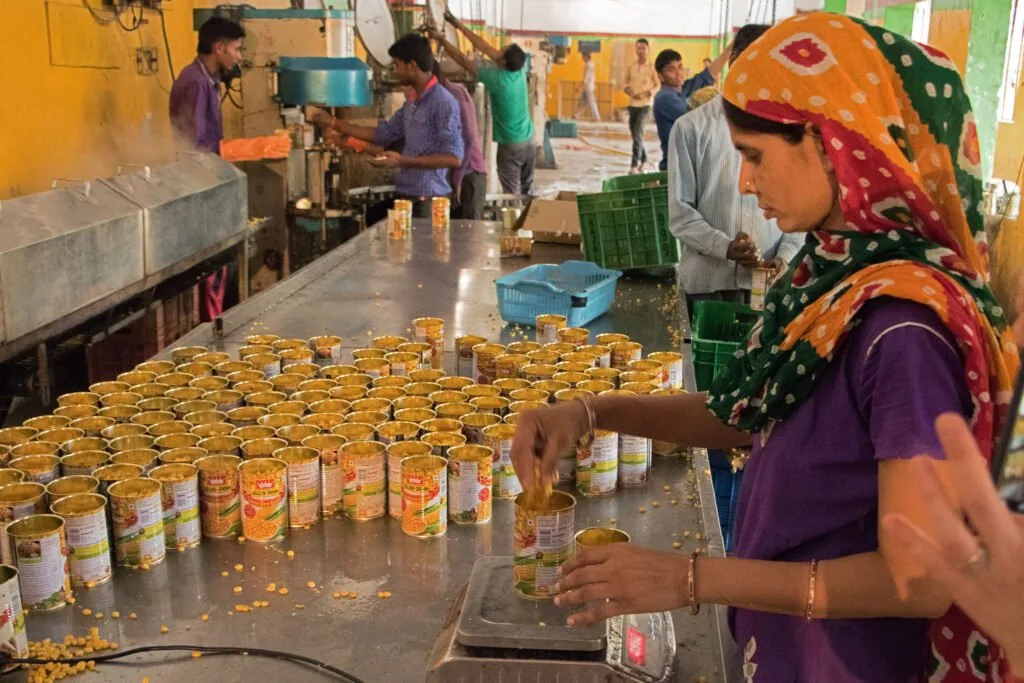
India’s efforts to strengthen the micro food processing sector received a major boost as the Pradhan Mantri Formalisation of Micro Food Processing Enterprises (PMFME) Scheme crossed the landmark of supporting more than two lakh credit-linked beneficiaries. The achievement marks an important chapter in the government’s broader strategy to promote entrepreneurship, formalise small businesses and increase value addition in the agriculture and food processing sectors.
The milestone was celebrated at a special event in New Delhi attended by senior government officials, representatives from state governments, banking institutions, development partners, entrepreneurs, Self-Help Groups (SHGs) and Farmer Producer Organisations (FPOs). The event showcased success stories from across the country and highlighted the impact of the scheme on livelihoods, employment generation and rural economic development.
Addressing the gathering, Union Minister for Food Processing Industries Chirag Paswan described the achievement as evidence that government efforts to support grassroots entrepreneurship are yielding measurable results. He said the success of the scheme demonstrates how targeted policy interventions can help transform local enterprises into sustainable business ventures while contributing to the vision of Aatmanirbhar Bharat and Viksit Bharat 2047.
Understanding the PMFME Scheme
The PMFME Scheme was launched by the Ministry of Food Processing Industries (MoFPI) to address long-standing challenges faced by India’s micro food processing sector. Despite accounting for a significant share of food processing activity in the country, many micro enterprises historically operated in the informal sector with limited access to institutional finance, technology, training and organised markets.
The scheme was designed to bridge these gaps by providing comprehensive support to entrepreneurs engaged in food processing activities. Unlike conventional subsidy programmes that focus primarily on financial assistance, PMFME follows an integrated approach that combines credit support, capacity building, formalisation, branding, marketing and market linkages.
The objective is not only to support individual enterprises but also to create a stronger ecosystem for the food processing industry at the grassroots level. By helping small businesses improve productivity, quality and market access, the scheme seeks to increase rural incomes, reduce post-harvest losses and generate employment opportunities across the food value chain.
More Than Rs 20,300 Crore in Investments
One of the most significant outcomes of the PMFME Scheme has been its ability to attract substantial investments into the micro food processing sector.
According to the Ministry of Food Processing Industries, the scheme has leveraged project investments exceeding Rs 20,300 crore. This investment has flowed into thousands of enterprises engaged in activities such as food processing, packaging, storage, branding and value addition.
The figure is particularly noteworthy because it reflects the confidence of entrepreneurs and financial institutions in the viability of micro food processing enterprises. By facilitating access to formal credit, the scheme has enabled entrepreneurs to expand operations, adopt better technologies and improve product quality.
The investment momentum generated through PMFME is also helping strengthen local economies by creating demand for raw materials, packaging services, transportation networks and other allied activities.
Generating Nearly 11 Lakh Employment Opportunities
Employment generation has emerged as one of the most visible outcomes of the PMFME Scheme.
The Ministry estimates that the initiative has created nearly 11 lakh direct and indirect employment opportunities across the country. These jobs span multiple segments of the food processing ecosystem, including production, procurement, packaging, logistics, marketing and retail.
Unlike large-scale industrial projects that are concentrated in specific regions, PMFME-supported enterprises are spread across rural and semi-urban areas. As a result, employment opportunities are being created closer to communities, reducing migration pressures and supporting local economic development.
The labour-intensive nature of food processing also makes the sector particularly important for inclusive growth. Small enterprises often employ family members, local workers and women, ensuring that economic benefits reach a wider section of society.
First-Generation Entrepreneurs Driving Growth
A striking feature of the PMFME Scheme is the large number of first-generation entrepreneurs it has supported.
According to official data, nearly 90 per cent of beneficiaries are first-generation entrepreneurs. This indicates that the scheme is helping individuals who may not have had previous business experience or family business backgrounds enter the world of enterprise.
For many beneficiaries, PMFME has provided the first opportunity to access institutional finance and establish a formal business. This transition from informal economic activity to organised entrepreneurship is considered a critical component of India’s broader economic transformation.
The emergence of first-generation entrepreneurs also reflects the growing aspirations among rural youth and local communities to create businesses rather than depend solely on traditional occupations.
Women Entrepreneurs at the Centre
One of the most celebrated achievements of the PMFME Scheme has been the participation of women entrepreneurs.
Women account for nearly 44 per cent of all beneficiaries under the scheme, highlighting the increasing role of women in India’s entrepreneurial ecosystem. Speaking at the event, Chirag Paswan described this as a reflection of the government’s commitment to women-led development.
He said the strong participation of women entrepreneurs demonstrates how policy interventions can create opportunities for economic empowerment and financial independence. The minister noted that women-led development remains a central pillar of the Viksit Bharat vision.
The impact extends beyond individual enterprises. Increased participation of women in business contributes to household incomes, strengthens local economies and promotes greater social and economic inclusion. Many women entrepreneurs supported under PMFME are engaged in activities such as spice processing, millet products, pickles, snacks, bakery items and traditional food products.
Bringing Enterprises into the Formal Economy
Formalisation has been another major achievement of the PMFME Scheme.
More than 75,000 PMFME-supported enterprises have entered the formal economy through registrations under Udyam Aadhaar, Udyam Assist, the Food Safety and Standards Authority of India (FSSAI) and the Goods and Services Tax (GST) framework.
Formalisation provides several advantages to small businesses. Registered enterprises gain easier access to credit, government schemes, insurance, quality certification and organised markets. Formal status also enhances consumer confidence and improves business credibility.
The transition from informal operations to formal enterprise structures is considered essential for long-term growth and competitiveness in the food processing sector.
The scheme has also played a significant role in strengthening Self-Help Groups across the country.
According to the Ministry, more than 4.18 lakh SHG members have benefited from Seed Capital support under PMFME. This assistance enables members to invest in working capital, purchase equipment and improve production capabilities.
Self-Help Groups have emerged as important vehicles for promoting entrepreneurship among women, particularly in rural areas. By providing financial support and market linkages, the scheme is helping SHGs move beyond subsistence-level activities and establish commercially viable enterprises.
This support is particularly significant in regions where access to formal finance remains limited.
Strengthening Skills Through Capacity Building
Financial assistance alone is often insufficient for ensuring the success of small enterprises. Recognising this, PMFME places strong emphasis on training and capacity building.
More than 1.76 lakh beneficiaries have received training under the scheme. Women account for nearly 77 per cent of those trained, reflecting the programme’s focus on building entrepreneurial capabilities among women.
Training programmes cover a wide range of areas, including food safety standards, product quality improvement, packaging, branding, financial management, marketing and business planning.
By enhancing technical and managerial skills, these initiatives help entrepreneurs improve productivity and compete more effectively in increasingly demanding markets.
The focus on capacity building ensures that enterprises are not merely created but are equipped to survive and grow over the long term.
Building Infrastructure Through Incubation Centres
Infrastructure support remains a critical requirement for the growth of micro food processing enterprises.
To address this need, the PMFME Scheme has approved 80 Common Incubation Centres across 27 states and Union Territories. Of these, 32 centres are already operational.
These centres provide entrepreneurs access to modern processing equipment, testing facilities, training infrastructure and technical expertise. Such facilities are particularly valuable for small businesses that may not have the resources to invest in expensive machinery individually.
The incubation centres also serve as hubs for innovation, product development and skill enhancement, helping enterprises improve quality and competitiveness.
The One District One Product Initiative
A defining feature of the PMFME Scheme is the One District One Product (ODOP) initiative.
The programme seeks to identify and promote products that have a unique connection with specific districts. By focusing on local strengths, the initiative aims to create stronger value chains and improve market opportunities for regional products.
Under ODOP, the Ministry has supported 40 common brands covering nearly 200 products. These include products such as makhana, millets, spices and various Geographical Indication (GI)-tagged products from different parts of the country.
The initiative helps preserve local traditions and indigenous knowledge while creating economic opportunities for producers. It also contributes to the development of regional brands that can compete in national and international markets.
During the event, Chirag Paswan commended several states for their effective implementation of the PMFME Scheme.
States such as Bihar, Maharashtra, Uttar Pradesh, Tamil Nadu and Madhya Pradesh were recognised for their efforts in promoting entrepreneurship, facilitating credit access and ensuring effective execution of the programme.
The minister noted that the success of the scheme is the result of coordinated efforts between the central government, state governments, district administrations, financial institutions and field-level functionaries.
He described the programme as an example of how national policy can be translated into a grassroots movement for enterprise development when supported by effective implementation mechanisms.
Beneficiary Number Two Lakh
A symbolic moment during the event was the felicitation of the scheme’s two lakhth beneficiary.
Chirag Paswan presented a loan sanction letter and certificate to Inderjeet Singh from Ranchi, Jharkhand, who became the two lakhth credit-linked beneficiary under the PMFME Scheme.
The recognition highlighted the human dimension of the programme, reminding stakeholders that behind every statistic is an entrepreneur seeking to build a sustainable livelihood and contribute to local economic growth.
To further increase participation and awareness, the Ministry announced the launch of a nationwide multimedia campaign.
Speaking at the event, MoFPI Joint Secretary Devesh Deval said the campaign aims to reach aspiring entrepreneurs across the country and inform them about the opportunities available under the scheme.
He emphasised that PMFME provides end-to-end support, covering financial assistance, training, branding, marketing and market linkages. According to him, the scheme is not merely supporting enterprises but transforming livelihoods and strengthening local value chains.
Food Processing Secretary A.P. Das Joshi echoed similar views, describing the achievement as evidence of a stronger ecosystem for the micro food processing sector. He said the scheme successfully integrates finance, technology, formalisation, capacity building and market access into a comprehensive enterprise development framework.
A Key Pillar of Aatmanirbhar Bharat
The success of the PMFME Scheme reflects the growing importance of food processing in India’s economic development strategy.
By supporting micro enterprises, promoting formalisation, encouraging value addition and generating employment, the scheme addresses multiple policy objectives simultaneously. It contributes to rural development, entrepreneurship, women’s empowerment and economic self-reliance.
The achievement of more than two lakh credit-linked beneficiaries demonstrates that grassroots enterprise development can play a significant role in transforming local economies. With investments exceeding Rs 20,300 crore, nearly 11 lakh employment opportunities created and thousands of businesses entering the formal economy, the scheme is emerging as a key pillar of India’s vision for Aatmanirbhar Bharat and Viksit Bharat 2047.
As the government looks to expand the food processing sector further, the PMFME Scheme stands out as a model of how targeted policy support can help small enterprises become engines of growth, employment and inclusive development across the country.