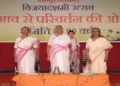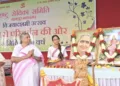
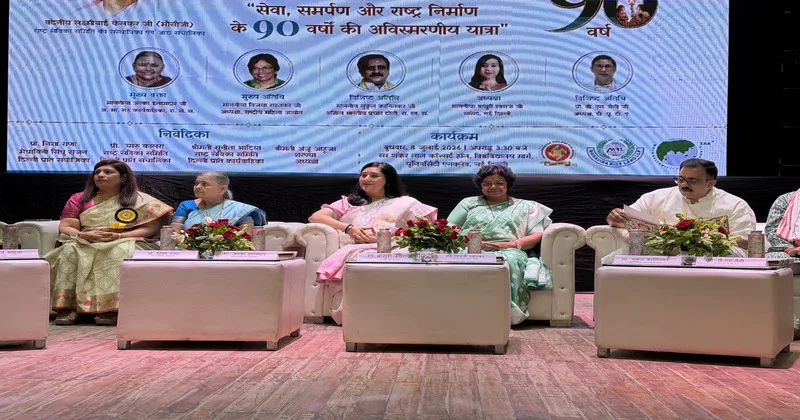
The success and continuity of any organisation depend on three important factors — its ideological foundation, its objective and the dedication of its workers. Rashtra Sevika Samiti’s foundation is based on Hindutva as a way of life, which represents values, social harmony and spiritual growth, said Alka Inamdar, Akhil bharatiya Sah-Sarkaryavahika of Rashtra Sevika Samiti at a programme organised by Medhavini Sindhu Srijan, Delhi Prant and Sharanya on July 8, 2026, at Shankar Lal Concert Hall, University Road, New Delhi, to mark the birth anniversary of Vandaniya Lakshmibai Kelkar (Mausi Ji), the founder and Adya sanchlika of Rashtra Sevika Samiti.
The theme of the event was “Seva, Samarpan aur Rashtra Nirman ke 90 Varsh ki Avismaraniya Yatra” (90 years of an unforgettable journey of service, dedication and nation-building). The programme also commemorates the 90-year journey of the Rashtra Sevika Samiti and highlighted the contribution of women in strengthening families, society and the nation through the values of service, dedication and cultural commitment.
Addressing the gathering, Alka Inamdar said that completing 90 years is a significant milestone for any organisation, especially for a women’s organisation that has continuously worked towards social awakening while balancing family responsibilities.
She said that though 90 years may appear a short period in the vast history of Bharat, the uninterrupted journey of Rashtra Sevika Samiti represents a remarkable achievement.
“Today, Rashtra Sevika Samiti is among the world’s largest women’s organisations, with around 5,000 shakhas and numerous service projects working towards national awakening,” she said.
“Hindutva is not merely a form of worship; it is a way of life that teaches individuals to work for personal development, social welfare and the larger good of humanity,” she said.
She added that the organisation’s objective is the reconstruction of the nation through personality development and value-based education. Tracing the historical background of the organisation, Alka Inamdar said that Bharatiya society witnessed periods of self-forgetfulness due to historical challenges, but whenever society faced such situations, great personalities emerged to awaken and guide it.
She mentioned figures such as Swami Dayananda Saraswati, Swami Vivekananda and Sri Aurobindo, who worked for social awakening, and highlighted the contribution of Keshav Baliram Hedgewar in providing an organised method of social transformation through the shakha system.
She said that Vandaniya Lakshmibai Kelkar carried this vision into the women’s sphere by establishing Rashtra Sevika Samiti, recognising that women, who guide families, also possess the ability to lead society and contribute to nation-building.
She also highlighted that Lakshmibai Kelkar’s vision was based on recognising the inherent strength of women rather than viewing women as needing empowerment from outside. “She believed that women are themselves a source of power. The need is not to give strength to women but to awaken the strength already present within them,” she said.
She recalled that when the organisation began in 1936, women participating in physical training and social activities faced criticism from sections of society. However, Lakshmibai Kelkar remained committed to the belief that women could contribute towards national life while fulfilling their responsibilities towards family.
She said Mausi Ji understood the realities of women’s lives and therefore allowed flexible working methods, including weekly shakhas, enabling women to balance household responsibilities and social service. “Women have the responsibility of carrying forward the values, traditions and ideals that contribute towards the future of society,” she said.
She further highlighted that service (seva) has been an integral part of the ethos of Rashtra Sevika Samiti since its inception. She said that service is not merely an activity but an expression of compassion, responsibility and a feeling of oneness with society.
“Service should emerge naturally from within. It should not be an act of charity but an expression of affection and belongingness,” she said. Recalling the teachings of Vandaniya Lakshmibai Kelkar, Alka Inamdar said that Mausi Ji encouraged every Sevika to treat those who assist them at home with dignity and respect.
She said that Mausi Ji never used terms that created a sense of distance or inequality. Instead, she encouraged women to consider everyone as part of their own family. “She taught that the woman who comes to help in your house should be treated like a sister. She should not be given separate utensils or treated differently. She should receive the same respect and affection as any guest,” Alka Tai said.
She added that such an approach reflects the Bharatiya idea of social harmony, where equality is not merely discussed but practised through everyday behaviour.
Highlighting the contribution of Rashtra Sevika Samiti during difficult situations, Alka Inamdar said that whenever the nation faced challenges, whether natural disasters, floods, earthquakes, cyclones or the COVID-19 pandemic, Sevikas came forward with dedication and compassion.
She said that the organisation’s service activities are guided by the values inherited from Lakshmibai Kelkar, where assistance is provided with respect and sensitivity.
Recalling Mausi Ji’s instructions during relief efforts, she said that while collecting materials for affected people, Sevikas were told to ensure that whatever they donated was of a quality they would willingly offer to their own family members. “Service is not about giving away what we do not need; it is about sharing with love and responsibility,” she said.
Alka Inamdar also highlighted Lakshmibai Kelkar’s vision of women’s economic independence. She said that decades before the term “women empowerment” became popular, Mausi Ji encouraged women to develop skills and undertake small-scale economic activities.
She said that Lakshmibai Kelkar wanted women to become self-reliant so that they could contribute to their families as well as support organisational activities without depending on others. “In the 1940s, encouraging women to become economically capable was a revolutionary idea,” she said.
According to her, Mausi Ji believed that women were not weak individuals who needed empowerment from outside; rather, they possessed immense inner strength that needed to be recognised and channelised. “She believed that every woman carries a divine potential within herself. The need is to awaken that strength and use it for the welfare of society,” she said.
“Women must move forward in every field, but while doing so, they should never forget their fundamental responsibility of nurturing the next generation,” she said.
She added that Mausi Ji used cultural platforms such as Ramayan discourses not merely for religious discussions but as a medium to awaken national consciousness among women. Through the example of Mata Sita, she explained the ideals of courage, dedication and commitment towards the nation.
She narrated the example of Lakshmibai Kelkar herself, who despite personal challenges continued to remain committed to organisational responsibilities. She also recalled instances where workers made personal sacrifices to ensure the success of organisational programmes.
She highlighted the dedication of Sevikas who contributed their personal resources during challenging times, demonstrating that the strength of an organisation lies in the commitment of its workers.
Bharatiya women have always led from the front: Mukul Kanitkar
Speaking on the contribution of Bharatiya women, Chief Guest and member of the Akhil Bharatiya Prachar Toli of Rashtriya Swayamsevak Sangh Mukul Kanitkar highlighted that Bharatiya women have continuously demonstrated leadership and excellence whenever opportunities were provided.
He pointed out that women have made significant contributions in various fields, including education, science and research. Citing examples, he noted that women constitute a significant proportion of teachers in school education, scientists in institutions like the Indian Council of Medical Research (ICMR) and the Indian Space Research Organisation (ISRO), and among university graduates.
Recalling the historic address of Swami Vivekananda at Chicago, Mukul Kanitkar said that Vivekananda deliberately addressed the audience as “Sisters and Brothers of America”, placing “sisters” before “brothers”, reflecting the importance accorded to women in Bharatiya thought.
He said that Swami Vivekananda had envisioned the coming era as the era of women’s leadership, and the growing contribution of Bharatiya women across fields reflects that vision.
He also highlighted that the concept of modernity should not be limited to imitation of Western lifestyles. “Modernity means what is progressive, advanced and relevant to the present time. It is not defined by adopting Western values,” he said.
He described Vandaniya Lakshmibai Kelkar as a visionary who was far ahead of her time. At a time when women’s participation in organised social work was limited, she envisioned a movement where women could contribute towards personality development, family values, social transformation and nation-building.
He said the establishment of Rashtra Sevika Samiti in 1936 reflected a thought that was decades ahead of its time, creating an organisation where women could collectively work towards national reconstruction while fulfilling their responsibilities towards family and society.
Mukul Kanitkar emphasised that Bharatiya civilisation has always viewed women not merely as participants but as guiding forces in social and national life.
He said that the idea of women’s leadership is deeply rooted in Bharatiya thought and cannot be understood through the narrow framework of Western concepts. Referring to the meaning of modernity, he said that being modern does not mean abandoning traditions but moving forward while carrying the wisdom of the past.
“Modernity does not mean becoming Western. A truly modern person is one who is progressive, updated and capable of moving ahead with time while remaining connected with one’s civilisational roots,” he said.
He said that the concept of women’s leadership in Rashtra Sevika Samiti was based on the Bharatiya understanding of matritva (motherhood), not merely as a biological role but as a quality of compassion, responsibility and the ability to nurture society.
“Motherhood is not limited to giving birth. The ability to nurture, guide and bring positive transformation is the essence of motherhood,” he said. He explained that Bharatiya tradition considers women as the foundation of family and society. The qualities of compassion, patience, forgiveness and dedication associated with motherhood provide direction to society.
He recalled a personal experience from his childhood, sharing how a poem written by his mother about motherhood changed his understanding of the role of women. He said that he realised motherhood represents sacrifice, unconditional love and the ability to put others before oneself.
He added that his mother taught him that while a woman gives birth to a child physically, a teacher and guide give birth to a person’s personality through values and sanskars.
Referring to the call given by Rashtra Sevika Samiti’s founder, he urged people to dedicate time towards nation-building activities. He said that every citizen should devote at least one hour daily towards society and national service.
“Vandaniya Mausi Ji never demanded anything extraordinary. She only asked for one hour dedicated to Bharat,” he said, appealing to citizens to participate in constructive social activities.
Bansuri Swaraj, Member of Parliament from New Delhi while addressing the gathering underlined that the focus today has shifted from merely discussing women empowerment to women-led development. She said that a developed nation requires the active participation and leadership of women in every sphere.
“Women-led development means strengthening the nation through the leadership of women. When a woman is empowered socially, economically and politically, it does not empower only an individual; it strengthens families, societies and ultimately the nation,” she said.
Nine distinguished women from diverse fields were also felicitated for their outstanding contributions to society and public service at the event.