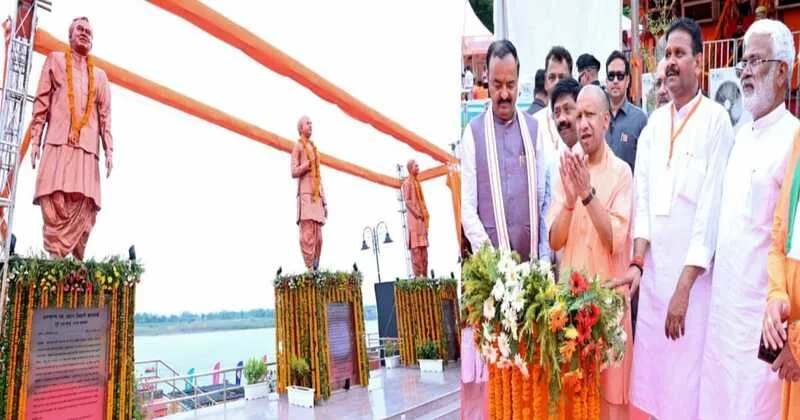
Prayagraj: In the sacred city where rivers meet, three mighty streams of Bharat’s national life have now converged in bronze. Uttar Pradesh Chief Minister Yogi Adityanath, on July 6, 2026, inaugurated Prerna Park at Kali Ghat on the banks of the Yamuna in Prayagraj, unveiling grand statues of Bharatiya Jana Sangh founder Dr Shyama Prasad Mukherjee, former Prime Minister Bharat Ratna Atal Bihari Vajpayee and former Vishwa Hindu Parishad International President Ashok Singhal.
The occasion was very special, on the birth anniversary of Dr Shyama Prasad Mukherjee, this park was inaugurated. The man who gave organised political expression to the idea of cultural nationalism in independent Bharat and who laid down his life for the complete integration of J&K.
Developed by the Prayagraj Municipal Corporation, the park now stands as a permanent tirtha of inspiration on the Yamuna riverfront, where the values of three of the most consequential figures of the nationalist movement will speak to every generation that walks its pathways.
Describing the trio as three great personalities whose lives were dedicated to nationalism, good governance and Sanatan values, the Chief Minister said their contribution to the making of modern Bharat is beyond measure and that Prerna Park will ensure their ideals remain a living presence in the public consciousness of Sangam Nagari.
The Soul of India Resides in Sanatan Dharma
Addressing the gathering after the unveiling, CM Yogi Adityanath articulated the civilisational vision that binds the three luminaries together. “The soul of India resides in Sanatan Dharma and Lord Ram is the primary source of Indian soul. Ram represents the nation and is the thread that binds India from north to south in unity,” he said.
It was a message delivered in Prayagraj, the eternal place of Sanatan faith, the city of the Sangam and the land that has for millennia embodied the spiritual unity of Bharat. In honouring Mukherjee, Vajpayee and Singhal, the Chief Minister underlined that the story of the nation cannot be separated from the story of its dharma and that those who dedicated themselves to protecting both deserve the gratitude of a thousand generations.
Dr Shyama Prasad Mukherjee: The Sacrifice That Shaped a Nation
Paying homage to Dr Shyama Prasad Mukherjee on his Jayanti, the Chief Minister recalled the defining act of moral courage that shaped the course of Indian politics. Dr Shyama Prasad Mukherjee resigned from the Union Cabinet led by then Prime Minister Jawaharlal Nehru in protest against policies he believed were against national interests. Refusing to remain a silent spectator to appeasement and territorial ambiguity, he went on to found the Bharatiya Jana Sangh in 1951, laying the ideological foundation upon which the Bharatiya Janata Party stands today.
Dr Shyama Prasad Mukherjee’s clarion call of one nation, one constitution, one flag, one head of state, became the article of faith for which he ultimately gave his life in Kashmir in 1953. For decades, his martyrdom remained an unfinished summons to the nation’s conscience.
That summons, the Chief Minister said, has finally been answered. “The dreams of Dr. Syama Prasad Mookerjee have been realised under the leadership of Prime Minister Narendra Modi. The abrogation of Article 370 integrated Jammu and Kashmir with the rest of India like every other state,” he said. The statue at Prerna Park thus does not commemorate a leader; it celebrates the moment when a martyr’s vision became the law of the land.
Atal Bihari Vajpayee: The Statesman Who Controls Allies and Adversaries Alike
The second statue honours the man who carried Dr Shyama Prasad Mukherjee’s ideological inheritance into the highest office of the land. Atal Bihari Vajpayee began his political journey as a young follower and trusted aide of Dr Shyama Prasad Mukherjee in the fledgling Jana Sangh. Rose to become the first non-Congress Prime Minister to complete a full term in office, proving that the nationalist stream was not merely a movement of protest but a force capable of governing a billion people with wisdom and grace.
Chief Minister Yogi Adityanath hailed Atal Bihari Vajpayee as a model of political integrity and good governance. “Atal Bihari Vajpayee showed what political stability and probity in public life should be,” he said. From the Pokhran nuclear tests that announced Bharat’s arrival as a confident power, to the highways that stitched the nation together. With a parliamentary career that earned the respect of allies and adversaries alike, Atal ji demonstrated that Rashtra dharma and raj dharma could walk hand in hand.
In Atal ji’s vision, the ideological seed sown by Shyama Prasad flowered into statecraft. The disciple who had stood by his mentor’s side during the Kashmir agitation of 1953 lived to steer the nation itself, a continuity of purpose spanning half a century that the twin statues at Prerna Park now capture in silent bronze conversation.
Ashok Singhal: The Karmayogi of Civilisational Awakening
The third figure completes the triveni. Ashok Singhal, the karmayogi of the Vishwa Hindu Parishad, devoted his entire life to Sanatan values and the nation. Chief Minister said, adding a tribute that placed Singhal’s legacy at the very centre of the new Bharat: “The grand Ram temple that we see today in Ayodhya and the transformed Ayodhya of today are founded on Ashok Singhal ji’s vision.”
A metallurgical engineer by training who renounced a worldly career for lifelong service to the Sangh, Singhal became the chief architect of the Shri Ram Janmabhoomi movement, the greatest mass awakening of Hindu society in the modern era. He united sants, mathas and individual masses into a single current of civilisational assertion and lived a life of such austere dedication that even his critics acknowledged his tapasya. Though he did not live to witness the Pran Pratishtha of Ram Lalla in his divine abode, the Ayodhya of today, full of resplendent, reborn, receiving crores of pilgrims, stands as his true memorial. The statue at Kali Ghat is simply telling the nation acknowledgement of a debt it can never fully repay.
Thinker, Statesman, Karmayogi: One Unbroken Sankalp
Seen together, the three statues narrate a single epic in three directions. Dr Shyama Prasad Mukherjee was the thinker who gave nationalism its political vocabulary and sealed it with his blood. Atal Bihari Vajpayee was the statesman who proved that this vocabulary could become the language of governance. Ashok Singhal was the karmayogi who awakened the civilisational self-confidence of society itself, without which no political change endures.
Ideology, governance, and awakening are incomplete without the others, each now standing shoulder to shoulder on the Yamuna’s bank. It is this continuity, this relay of sankalp passed from hand to hand across generations, that Prerna Park enshrines. Young visitors who pause before these statues will read not three separate biographies but one continuous channel of how a civilisation remembered itself.
The Prayagraj Connections of Three Pillars
Ashok Singhal: Prayag is the spiritual launchpad of his life’s work. The VHP, founded in 1964, held its inaugural world convention of Hindus at Prayag during the 1966 Kumbh Mela. More decisively, the Dharma Sansad convened at Prayag during the Maha Kumbh of January 1989, where Singhal, VHP Secretary General, delivered the introductory speech before some 3,000 sants. His idea was accepted as the model design of the Shri Ram Mandir and set in motion the Ram Shila Pujan, leading to the Shilanyas of November 1989. The blueprint of the Ayodhya temple was, quite literally, sanctified at the Sangam.
In the later phase, Ashok Singhal’s association with Rajju Bhaiya, the physics professor at Allahabad University who later became the fourth RSS Sarsanghchalak, deepened during the Emergency when both were arrested, and it was Rajju Bhaiya who appointed Singhal as a Joint General Secretary of the VHP. So, Prayagraj gave Singhal both his mentor and his movement’s defining moment. He was also an RSS pracharak in Kanpur and studied Metallurgy at IIT BHU, in the same Purvanchal-Doab belt.
Dr Shyama Prasad Mukherjee: His direct footprint in Prayagraj is thinner (his karmabhoomi was Bengal and Delhi), the connection here is commemorative and ideological. The event on his jayanti, the Ekta race, embodies his “one nation” doctrine. In fact, Prayagraj, known as the city of the Nehru family and Anand Bhawan, now hosts the statue of the man who resigned from Nehru’s cabinet in protest against policies he believed were against national interests.
Atal Bihari Vajpayee: Vajpayee, accompanied by the RSS in 1951 to the newly formed Jana Sangh, became Mukherjee’s follower and aide, and was at his side during the 1953 Kashmir fast that ended in his death. His UP political life (Balrampur MP, Lucknow MP, Rashtradharma editor in Lucknow) kept him tied to the state, and after his passing in 2018, his asthi kalash was immersed at the Sangam among rivers across Bharat, confirming the disciple’s final journey ended where his guru’s ideological heirs would later be immortalised.
Heritage and Development, Advancing Together
The inauguration of Prerna Park is also a chapter in the larger transformation of Prayagraj. The park features landscaped gardens, illuminated pathways, seating arrangements and beautification works around the statues, which have come up as part of the state government’s sustained effort to give a new look to the ghats of the Ganga and the Yamuna.
During the same visit, the Chief Minister reviewed 1,553 works of the Public Works Department and other departments across the Prayagraj Zone, involving projects worth more than Rs 2,500 crore. The message was unmistakable: in the new Uttar Pradesh, virasat and vikas are new partners in UP development. The city that hosted the grandest Maha Kumbh in human memory continues to build its roads, riverfronts, infrastructure and its institutions of memory with equal devotion.
A Prerna Sthal for Generations to Come
Prayagraj Mayor Umesh Chandra Ganesh Kesarwani summed up the purpose of the event by stating that the park has been constructed to convey the life values and ideas of Dr Shyama Prasad Mukherjee, Atal ji and Singhal ji, who are regarded as sources of inspiration for national service, cultural nationalism, social harmony and public welfare to future generations.
That is what distinguishes Prerna Park from an ordinary memorial. Statues of stone and bronze are raised in every age; what endures is the sanskar they transmit. On the banks of the Yamuna, in the city where Bharat has always come to renew its soul, three guardians of the national idea now keep eternal watch. The pilgrim who folds his hands before them on his way to the Sangam will carry away a spark of the same fire that lit three extraordinary lives. Prayagraj is moving firmly on the auspicious path of development. With Prerna Park, it has ensured that the journey remains illuminated by the ideals of those who showed the way.