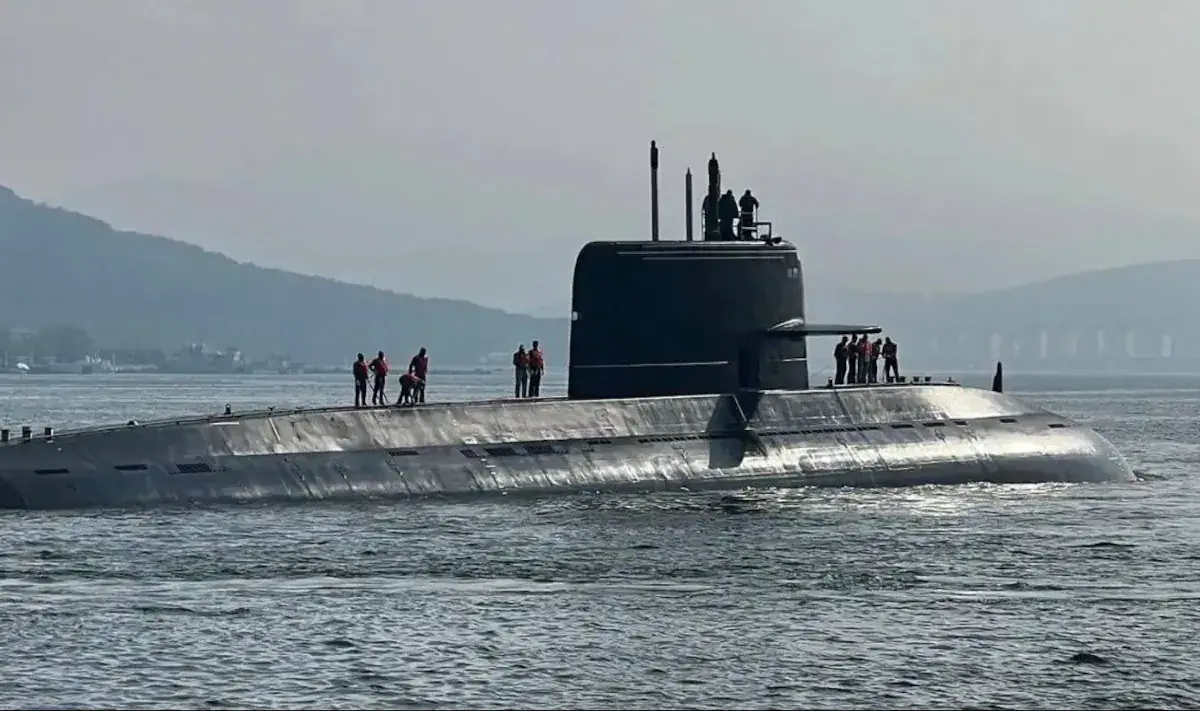
There is a particular genius to a weapon that need never be fired to achieve its objective. The eight Chinese-origin Hangor-class submarines now being transferred to Pakistan, the largest naval acquisition in Pakistan’s history, belong to this category of strategic instrument. Their military significance is real but secondary. Their true purpose is cognitive, architectural, and deeply connected to China’s long-term ambition in the Indian Ocean. India’s defence establishment understands this, even if the public discourse has not yet caught up.
To understand why, begin not with the submarines themselves but with a name.
The weight of a name
On 9 December 1971, the Pakistani submarine PNS Hangor sank the Indian frigate INS Khukri in the Arabian Sea and it was the first warship to be sunk by a submarine in combat since World War II. To this day it stays Pakistan Navy’s most celebrated operational win , the one people bring up at every institutional occasion as if it were evidence that smaller powers can hit back with asymmetric blows against bigger opponents. So the choice to name the new Chinese-built submarines PNS Hangor is , in the end , not just sentimentality or any simple naval tradition. It is a calculated message, directed at New Delhi with unmistakable precision.
The message is this: Pakistan’s undersea warfare capability is being restored, modernised, and extended, and it remembers what it once achieved. That the message is partly bluster matters less than the fact that it forces India to take it seriously. Psychological pressure that compels resource allocation is as strategically valuable as a torpedo that finds its mark.
But the symbolism of the name is only the visible surface. Beneath it lies a more consequential strategic architecture.
Beyond bean counting
The new submarines are technically formidable. With Air Independent Propulsion, or AIP tech, a system that lets the normal submarines remain underwater for long stretches without resurfacing , they end up being much more silent than the older Agosta-class boats they replace. They offer greater endurance, lower acoustic signatures and significantly enhanced detection resistance. India’s anti-submarine warfare capabilities, while advanced, will face a more demanding operational environment. That is a genuine military challenge.
What is more significant, however, is the geographic ambition signalled alongside the hardware. Pakistan has historically been an Arabian Sea navy, its strategic attention fixed on India’s western seaboard. There are now clear indications that Pakistan intends to extend submarine operations into the Bay of Bengal, India’s eastern maritime domain, where the Andaman Sea sits astride critical Indo-Pacific shipping lanes. If Pakistan operationalises that ambition, even partially, India can no longer concentrate its naval assets against one front. The arithmetic of two-front maritime pressure begins to impose itself.
That is China’s real strategic achievement here. Not the submarines themselves. The reorientation of India’s naval planning calculus.
The dragon behind the deal
The transfer cannot be understood in isolation from China’s own Indian Ocean trajectory. Since approximately 2006, the People’s Liberation Army Navy has steadily expanded its presence in these waters, counter-piracy deployments that morphed into persistent patrols, a naval support facility in Djibouti, repeated submarine visits to Karachi, and a systematic programme of port infrastructure investment from Gwadar to Hambantota to Chittagong. The logic is publicly stated but consistently underappreciated: China faces what strategists call the Malacca Dilemma, its energy imports and trade flows transit sea lanes it does not control, leaving Beijing strategically exposed to interdiction.
China’s Indian Ocean strategy is therefore primarily about securing economic lifelines. But from New Delhi’s perspective, the accumulation of Chinese naval presence, port access, and now a Pakistan submarine fleet of Chinese origin creates the appearance, and increasingly the reality, of strategic encirclement. The same activity is simply interpreted differently depending on the observer. Beijing calls it port investment and freedom of navigation. New Delhi calls it the String of Pearls. Both are correct.
The submarine deal tightens this architecture in a specific way. China gains a forward undersea capability that it does not need to man or maintain directly. Pakistan ends up taking on hardware it really can’t afford, not unless the Chinese financing keeps coming, and that creates a debt dependency. The whole thing also gives Beijing extra leverage over Islamabad’s naval posture, in a quiet but persistent way. Yes, the relationship looks symbiotic, but it’s also unequal, and that imbalance ends up serving Chinese grand strategy more than it serves Pakistani national interest.
The proxy question
It is tempting and not entirely wrong, to frame Pakistan as China’s naval proxy in the Indian Ocean. Beijing rarely fights its adversaries directly. It prefers to raise costs through partners, grey-zone operations, and carefully calibrated capability transfers. The Hangor deal fits this pattern. But the proxy framing oversimplifies a relationship that Pakistan enters with its own strategic agency intact.
Pakistan’s existential clash with India really goes way back, like before its links with China, by decades. Islamabad keeps saying it wants these submarines to guard the maritime lanes around the China Pakistan Economic Corridor, to keep a credible deterrent against Indian naval interference, and to uphold institutional prestige inside a navy that for a long time has been operating under India’s shadow. These are Pakistani motivations, not Chinese instructions. What Beijing provides is the enabling technology and the financing. What Pakistan provides is the geography and the forward presence. The relationship is a convergence of interests, not a command relationship, and that distinction matters for how India should respond.
India’s real challenge
The good news for India is that the basic equilibrium of naval power in the Indian Ocean hasn’t really been flipped. The Indian Navy still keeps decisive edges in fleet count, carrier aviation, maritime sensing infrastructure, and networked operational capacity. With bilateral agreements with the United States, France, and Japan , India gets access to intelligence and tracking data which does enhance India’s anti-submarine reach in a meaningful way. Meanwhile, the Arihant-class nuclear-armed submarines allow New Delhi an undersea second strike posture, and that’s something that no Pakistani conventional submarine acquisition can simply cancel out. The strategic buffer remains intact.
The challenge India faces is not vulnerability. It is cost. The Hangor deal forces India to put extra resources into anti-submarine warfare, keep up surveillance over the Arabian Sea, and cover the eastern flank, which would otherwise get aimed toward India’s central maritime objective: pushing power into the South China Sea and beyond, deeper Indo-Pacific territory. Every rupee that goes into defending against a Pakistani submarine risk that is at least partly performative, is a rupee that can’t be used for the blue-water navy India needs in order to work as an actual Indo-Pacific maritime power.
That is China’s victory condition, not sinking Indian ships but sinking Indian naval budgets into a defensive posture. Beijing does not really need Pakistan submarine capabilities to hurt India in a direct way. what it wants is to create complications for India’s strategic thinking, dilute India’s maritime focus, and make sure that New Delhi stays stuck dealing with its western side, while China quietly consolidates its position across the Indian Ocean on the eastern front. It is a strategy of distraction disguised as an arms deal.
What India must do
India’s response must be calibrated to the actual threat rather than its symbolic packaging. Accelerating the P-75I submarine programme to induct additional AIP-equipped boats is essential, India cannot allow Pakistan to achieve parity in undersea endurance. Deepening the Quad-adjacent intelligence-sharing architecture, particularly with the United States and Japan, which have unmatched undersea surveillance capabilities, will significantly offset the detection challenge posed by Pakistan’s quieter new fleet. And India must resist the temptation to treat the Hangor deal as a Pakistan problem requiring a Pakistan-only solution.
The appropriate strategic response to a Chinese-enabled Pakistani submarine force is not merely more Indian submarines. Its a deeper integration of India’s maritime abilities into the wider network of Indo-Pacific security relations, those relations that give India access to collective capacities no one bilateral arms race can really emulate.
The ghost of INS Khukri haunts Indian naval memory for a reason. Pakistan chose that name deliberately. But India in 2026 isn’t quite the same India, as in 1971, and Beijing, with all of its strategic patience, seems to be making this bet that Indian over reaction, will end up doing more harm to Indian interests than even the submarines themselves. Proving that bet wrong requires not alarm, but clarity.