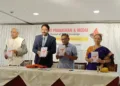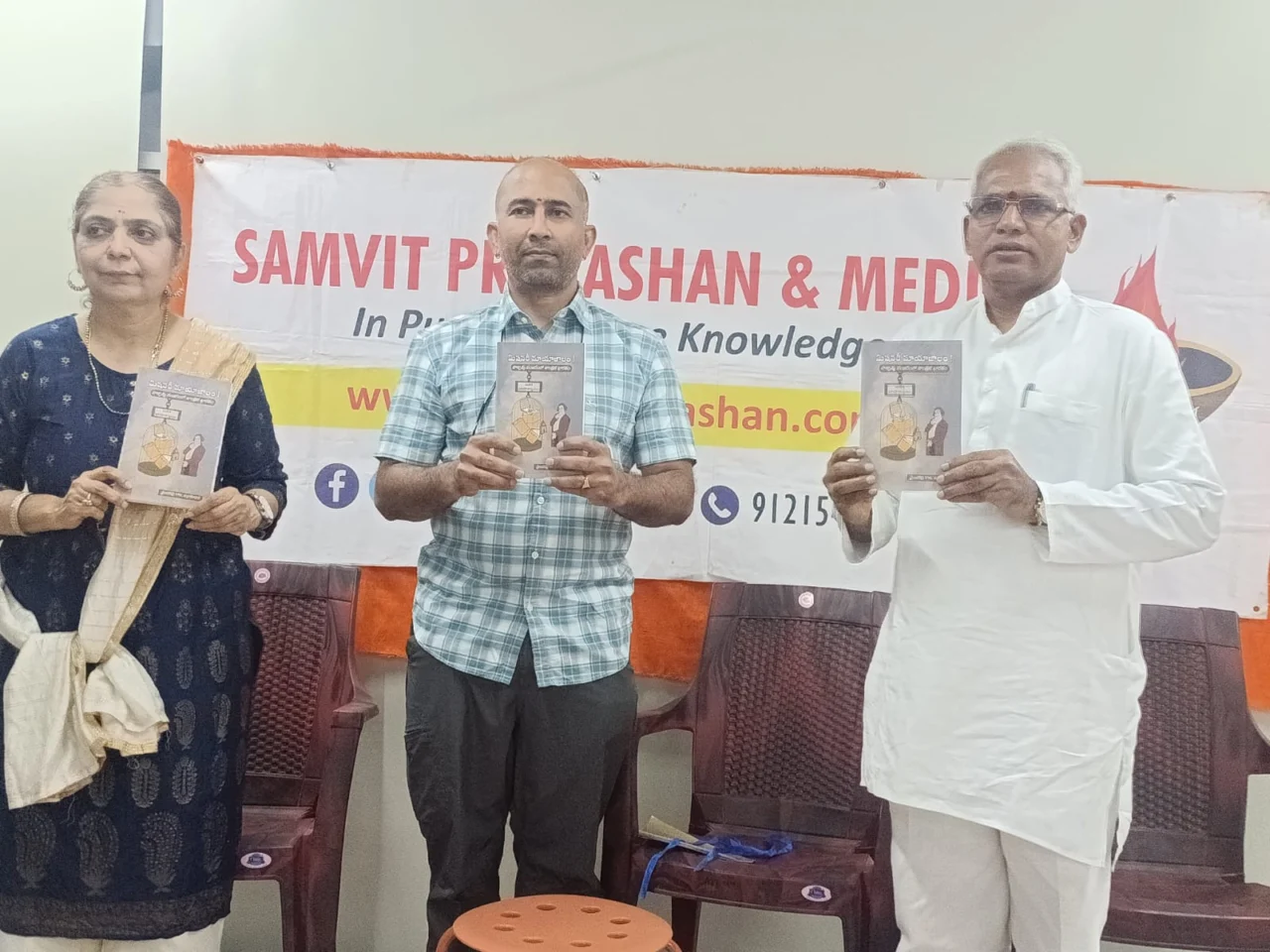
The Telugu book Missionary Mayajaalam, authored by Sudha Mohan, was launched at a programme organised by Samvit Prakashan in Hyderabad on June 30. Amara Linganna, Dakshina Madhya Kshetra Dharma Jagaran Pramukh, delivered the keynote address, while P. Shailaja, Director of Samvit Prakashan also addressed the gathering.
Addressing the audience, Amaralinganna said Bharat has endured centuries of physical and intellectual attacks by Islamic invaders and Christian missionaries, yet its civilisational foundations have survived. He remarked that religious wars waged by Islam and Christianity caused the deaths of millions of people across the world in the name of supreme God and ideology.
“We were attacked and suffered innumerable difficulties, but we Hindus were not defeated,” he said, adding that the intellectual battle against distortions of India’s history and culture continues even today.
He said attempts to distort or rewrite India’s civilisational history have persisted over centuries, but the essence of Dharma has survived through village traditions, folklore and community life. These traditions enabled ordinary people to understand and live according to Dharmic values despite repeated invasions and ideological challenges.
Amaralinganna said there is now a widening disconnect between society and its civilisational roots. He cautioned against complacency, saying that while Hindutva cannot be eradicated, the threats confronting Hindu society are real and should neither be ignored nor met with silence.
Referring specifically to Christian missionary activities and Islamic ideological expansion, he described them as challenges to Hindu society and said remaining silent would only weaken future generations. “We cannot afford to lose millions more,” he said.
He asserted that governments alone cannot protect Hindu society and that the responsibility of preserving Dharma rests primarily with society itself.
Referring to history, he said that while Hindu rulers, including Chhatrapati Shivaji Maharaj, defended the nation and Dharma, it was ultimately society that stood firm and ensured the continuity of India’s civilisation.
Calling for an honest understanding of history, Amaralinganna said future generations should be taught historical facts without distortion or cosmetic reinterpretation about religious threats from radical Islam and Christian missionaries.
He said the next generation should be made aware of the historical record relating to the Church, Christian missionary activities and Islamic invasions, along with the philosophical foundations and virtues of the Hindu tradition.
Concluding his address, Amaralinganna urged people to take such literature to every section of society. He said books that critically examine India’s history and civilisational heritage should reach the public and inspire informed discussion, research and awareness so that future generations understand their cultural roots through evidence-based study.
మిషనరీ మాయాజాలం : పాశ్చాత్య పంజరంలో తాంత్రిక భారతం Missionary Mayajalam
Link : https://t.co/LMPeay5yy4
— Samvit Prakashan (@SamvitPrakashan) June 20, 2025
Sudha Mohan, author of Missionary Mayajaalam, said the book examines how colonial scholars constructed narratives about India’s history, civilisation and culture that were often presented as accepted truths without adequate evidence or rigorous research.
He argued that many such sweeping generalisations were later adopted by sections of Indian academia and society, creating as a “Missionary Mayajaalam”. He said the book offers an overview of these issues and encourages readers to undertake deeper research, examine evidence and contribute towards correcting historical distortions through scholarly enquiry.
Addressing the gathering, P. Shailaja, Director of Samvit Prakashan, introduced the publishing house and highlighted its efforts to publish books on Bharatiya thought, civilisation, history and philosophy. She said Samvit Prakashan has published a wide range of titles in English, Telugu, Hindi, Tamil and Kannada, making literature on Indian knowledge traditions accessible to readers across the country.