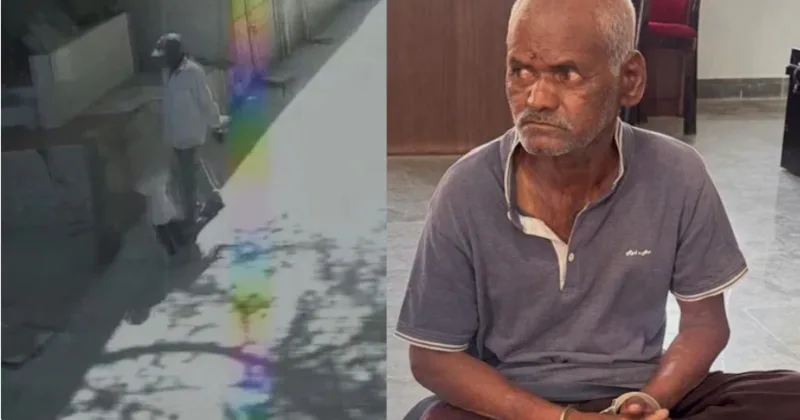
PUNE: In a verdict that has sent a strong message across Maharashtra and possibly India, a special court sentenced 65-year-old Bhimrao Prabhakar Kamble to death for the rape and murder of a three-and-a-half-year-old girl in Nasrapur village under Bhor taluka of Pune district.
The judgment, delivered by Special Judge S.R. Salunke, comes barely two months after the horrific crime on May 1, 2026, marking one of the fastest resolutions in the state’s history for a case under the Protection of Children from Sexual Offences (POCSO) Act.
The special court had convicted the accused on Thursday June 25, but the quantum of punishment was announced today.
News Alert ! Special court in Pune convicts 65-year-old man in rape-murder of 3-year-old girl in Nasrapur; to pronounce quantum of punishment on Jun 29. pic.twitter.com/ZeQC3Q6CFf
— Press Trust of India (@PTI_News) June 25, 2026
The court described the offence as falling under the “rarest of rare” category, citing its extreme brutality, the tender age of the victim, and the accused’s prior criminal history involving sexual assaults.
Crime That Shocked a Village and the State
On May 1, 2026, the young girl (on a summer vacation visit to her grandmother) went missing from Nasrapur village while playing near her home.
Family members launched a frantic search and later discovered her body in a shed near a cattle barn.
According to the investigation, Kamble lured the child by offering snacks and showing her a new-born calf. He then took her to the isolated spot, where he sexually assaulted and murdered her.
The post-mortem report confirmed sexual violence and asphyxia as the cause of death, with evidence indicating the assault had continued even after the tiny tot had breathed her last.
The sheer brutality of the crime, involving an innocent and helpless toddler, triggered immediate public outrage in the region.
Kamble, a resident of the same village, was arrested soon after. CCTV footage from the vicinity played a crucial role in identifying him as the suspect. Police said the accused had a disturbing criminal background, including a previous case of sexual assault on a minor girl in his family and an attack on an elderly woman.
Swift Police Investigation and Fast-Track Trial
The Pune Rural Police responded with urgency. Superintendent of Police Sandeep Singh Gill formed a Special Investigation Team (SIT) comprising six officers, led by Senior Police Inspector Vijaymala Pawar.
#WATCH | Pune | Nasrapur Minor Girl Rape and Murder Case | SSP Pune Rural, Sandeep Singh Gill says, "…After hearing the arguments, the Court considered mitigating circumstances before passing the sentence. The judgment in this case was delivered today…The death sentence was… pic.twitter.com/TF7AEbSuNt
— ANI (@ANI) June 29, 2026
The team worked day and night, collecting forensic evidence, medical reports, mobile location data, call records, and statements from over 55 witnesses.
A comprehensive 1,200-page charge sheet was filed within 15 days of the incident.
The trial began on May 21 in a special POCSO court and proceeded with daily in-camera hearings to protect the dignity of the proceedings and the victim’s family. The court conducted the entire process with sensitivity while ensuring thorough examination of evidence.
On June 25, the court convicted Kamble under multiple sections of the Indian Penal Code, including those for murder, rape, kidnapping, and outraging modesty, along with relevant provisions of the POCSO Act (Sections 4, 6, 8, and 12). Sentencing was reserved and pronounced on June 29.
During the sentencing hearing, the prosecution cited 12 key Supreme Court judgments on capital punishment to argue that the case qualified as “rarest of rare.” The defence sought life imprisonment, but the court rejected any leniency.
#WATCH | Pune | Nasrapur Minor Girl Rape and Murder Case | Special Public Prosecutor Advocate Ajay Misar says, "Today, the court delivered its final judgment regarding the quantum of punishment in the Nasrapur case…The victim was of a very tender age, specifically three years,… https://t.co/Rzq0yXoNSb pic.twitter.com/tlWftopxAu
— ANI (@ANI) June 29, 2026
Judge’s Strong Remarks: “No Mercy Possible”
In a detailed order, Judge S.R. Salunke highlighted several aggravating factors. He noted that the accused committed the crime solely to satisfy his lust, showing “total depravity” and “inhuman behaviour” towards an innocent child.
“The offence was committed outrageously and involved inhuman treatment and torture of the victim. The victim was an innocent, helpless child. The murder was committed to satisfy lust, which evidences total depravity,” the judge observed, according to reports.
The court further pointed out that even at 65 years of age, Kamble’s “thirst for lust” had not diminished but had reached a “very dangerous stage.” Referring to his criminal antecedents, the judge said the accused acted fearlessly because of past experience that “nothing would happen in court.”
After pronouncing the death sentence, Judge Salunke reportedly addressed the convict with the words in Marathis that loosely translate as “Now go to the gallows!!!” leaving many in the courtroom moved.
The victim’s family members, who were present, broke down in tears upon hearing the verdict, expressing a mix of grief and relief that justice had been served.
Legal experts have noted that while the death penalty has been awarded, it will undergo mandatory confirmation by the Bombay High Court if an appeal is filed. The process can extend further to the Supreme Court and potentially include mercy petitions.
Political Reactions and Broader Implications
The verdict has drawn reactions across party lines.
Deputy Chief Minister Sunetra Pawar welcomed the verdict and expressed faith that the quick delivery of justice will revive people’s faith in fair and just judicial processes.
Watch: On Nasrapur rape case, DCM Sunetra Pawar says, "…I believe that today’s court verdict has truly delivered justice to the victim and her family… This decision will further strengthen faith in the justice system. I wholeheartedly welcome this historic judgment of the… pic.twitter.com/2evz1y0icx
— IANS (@ians_india) June 29, 2026
Nationalist Congress Party (SP) leader and MP Supriya Sule welcomed the judgment and praised the police, prosecution, and judiciary. She demanded that the sentence be carried out publicly in the town square at the earliest and stated there should be no mercy or parole for such convicts.
Sule revealed that she and other leaders had met Chief Minister Devendra Fadnavis immediately after the incident, with a resolve to not do any politics on this matter. She said the CM had given assurances of strict action and fast-tracked trial, and had also delivered on the promise as was seen today, Sule said.
“The CM kept his word despite being from a different party,” she noted.
BJP leader Chitra Wagh described the punishment as a deterrent not just for this accused but for all individuals with “perverted mind-sets.”
She highlighted the role of fast-track courts, increased forensic capabilities, and the state government’s zero-tolerance policy.
Chief Minister Devendra Fadnavis welcomed the court’s decision, calling it a reflection of the government’s commitment to law and order. He personally congratulated SP Sandeep Singh Gill and Special Public Prosecutor Ajay Misar.
In the wake of the case, Fadnavis had directed officials in May to draft stringent rules to deny parole to persons convicted of sexual offences.
The case has also renewed discussions on expedited justice delivery in crimes against children. Police and judicial sources said the combination of strong political will, robust evidence collection, and dedicated fast-track procedures made the swift outcome possible.
Impact on the Community and Society
Residents of Nasrapur and surrounding areas expressed satisfaction with the verdict, though many voiced sadness that such a heinous crime occurred in their village. Protests had erupted earlier, including the blocking of the Pune-Bengaluru Highway, demanding strict punishment.
Child rights activists have welcomed the judgment but called for systemic improvements to prevent such incidents. The case has once again brought attention to the vulnerability of young children in rural areas and the need for better community vigilance and support systems.
As Maharashtra pushes for stronger deterrence, including faster trials and stricter parole norms, the Nasrapur case stands as a significant benchmark. It demonstrates what coordinated efforts between police, forensics, prosecution, and judiciary can achieve in delivering timely justice.
The victim’s family, though devastated, has found some closure in the court’s firm stance. For them and for many across the state, the verdict reinforces hope that the justice system can respond decisively to the most vulnerable victims.
While appeals are expected, the swift conviction and death sentence have been widely viewed as a step towards rebuilding public trust in institutions handling grave crimes against children.
As one senior official remarked, “This is not just about one case, it is about sending a clear message that society will not tolerate such barbarity.”
Disclaimer: This article is based on official court proceedings, police statements, and public reactions reported on June 29, 2026.